

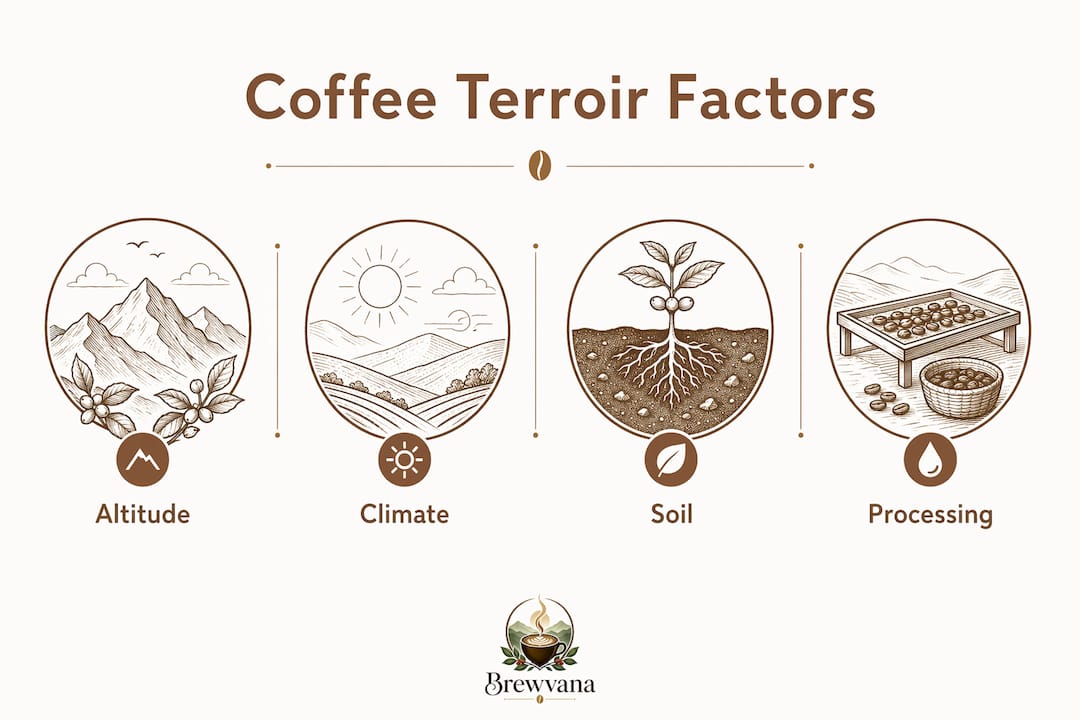
Terroir in coffee is defined as the complete set of environmental conditions at a growing location that directly shape the bean’s chemical composition, flavor, and quality. The concept, borrowed from wine, covers altitude, soil type, climate, rainfall, and even surrounding vegetation. These factors work together to determine whether your cup tastes bright and citrusy or deep and chocolatey. Arabica coffee, the species behind most specialty coffee, is especially sensitive to terroir because its flavor precursor compounds, including chlorogenic acids, trigonelline, and sugars, shift measurably with changes in growing conditions. Understanding the role of terroir in coffee is the clearest path to understanding why two coffees from the same variety can taste completely different.
How does terroir influence coffee flavor and quality?
Terroir sets a biological ceiling on what a coffee can become. Every environmental variable at the farm level leaves a chemical fingerprint in the bean, and that fingerprint determines the sensory experience in your cup. The interaction of altitude, temperature, soil, and microclimate creates a signature that no roasting technique can manufacture from scratch.
Altitude and its effect on bean chemistry
Optimal Arabica terroir involves altitudes of 1,200–2,200 meters, where cooler temperatures slow cherry maturation and produce denser beans with higher acidity and greater flavor complexity. Slower ripening gives the bean more time to accumulate sugars and aromatic compounds. The result is a cup with layered complexity that lower-altitude coffees rarely achieve. Robusta, by contrast, thrives at 200–900 meters, which partly explains its flatter, more bitter profile.
Altitude also shifts the concentration of specific chemical markers. Planting altitude alters key flavor precursors including chlorogenic acids, trigonelline, and sugars, which directly affect aroma, acidity, and body. Warmer, lower-altitude sites increase chlorogenic acid levels but reduce perceived acidity in the cup. That sounds counterintuitive, but higher chlorogenic acid at lower altitudes correlates with a harsher, less refined bitterness rather than the clean brightness found in high-altitude beans.
Chemical markers such as methoxypyrazines, aldehydes, and hexanoic acid trace directly to terroir and produce flavor notes ranging from grassy to nutty to sweet depending on altitude and soil conditions. These compounds are not added during processing. They are built into the bean by the environment itself.
- Beans grown above 1,800 meters typically show brighter acidity and floral or fruit-forward notes.
- Beans from 1,200–1,800 meters often produce balanced cups with caramel, nut, and mild fruit character.
- Beans below 1,200 meters tend toward earthy, heavier body with less aromatic complexity.
Pro Tip: When reading a coffee label, check for altitude information. A farm listed above 1,800 meters is a reliable signal of dense, complex beans with high cup potential.
Climate stability and seasonal effects
Optimal growing temperatures fall between 15°C and 24°C, and climate stability within that range is critical for uniform cherry ripening. A pronounced dry season helps concentrate sugars in the cherry and makes post-harvest drying more efficient. Higher rainfall slightly reduces caffeine content and can dilute flavor intensity. Microclimates within a single farm can create pockets of exceptional quality right next to ordinary-tasting lots.
What role does soil play in coffee terroir characteristics?
Soil is the medium through which all of a farm’s mineral wealth reaches the coffee plant. The type of soil, its mineral content, and its drainage capacity shape the bean’s biochemical profile before any human intervention occurs.
Volcanic soils and mineral complexity
Volcanic andosols, rich in minerals like magnesium and zinc, are theorized to enhance cup complexity, and Ethiopian volcanic soils in particular increase phenolic compound concentrations in the bean. Phenolic compounds contribute to the wine-like, fruit-forward character that makes Ethiopian coffees famous on the specialty market. The exact mechanism linking specific minerals to specific flavor notes is still being researched, but the correlation between volcanic soil and cup quality is well established among producers.
How geography separates regional flavor profiles
Geography determines which soil types form, how water drains, and what nutrients are available to the plant. The differences across major coffee growing regions are measurable, not just anecdotal.
- Ethiopia: High-altitude volcanic soils produce beans with elevated phenolic compounds, yielding floral, berry, and wine-like cup profiles.
- Colombia: Andean slopes with well-drained clay-loam soils support consistent acidity and a clean, caramel-sweet body.
- Costa Rica: Mineral-rich volcanic soils at high altitude create bright citrus acidity with a honey-like sweetness.
- Peru: Andean terroir at elevation produces mild, balanced cups with gentle fruit notes and low bitterness.
- Brazil (Minas Gerais): Lower-altitude cerrado soils favor heavier body and nutty, chocolate-forward profiles.
Infrared spectroscopy can now differentiate coffees by region with confirmed sensory differences, proving that terroir’s chemical signatures are real and measurable. This is not a marketing claim. It is a laboratory-verified fact that geography leaves a traceable mark in the bean.
| Region | Dominant soil type | Signature flavor profile |
|---|---|---|
| Ethiopia | Volcanic andosol | Floral, berry, wine-like |
| Colombia | Clay-loam Andean | Caramel, clean acidity |
| Costa Rica | Volcanic mineral-rich | Citrus, honey sweetness |
| Peru | High-altitude Andean | Mild fruit, low bitterness |
| Brazil (Minas Gerais) | Cerrado clay | Chocolate, heavy body |
Pro Tip: Explore single-origin coffees by region to taste terroir differences side by side. Brewing the same roast level from two different origins is the fastest way to feel the soil and altitude differences in your cup.
Does terroir alone determine coffee quality?
Terroir sets the potential, but it does not guarantee the result. No farm achieves world-class coffee without quality post-harvest processing, even with perfect terroir. This is the most common misconception among coffee enthusiasts who assume that a famous origin automatically means a great cup.
Varietal genetics interact with terroir in ways that amplify or suppress specific flavor traits. An Arabica varietal like Gesha planted in Ethiopian volcanic soil will express different characteristics than the same varietal grown in Colombian clay-loam, even at the same altitude. The genetics and terroir relationship is multiplicative, not additive. Each factor shapes how the other expresses itself.
Post-harvest processing adapts to terroir conditions and finalizes the flavor outcome. Washed processing, which removes the fruit before drying, highlights the bean’s inherent terroir-driven acidity and clarity. Natural processing, which dries the whole cherry, adds fermentation-derived sweetness that can either complement or mask terroir character. Processing methods are not separate from terroir. They are the final step in translating terroir potential into cup quality.
- Terroir provides the raw chemical blueprint.
- Varietal selection determines which traits within that blueprint are expressed most strongly.
- Processing locks in or transforms those traits before the bean reaches the roaster.
- Poor processing at any stage can erase the advantages of exceptional terroir.
Terroir is inseparable from varietal selection and processing. Flavor potential is unlocked only when all three align.
How do specialty producers and roasters apply terroir knowledge?
Specialty coffee producers use terroir data as a farm management tool, not just a marketing story. Microclimate mapping predicts pest resistance and yield outcomes before planting, giving producers a data-driven basis for varietal selection and agricultural decisions. A farm that maps its microclimates can identify which plots will ripen uniformly and which will need extra attention during harvest.
Roasters use terroir signatures to build roast profiles that highlight origin character. A high-altitude Ethiopian natural process coffee calls for a lighter roast that preserves its floral and fruit-forward volatiles. A lower-altitude Brazilian bean benefits from a longer development phase that brings out its chocolate and nut notes. Roasters treat terroir as a framework for roast profiling, not a fixed recipe.
Seasonal variability is real and worth understanding. Terroir expresses a geological identity, but annual weather shifts can move a farm’s flavor profile noticeably from one harvest to the next. A drought year may concentrate sugars and intensify flavor. An unusually wet season may dilute acidity and body. Experienced roasters adjust their profiles year to year based on the current harvest’s terroir expression.
- Microclimate data guides planting decisions and varietal matching.
- Terroir analysis informs harvest timing to capture peak cherry ripeness.
- Roast profiles are calibrated to the specific chemical signature of each origin and harvest year.
- Altitude’s impact on flavor is one of the most reliable terroir variables roasters use to set initial roast parameters.
Single-origin coffees serve as the clearest proxies for terroir expression, linking geographic, climatic, and soil factors to unique sensory and chemical signatures in every bag.
Key Takeaways
Terroir is the primary environmental blueprint that determines coffee’s flavor ceiling, and quality is only achieved when terroir aligns with the right varietal, processing, and roast approach.
| Point | Details |
|---|---|
| Altitude drives complexity | Arabica grown at 1,200–2,200 meters produces denser beans with higher acidity and layered flavor. |
| Soil shapes chemical identity | Volcanic andosols increase phenolic compounds, producing the fruit-forward profiles found in Ethiopian coffees. |
| Terroir is not a quality guarantee | Poor post-harvest processing negates even the best terroir; all three factors must align. |
| Seasonal variability is normal | Annual weather shifts move flavor profiles year to year; roasters adjust profiles accordingly. |
| Single-origin coffees reveal terroir | Tasting coffees by region is the most direct way to experience terroir differences in the cup. |
Terroir as a quality ceiling, not a magic wand
Terroir is the most misunderstood concept in specialty coffee, and the misunderstanding usually goes in one direction. Coffee drinkers hear “Ethiopian natural” or “Costa Rica high-altitude” and assume the origin alone guarantees something extraordinary. It does not. What terroir actually provides is a ceiling. The environment determines the maximum quality a farm can produce. Whether the coffee reaches that ceiling depends entirely on what happens after the cherry is picked.
What I find most exciting about terroir is its variability. The same farm in Ethiopia will taste slightly different this year than it did last year because the rains came differently, the dry season ended earlier, or the temperature swings were more pronounced. That is not a flaw. That is terroir being honest. Wine drinkers have accepted vintage variation for centuries. Coffee drinkers are only beginning to appreciate it.
The specialty market is moving toward terroir transparency, and that is the right direction. Producers who publish altitude, soil type, and microclimate data give roasters and consumers the tools to understand what they are tasting. Brewvana’s approach to sourcing single-origin coffees reflects this shift. When you know where a coffee grew and under what conditions, the cup stops being a mystery and starts being a conversation between you and the land.
— Brewvana
Brewvana’s single-origin coffees and the terroir difference
Terroir is best understood through direct experience, and Brewvana’s single-origin lineup is built exactly for that purpose.

Brewvana sources coffees that represent distinct terroir signatures across the world’s most compelling growing regions. The Ethiopia Natural Process delivers the volcanic soil and high-altitude character of one of coffee’s oldest origins, with fruit-forward, wine-like complexity that terroir alone makes possible. The Costa Rica Single Origin showcases mineral-rich volcanic soil and bright citrus acidity from high-altitude Central American farms. For Andean high-altitude terroir, the Peru Single Origin offers a clean, mild cup shaped by elevation and mountain soil. Tasting these side by side is the fastest education in terroir you can get without boarding a plane.
FAQ
What is terroir in coffee?
Terroir in coffee refers to the combined environmental factors at a growing location, including altitude, soil, climate, and surrounding flora, that directly shape the bean’s chemical composition and flavor profile.
How does altitude affect coffee flavor?
Arabica grown at 1,200–2,200 meters matures more slowly, producing denser beans with higher acidity, more complex sugars, and greater aromatic depth than beans grown at lower elevations.
Does soil type change how coffee tastes?
Volcanic andosols rich in magnesium and zinc are linked to elevated phenolic compounds in the bean, which produce the fruit-forward and wine-like notes characteristic of Ethiopian and other volcanic-soil origins.
Can processing methods override terroir?
Processing finalizes terroir’s potential but cannot create quality that terroir does not provide. Poor processing can erase the advantages of exceptional terroir, while skilled processing amplifies its best traits.
Why do single-origin coffees taste different each year?
Seasonal weather shifts alter cherry ripening, sugar concentration, and acidity levels from harvest to harvest. Terroir expresses a consistent geological identity, but annual climate variation introduces measurable differences in the cup.