

Arabica coffee varietals are the genetic subtypes within Coffea arabica that determine a plant’s potential flavor, aroma, yield, and resilience before a single bean is roasted. The industry term is “cultivar,” short for cultivated variety, though “varietal” has become the accepted shorthand in specialty coffee circles. Arabica accounts for roughly 60% of global coffee production and virtually all specialty coffee, making it the species that defines what most of us think of as great coffee. Understanding these subtypes, from the ancient Typica to the prized Gesha, gives you a real framework for choosing, tasting, and appreciating what’s in your cup.
What are the main Arabica coffee varietals?
The entire family tree of Arabica coffee varietals traces back to two founding lineages: Typica and Bourbon. Typica originated in Ethiopia, traveled through Yemen, and spread to India, Java, and eventually the Americas via Dutch and French traders in the 17th and 18th centuries. Bourbon is a natural mutation of Typica that developed on the island of Réunion (formerly called Bourbon) and later spread across Latin America and East Africa. Nearly every cultivar you encounter today descends from one or both of these two plants.
Here are the key Arabica varietals worth knowing:
- Typica: The genetic ancestor of most modern cultivars. It produces a delicate, clean cup with mild acidity and subtle sweetness, but yields are low and disease susceptibility is high.
- Bourbon: A natural mutation of Typica with a richer, more complex flavor profile and noticeably higher productivity. Bourbon yields 20 to 30% more than Typica, making it a practical choice for farmers without sacrificing cup quality.
- Caturra: A natural dwarf mutation of Bourbon discovered in Brazil. Its compact size allows for denser planting, and it produces a bright, citrus-forward cup. It became the backbone of Colombian coffee production for decades.
- Maragogipe: An unusually large-bean mutation of Typica, sometimes called the “elephant bean.” It produces a mild, low-acid cup and is prized by collectors, though yields are poor.
- SL28: Developed in Kenya by Scott Laboratories in the 1930s, SL28 is associated with intense berry fruit notes and wine-like acidity. It remains a quality benchmark in African coffee despite being low-yielding and disease-susceptible.
- Gesha (also spelled Geisha): Originally collected in Ethiopia’s Gesha region, this varietal was largely ignored until Hacienda La Esmeralda in Panama showcased it in 2004. Gesha is known for jasmine, bergamot, tropical fruit, and tea-like characteristics and now commands some of the highest auction prices in specialty coffee history.
Each of these varietals spread globally through colonial trade routes, agricultural research stations, and specialty coffee’s growing demand for traceability. The path a varietal took from Ethiopia to your cup is often as interesting as the flavor it produces.
How do Arabica varietals differ in flavor, yield, and disease resistance?
Not all Arabica varietals perform equally in the field or in the cup. The differences between them span three dimensions: flavor potential, agricultural productivity, and vulnerability to disease. Understanding these trade-offs explains why farmers plant what they plant and why certain coffees cost more than others.
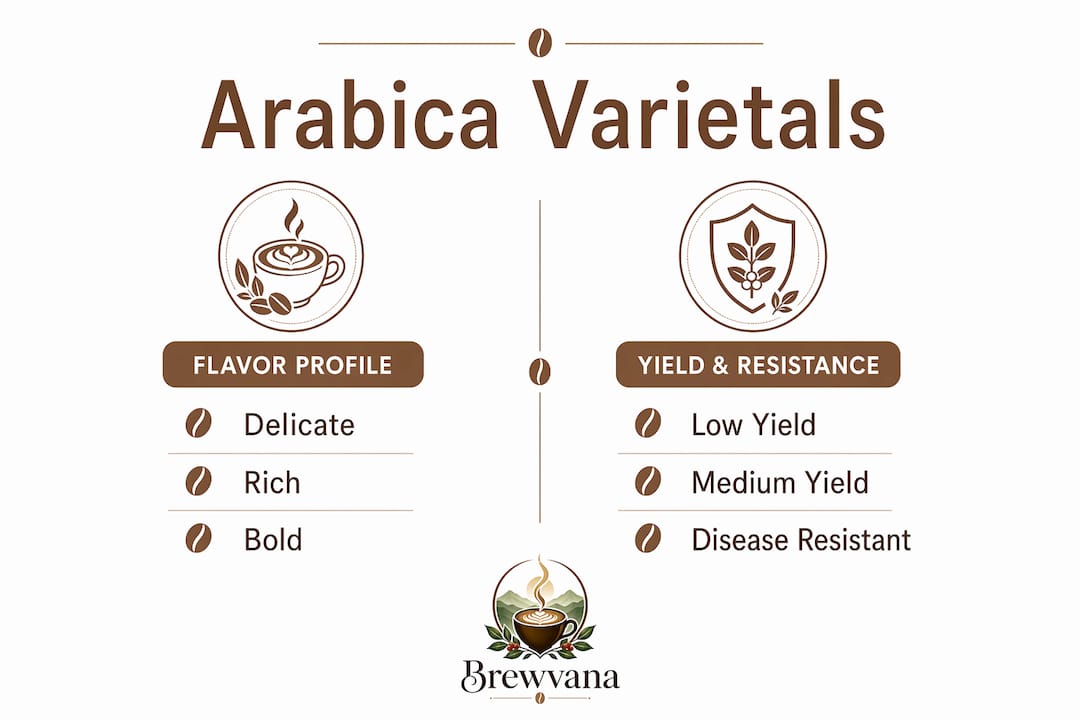
| Varietal | Flavor Profile | Yield | Disease Resistance |
|---|---|---|---|
| Typica | Delicate, clean, mild sweetness | Low | Low |
| Bourbon | Rich, complex, balanced acidity | Moderate to high | Low |
| Caturra | Bright, citrus, lively | High | Low to moderate |
| SL28 | Berry fruit, wine-like acidity | Low | Low |
| Gesha | Jasmine, bergamot, tea-like | Very low | Low |
| Catimor | Neutral to earthy | Very high | High |
Catimor deserves a specific mention here. It is a cross between Timor Hybrid and Caturra, bred specifically for resistance to coffee leaf rust. It produces high yields and survives where other varietals fail, but its cup quality is widely considered inferior to the heirloom types. This trade-off between productivity and flavor is the central tension in Arabica cultivation today.
Flavor distinctions between varietals are real but often subtle. Bourbon’s richness comes partly from a higher sugar content in the cherry, while Typica’s delicacy reflects a thinner cell structure in the bean. SL28’s wine-like acidity is tied to its specific phosphorus uptake in Kenya’s volcanic soils, which is why the same varietal grown elsewhere rarely replicates that profile. Knowing the difference between roast level and varietal influence on flavor prevents a common mistake: blaming the bean for what the roaster did.
Pro Tip: When buying single-origin coffee, look for bags that list both the varietal and the processing method. Those two data points together tell you far more about what to expect in the cup than either one alone.
What role do environment and processing play in varietal flavor?
Genetics set the ceiling for a coffee’s quality, but environment and processing determine how close you get to it. Varietal names identify genetics, not cup taste alone, which is the most important misconception to clear up when understanding arabica coffee. A washed SL28 from Kenya and a natural-processed SL28 from Guatemala are technically the same plant but taste dramatically different.
Here is how the key factors stack up in shaping what ends up in your cup:
- Altitude and climate. Higher altitudes slow cherry development, concentrating sugars and acids. A Bourbon grown at 1,800 meters in Colombia will express more complexity than the same varietal at 900 meters in lower-elevation farms. Altitude and microclimate can cause the same varietal to produce starkly different flavor profiles across regions.
- Soil composition. Kenya’s volcanic red soils give SL28 its distinctive phosphorus-driven acidity. Ethiopian highland soils, rich in organic matter, amplify the floral and fruit notes in Gesha. Soil is not background noise; it is an active ingredient.
- Processing method. Washed (wet) processing strips the cherry fruit before drying, producing cleaner, brighter cups that highlight the varietal’s inherent acidity. Natural (dry) processing leaves the cherry intact during drying, adding fruity, fermented sweetness that can mask or transform varietal character. Anaerobic fermentation, a newer method, pushes flavor intensity even further. Learning about coffee bean processing methods is one of the fastest ways to understand why two coffees from the same farm taste so different.
- Roast level. Light roasts preserve varietal and terroir character. Dark roasts replace those nuances with roast-driven flavors like chocolate, smoke, and caramel. A Gesha roasted dark is a waste of the varietal’s genetic potential.
The practical takeaway: do not judge a varietal based on one cup. Judge it across multiple origins, processing styles, and roast levels before forming an opinion.
Why is Arabica’s genetic diversity so limited?
The narrow genetic base of Arabica coffee is one of the most serious challenges facing the global coffee industry. In Brazil, 97.55% of Arabica cultivars descend from Typica and Bourbon lineages, meaning the world’s largest coffee producer is essentially farming two plants with slight variations. This genetic uniformity creates a monoculture that is highly vulnerable to disease, climate shifts, and pests.
“The homogenization of Arabica genetics globally creates a monoculture prone to disease outbreaks, challenging coffee’s future sustainability.” — Coffee Varietal Guide, JayArr Coffee
The consequences are not theoretical. Coffee leaf rust devastated Central American farms in 2012 and 2013, wiping out harvests across Guatemala, Honduras, and Costa Rica because the cultivated plants had no genetic resistance. The pathogen, Hemileia vastatrix, had already destroyed Sri Lanka’s coffee industry in the 1870s. History repeated itself because the genetic lesson was never fully applied.
Breeding programs are working to change this. The Timor Hybrid, a natural cross between Arabica and Robusta discovered in Timor-Leste in the 1920s, introduced disease-resistance genes that most rust-resistant varieties now carry. Most rust-resistant varieties descend from this single hybrid. F1 hybrids like Centroamericano take this further by combining disease resistance, high yield, and cup quality in one plant. The catch is that F1 hybrids require clonal propagation because seeds do not breed true, making them more expensive and logistically complex for smallholder farmers.
Pro Tip: If you see “F1 hybrid” or “Centroamericano” on a coffee label, you are drinking the result of decades of agricultural research. These coffees often punch above their price point in cup quality.
The long-term solution requires preserving wild Arabica genetic material from Ethiopia, where the species originated and where the greatest natural diversity still exists. Organizations like the World Coffee Research institute are actively collecting and cataloging this material, but the window is narrowing as climate change shrinks suitable growing regions.
Key takeaways
Arabica varietals set the genetic foundation for coffee quality, but terroir, processing, and roast level determine how much of that potential reaches your cup.
| Point | Details |
|---|---|
| Typica and Bourbon are the source | Nearly all Arabica cultivars worldwide descend from these two foundational varietals. |
| Flavor and genetics are distinct | Varietal names identify plant genetics, not guaranteed cup flavor; processing and origin matter equally. |
| Yield and quality trade off | High-quality varietals like Gesha and SL28 produce low yields, which directly drives their higher price. |
| Genetic uniformity is a real risk | Over 97% of Brazilian Arabica comes from two lineages, making the crop vulnerable to disease outbreaks. |
| F1 hybrids represent the future | Varieties like Centroamericano combine disease resistance and cup quality but require specialized propagation. |
Why varietal labels are a starting point, not a verdict
I have tasted the same Bourbon varietal from three different farms in Rwanda, Colombia, and Brazil in the same week, and they tasted like three completely different coffees. That experience permanently changed how I read coffee labels. The varietal name is the beginning of the story, not the whole thing.
What I find most coffee drinkers get wrong is treating varietal information as a flavor guarantee. You read “Gesha” on a bag and expect jasmine and bergamot. But if that Gesha was grown at low altitude, processed carelessly, and roasted dark, you will get none of those characteristics. The genetics were there. The execution was not. Varietals set the genetic limit for quality, but farmers and roasters must optimize every other variable to realize that potential.
My honest advice: use varietal knowledge to build hypotheses, not expectations. If you know SL28 tends toward berry fruit and wine-like acidity, use that as a lens when tasting, not a checklist. When the coffee surprises you, that is where the real learning happens. Exploring how to identify high-quality coffee beans alongside varietal knowledge gives you a much sharper palate faster than focusing on either alone.
The genetic diversity crisis is the part of this story I think deserves far more attention from everyday coffee drinkers. When you pay a premium for a rare varietal like SL28 or Gesha, you are also voting for the preservation of genetic diversity in coffee. That is not a small thing.
— KIngram
Explore Arabica varietals through Brewvana’s curated selections

Brewvana’s single-origin coffees are sourced specifically to showcase how varietal and region interact, giving you a direct, side-by-side education in what makes each cup distinct. If you want to experience the difference between a Bourbon-based Latin American coffee and an Ethiopian natural firsthand, Brewvana’s coffee sample packs are the most efficient way to do it. Every order is roasted to order, so the varietal character you read about in this guide is the same character that arrives at your door. Brewvana also donates a portion of every sale to local schools, so your coffee curiosity supports something larger than the cup.
FAQ
What is the difference between a coffee varietal and a cultivar?
A cultivar is the precise industry term for a cultivated plant variety selected for specific traits; “varietal” is the widely used shorthand in specialty coffee. Both terms refer to the same concept: a genetically distinct subtype within Coffea arabica.
Is Arabica always better than Robusta?
Arabica generally produces more complex, nuanced flavors with higher acidity and lower caffeine than Robusta, which is why it dominates specialty coffee. Robusta has higher yields and stronger disease resistance, making it common in commercial blends and espresso for its crema-producing properties.
Why does Gesha coffee cost so much?
Gesha produces very low yields per plant, requires specific high-altitude growing conditions to express its signature jasmine and bergamot notes, and commands intense demand from specialty buyers. These factors combined push auction prices to some of the highest in the coffee world.
Can the same varietal taste different in different countries?
Yes, and dramatically so. Environmental influences like altitude and microclimate cause the same varietal to produce starkly different flavor profiles across regions. An SL28 from Kenya and an SL28 from Guatemala share genetics but express entirely different cups due to soil, climate, and processing differences.
What does “washed” vs. “natural” mean on a coffee bag?
Washed processing removes the fruit before drying, producing cleaner cups that highlight the varietal’s acidity and clarity. Natural processing dries the whole cherry, adding fruity and fermented sweetness that can significantly alter the varietal’s baseline character.