

You spent good money on a bag of specialty coffee, brewed it carefully, and still got a flat, lifeless cup. The beans looked beautiful. The origin sounded exotic. But something was off. Chances are, the roast date was the culprit. Most coffee enthusiasts obsess over single-origin sourcing, processing methods, and roast profiles, yet completely overlook the one number that determines whether all that care actually makes it into your cup: the roast date. Understanding this date is not optional for anyone serious about flavor.
Table of Contents
- What does the roast date really tell you?
- The science: Post-roast degassing and flavor development
- How roast date timing impacts flavor, aroma, and crema
- Factors that change the ‘perfect’ roast date: Roast level and storage
- A connoisseur’s perspective: The hidden impact of roast date on your ritual
- Discover premium coffee at its peak freshness
- Frequently asked questions
Key Takeaways
| Point | Details |
|---|---|
| Roast date is freshness | The roast date gives a reliable indicator of freshness and optimal brewing window for premium coffee. |
| Degassing shapes flavor | CO2 off-gassing post-roast directly impacts extraction, crema, and taste of your brew. |
| No single ‘peak day’ | The optimal time to brew varies by roast level, storage, and packaging, not a fixed number of days. |
| Packaging matters | Valve bag technology helps preserve flavor and aroma by controlling CO2 release and oxidation. |
| Taste evolves over time | Experimenting with brewing across several days reveals complex flavor development in gourmet coffee. |
What does the roast date really tell you?
The roast date is not just a timestamp. It is the starting gun for a complex series of chemical changes that directly shape what you taste and smell in your cup. The moment coffee leaves the roaster, it begins transforming. Gases escape. Oils shift. Aromatic compounds either develop or begin breaking down. The roast date tells you exactly where your coffee sits in that timeline.
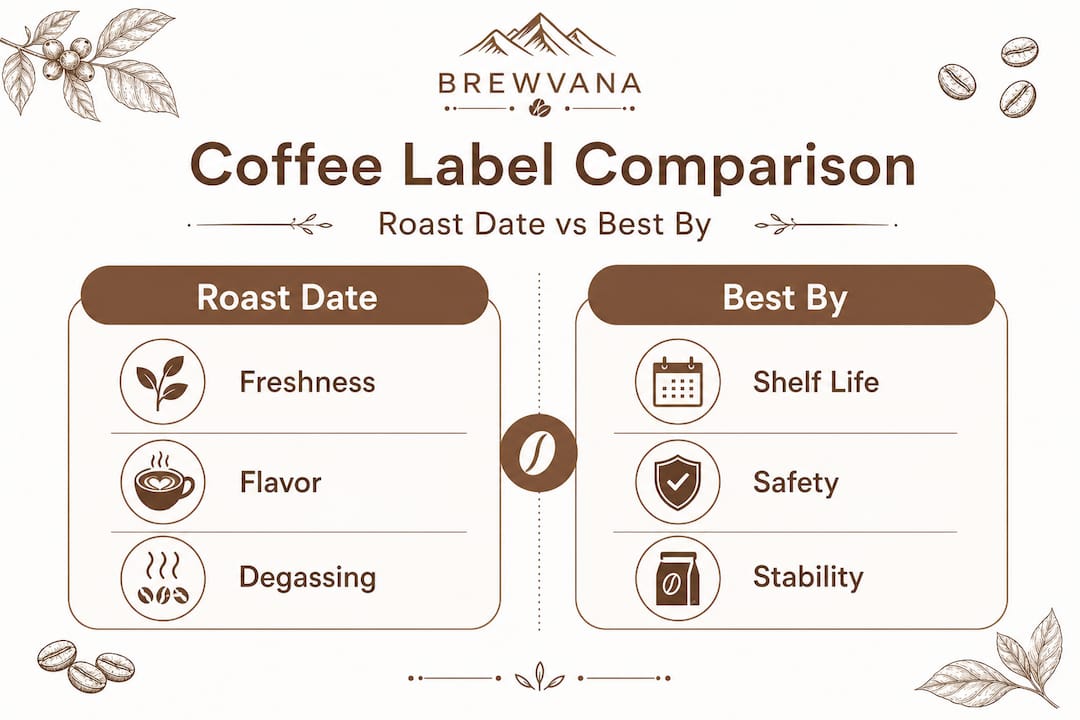
Here is where confusion creeps in. Many bags display a “best by” date or a “packaged on” date, and consumers naturally assume these are the same as the roast date. They are not, and the difference matters enormously.
“Roast date marks the start of coffee’s degassing cycle and determines where coffee sits in its freshness timeline.” — Specialty Coffee Association, 25 Magazine Issue 4
The “best by” date is essentially a shelf-life estimate based on food safety and general palatability. It tells you when the coffee stops being acceptable, not when it is at its best. The packaging date tells you when the coffee was sealed into a bag, which could be days or even weeks after roasting. Neither gives you the precise chemical context that the roast date provides.
| Label | What it measures | Useful for flavor? |
|---|---|---|
| Roast date | Days since roasting; degassing stage | Yes, directly |
| Best by date | General shelf stability | No, not for flavor timing |
| Packaging date | When bag was sealed | Only if roasted same day |
When you look for a French roast coffee or a medium roast mushrooms coffee, the roast date is the clearest signal of what you are actually getting. A bag without one should raise a red flag immediately. Roasters who are proud of their work put the roast date front and center because they want you to brew at the right moment.
Key things the roast date tells you:
- Where the coffee sits in its degassing cycle
- Whether it needs more rest before brewing
- How much longer it will hold peak flavor
- Which brew method will suit it best at that moment
The science: Post-roast degassing and flavor development
Roasting transforms green coffee beans through heat-driven chemical reactions, including the Maillard reaction and caramelization. One major byproduct is carbon dioxide, or CO2, which gets trapped inside the bean’s cell structure during roasting. After roasting ends, that CO2 starts escaping in a process called degassing.
The SCA reports that up to 2% of coffee’s weight is gas trapped post-roast, and degassing is most active in the first 24 to 48 hours. That sounds like a small number, but it has a massive impact on your brew. When you grind and brew coffee that is still heavily loaded with CO2, the escaping gas physically disrupts the water’s contact with the coffee particles. This leads to uneven extraction, which means some flavor compounds get pulled out too aggressively while others barely contribute at all.
Stat to know: The SCA identifies the first 24 to 48 hours post-roast as the most volatile degassing window, with significant effects on extraction consistency and cup clarity.
Degassing speed is not the same across all roast levels. Darker roasts have more porous, brittle cell structures, so CO2 escapes faster. Lighter roasts retain their denser structure longer, meaning the gas takes more time to fully release. This is why a dark roast might be ready to brew in just two or three days, while a light roast often needs a full week or more.
| Roast level | Degassing speed | Recommended rest period |
|---|---|---|
| Light roast | Slow | 7 to 14 days post-roast |
| Medium roast | Moderate | 5 to 10 days post-roast |
| Dark roast | Fast | 2 to 5 days post-roast |
For espresso, the impact of degassing is especially visible. Degassing influences espresso crema and extraction quality, especially in the first week after roasting. Crema, the golden-brown foam that sits on top of a well-pulled espresso shot, is formed partly by CO2 interacting with water under pressure. Brew too early and you get an unstable, bubbly crema that collapses quickly. Brew at the right window and you get a thick, persistent layer that signals excellent extraction.
For filter brewing methods, the impact is slightly more forgiving, but still real. A cold brew coffee made with beans that have not rested enough will often taste muddled or grassy. A dark roast mushrooms coffee brewed at its optimal window delivers the earthy, bold notes that make it distinct.
Pro Tip: For espresso, wait at least four to five days after the roast date before pulling your first shot. For filter coffee, three to four days is usually enough to let the most active degassing settle without losing peak aroma.
How roast date timing impacts flavor, aroma, and crema
Now that we have covered the science, let us look at how roast date translates to real changes in your coffee’s taste and presentation. Think of coffee flavor as having three distinct phases after roasting.
Phase 1: Too fresh (days 0 to 2). The coffee is still actively off-gassing. Brewed at this stage, you will notice muted sweetness, an almost grassy or sharp acidity, and crema that is overly bubbly and unstable. The extraction is uneven because CO2 is physically pushing water away from the grounds.
Phase 2: Peak window (days 3 to 14, depending on roast level). This is where the magic happens. Aromatic compounds are at their most expressive. Sugars and acids are in balance. Crema is dense and persistent. The coffee tastes like what the roaster intended. Packaging with valve bags and proper resting time partially mitigate oxidation, helping preserve this window longer and protecting crema quality in the first week post-roast.
Phase 3: Past peak (beyond 3 to 4 weeks). Oxidation takes over. The oils that carry flavor and aroma go stale. The cup tastes flat, papery, or faintly rancid. No amount of skilled brewing recovers what oxidation has taken.
Here is a practical timing guide for different brew methods:
- Espresso: Rest 4 to 7 days after roast date. The CO2 level drops enough for consistent extraction while still supporting excellent crema.
- Pour-over or drip filter: Rest 3 to 5 days. Slightly less CO2 sensitivity than espresso, but still benefits from a short rest.
- French press: Rest 3 to 6 days. The immersion method is more forgiving, but fresh-roasted beans still produce uneven results.
- Cold brew: Rest 5 to 7 days. The long, cold extraction amplifies any off-flavors from under-rested beans.
- Sample packs: Check the roast date on arrival and plan your brewing accordingly. A flavored coffees sample pack gives you the chance to taste multiple roast profiles at their intended window.
Valve bag packaging plays a critical supporting role here. One-way valve bags allow CO2 to escape without letting oxygen in, which is exactly what you want during the degassing phase. Without a valve, CO2 would either burst the bag or be sealed inside, accelerating stale flavor development. When you see a valve bag, that is a sign the roaster is thinking carefully about your brewing experience. Pair that with single-serve coffee capsules designed with freshness in mind, and you have a system built for peak flavor delivery.
Pro Tip: For maximum crema in your espresso, aim to brew between days 5 and 10 after the roast date. Mark the date on the bag when you receive it so you never have to guess.
Factors that change the ‘perfect’ roast date: Roast level and storage
Finally, let us put it all together. The ideal roast date is not one-size-fits-all. Resting time, roast level, and storage conditions change the rate of freshness decay, and ideal brew timing is not universal. Two bags with the same roast date can behave completely differently depending on how they were stored and what roast level they are.
Roast level variables:
- Light roasts have denser bean structures and release CO2 slowly. They often need 7 to 14 days of rest before hitting peak flavor, and they hold that peak longer because their cell walls protect the aromatic compounds.
- Medium roasts sit in the middle. They typically peak between days 5 and 10 and begin declining noticeably around the three-week mark.
- Dark roasts degas quickly due to their more open, porous structure. They are ready sooner but also fade faster. A French roast coffee can be excellent on day three but noticeably flat by day 18.
Storage variables that accelerate freshness decay:
- Oxygen: The number one enemy of fresh coffee. Exposure to air triggers oxidation, which breaks down aromatic compounds and oils rapidly.
- Moisture: Humidity causes coffee to absorb water, which speeds up staling and can introduce off-flavors.
- Heat: Warmth accelerates nearly every chemical reaction involved in staling. Keep coffee away from stovetops, direct sunlight, and warm countertops.
- Light: UV exposure degrades flavor compounds. Opaque packaging matters.
The practical takeaway is simple. Store coffee in an airtight container, in a cool and dark location, and buy in quantities you will use within two to three weeks of the roast date. For those who want the ultimate convenience without sacrificing freshness, instant coffee options have improved dramatically and can be a smart choice for travel or office use. But for your daily ritual at home, buying small and buying freshly roasted coffee is always the better strategy.
Pro Tip: Invest in a quality airtight canister and buy coffee in smaller quantities more frequently. A 250-gram bag consumed within two weeks will always outperform a 1-kilogram bag that sits open for a month.
A connoisseur’s perspective: The hidden impact of roast date on your ritual
Here is something most freshness guides will not tell you: the idea of a single “peak day” is mostly a myth. Flavor does not spike on day four and then immediately fall off a cliff. It matures across a range of days, and your personal palate plays a significant role in which point in that curve you actually prefer.
We have tasted the same French roast coffee on day three, day six, and day ten, and each experience was genuinely different, not better or worse, just different. On day three, the brightness was almost aggressive. By day six, the sweetness had settled into something rounder and more satisfying. On day ten, there was a depth and body that the earlier versions lacked.
The hard-won lesson here is that chasing the “freshest possible” coffee can actually work against you. Some of the most complex, rewarding cups come from beans that have had a full week or more to develop. Brewing on day one because you are excited is understandable, but it is also a bit like opening a bottle of wine the moment you walk in from the store.
Our take: Freshness is not a single moment. It is a window. And within that window, the best cup is the one that matches your taste preferences, not the one that matches a calendar.
The ritual of tracking your coffee’s roast date and tasting it across several days is one of the most rewarding practices a coffee enthusiast can develop. It builds sensory vocabulary, deepens your understanding of roast profiles, and makes every cup more intentional.
Pro Tip: Try tasting your favorite roast on days three, six, and nine after the roast date. Take brief notes on aroma, sweetness, acidity, and body. You will quickly discover your personal sweet spot in the freshness window.
Discover premium coffee at its peak freshness
Armed with a real understanding of roast date and its impact on your cup, the next step is finding coffee that puts these principles into practice from the start.
At Brewvana, every product is built around freshness as a measurable standard, not a marketing claim. Our single origin sample pack lets you explore distinct roast profiles while applying your new knowledge of degassing windows and flavor development. Each bag is clearly marked with the roast date so you can plan your brewing with precision. Browse our full range of coffee sample packs to find the roast level and origin that fits your ideal brewing window. Freshness is not an accident here. It is the whole point.
Frequently asked questions
How soon after roasting should I brew coffee for best flavor?
Most coffee reaches peak flavor 3 to 7 days after roasting, though roast level and storage conditions alter the perfect resting time, with lighter roasts often needing closer to 7 to 14 days.
Does brewing coffee too soon after roasting affect taste?
Yes, brewing too soon causes muted flavors and uneven extraction because CO2 off-gassing is highest during the first 24 to 48 hours after roasting, physically disrupting water contact with the grounds.
How does ‘best by’ date differ from roast date for coffee?
The “best by” date indicates shelf stability, while the roast date reveals actual freshness timing since roast date marks the start of the degassing cycle, not shelf life.
Do different coffee roasts require different resting times?
Yes, darker roasts off-gas faster and can be brewed within two to five days, while lighter roasts off-gas more slowly and typically need seven to fourteen days before reaching peak flavor.
Can packaging affect the freshness and crema of coffee?
Absolutely. Valve bag packaging and CO2 build-up directly impact crema quality and oxidation rate, making one-way valve bags one of the most important tools for preserving post-roast freshness.