

When you read “notes of blueberry, dark chocolate, and jasmine” on a bag of coffee, your first instinct might be to look for added flavors. There are none. Understanding why coffee has tasting notes starts with one clarifying fact: those descriptors are natural, emerging from the bean’s origin, plant variety, processing method, and roast. This concept, known in the specialty coffee world as sensory evaluation or cupping, gives roasters and drinkers a shared language. This guide breaks down the science and the sensory experience so you can actually taste what the label is describing.
Table of Contents
- Key Takeaways
- Why coffee has tasting notes: from plant to cup
- Coffee tasting terminology and how your senses decode it
- The chemistry behind coffee’s flavor fingerprints
- How to taste coffee and actually find the notes
- Roast level and its effect on tasting notes
- My perspective: what tasting notes actually taught me
- Discover tasting notes through Brewvana’s freshly roasted coffees
- FAQ
Key Takeaways
| Point | Details |
|---|---|
| Tasting notes are not additives | Coffee flavor descriptors reflect natural compounds formed during growing, processing, and roasting. |
| Origin shapes flavor first | Soil, altitude, and climate create distinct flavor precursors before the bean is ever roasted. |
| Aroma drives most perception | Coffee contains over 800 aroma compounds, making smell the dominant sense in tasting. |
| Roast level shifts the profile | Light roasts preserve origin notes; dark roasts replace them with roast-driven flavors like smoke and bittersweet chocolate. |
| Tasting is a learnable skill | Starting with aroma before sipping, and tasting without milk or sugar, sharpens your ability to detect specific notes. |
Why coffee has tasting notes: from plant to cup
Coffee is a seed inside a fruit. That single fact explains more about flavor complexity than anything else. The cherry surrounding the bean contains sugars, acids, and aromatic compounds that, during processing, directly influence what ends up in your cup.
Variety matters more than most people realize. Arabica and Robusta are the two dominant species, but within Arabica alone, cultivars like Gesha, Bourbon, and Typica each carry distinct flavor potential. Gesha, famously grown in Panama and Ethiopia, produces intensely floral, tea-like cups. Bourbon tends toward stone fruit and soft sweetness. Robusta, by contrast, is earthier and higher in caffeine, with a blunter, more rubbery character.
Terroir is real in coffee, just as it is in wine. Altitude, soil composition, rainfall, and temperature all shape the flavor precursors inside the bean. Ethiopian coffees grown above 2,000 meters tend toward bergamot and blueberry. Brazilian coffees grown at lower altitudes develop nuttier, chocolatey profiles.
Processing adds another layer entirely. Here is how the main methods affect flavor:
- Washed (wet) processing: Removes the fruit before drying, producing clean, bright cups where origin character shines. Expect clarity and high acidity.
- Natural (dry) processing: The bean dries inside the fruit, absorbing sugars and fermentation byproducts. The result is bold fruitiness, often berry-forward and wine-like. Learn more about each processing method and how they shape what you taste.
- Honey processing: A middle path. Some fruit mucilage stays on the bean during drying, producing cups that balance sweetness and acidity.
Roasting transforms these raw precursors through two key chemical reactions: the Maillard reaction and pyrolysis. The Maillard reaction, the same one that browns bread and sears steak, produces hundreds of new aromatic compounds. Pyrolysis breaks down sugars and plant fibers at higher temperatures, generating the darker, smoky, bitter compounds that define dark roast profiles.
Pro Tip: Look for the roast date, not just the roast level. A light roast that is six months old will taste flat and papery compared to the same beans roasted two weeks ago. Freshness preserves every note the roaster worked to develop.
Coffee tasting terminology and how your senses decode it
Here is where understanding coffee tasting gets genuinely interesting. When you sip coffee, your brain is processing two separate streams of sensory information simultaneously: taste from your tongue and aroma from retronasal olfaction, which is the process of smelling through the back of your throat.
Your tongue detects five basic tastes: sweet, sour, salty, bitter, and umami. Coffee has all five in varying degrees depending on origin and roast, but taste alone does not explain why a coffee reminds you of peaches or flowers. That complexity comes from aroma. Coffee contains over 800 volatile aroma compounds, far exceeding what the tongue can categorize. This is the central reason why coffee smells different than it tastes: your nose processes a richer, more complex signal than your mouth does.
The most commonly used coffee tasting terminology breaks down into these categories:
- Fruity notes: Citrus (lemon, orange), stone fruit (peach, apricot), berry (blueberry, cherry). These come from organic acids and fermentation-derived esters.
- Floral notes: Jasmine, rose, lavender. Common in Ethiopian washed coffees; linked to terpene compounds.
- Nutty and chocolatey notes: Almond, walnut, milk chocolate, dark chocolate. Typical in Brazilian and Central American coffees; produced by pyrazines during roasting.
- Caramel and sweet notes: Brown sugar, toffee, maple. Result from caramelization of sucrose during medium roasting.
Bitterness deserves special mention. Humans detect bitterness through specific receptors, and TAS2R43 is the receptor that responds to caffeine and diterpene compounds like cafestol and kahweol. Humans actually have about 26 bitter taste receptors, which explains why some people find dark roasts unpleasantly harsh while others find them pleasurable. Sensitivity varies by individual genetics.
Body refers to the weight and texture of coffee on your palate, ranging from tea-like and delicate to full and syrupy. Acidity describes brightness, not sourness, though poor extraction can tip acidity into an unpleasant sharpness. These structural elements frame the tasting notes the way a canvas frames a painting.
The chemistry behind coffee’s flavor fingerprints
Recent research has moved beyond subjective description and into molecular science. Researchers have found that chemical fingerprinting can objectively differentiate coffee batches by roast color, extraction strength, and volatile compound release, using electrical currents to map flavor signatures that correlate with sensory perception.
A 2025 study using explainable AI found that different origins show distinct compound dominance: pyrazines dominate in Brazilian coffees, terpenes in Ethiopian coffees, and organic acids in Colombian coffees. This is not guesswork. It is measurable chemistry that explains why an Ethiopian natural process cup genuinely smells of blueberries while a Brazilian pulped natural cup delivers milk chocolate and hazelnuts.
Here is how origin chemistry translates to the cup:
| Origin | Dominant compounds | Typical tasting notes |
|---|---|---|
| Ethiopia | Terpenes, esters | Floral, blueberry, bergamot |
| Brazil | Pyrazines, furans | Nutty, chocolate, caramel |
| Colombia | Organic acids | Citrus, caramel, red apple |
| Kenya | Malic and citric acids | Blackcurrant, tomato, bright acidity |
“Sensory experience of coffee relies heavily on the complex interplay between volatile organic compounds, not single molecules, explaining the diversity of tasting notes.” — Explainable AI research on coffee quality control
This interplay is why no single compound defines a coffee’s character. A blueberry note in Ethiopian coffee is not produced by one molecule. It is an ensemble of dozens of compounds that together trigger your brain’s association with blueberries. Understanding this makes the importance of tasting notes clearer: they are shorthand for a complex sensory reality that no single chemical description could capture.
How to taste coffee and actually find the notes
The most common mistake in exploring coffee flavor characteristics is tasting too casually. Here is a process that actually works:
- Start with the aroma before brewing. Smell the dry grounds first. This gives you access to volatile compounds before heat and water alter them. You will often detect the most delicate notes here.
- Brew without additives initially. Milk, cream, and sugar mask the origin character of a coffee. Taste it black on the first pass, even if just for 30 seconds.
- Sip and let it move across your palate. Hold the coffee for a moment before swallowing. Notice where you feel sweetness (front of the tongue), acidity (sides), and bitterness (back).
- Note the finish. The aftertaste, called the finish in coffee sensory evaluation, often reveals notes you missed on the first sip. Floral and fruity notes frequently appear here.
- Use a flavor wheel. The Specialty Coffee Association’s Coffee Taster’s Flavor Wheel is the standard reference tool. Start at the center with broad categories (fruity, sweet, roasted) and work outward to specific descriptors.
Tasting notes are not a test. They are a skill built through curiosity and repetition. Tasting broadly before narrowing down removes the pressure to name something precisely and encourages you to actually pay attention.
Consistent grind size directly affects which notes you can detect. Too fine a grind causes over-extraction, bringing out harsh bitterness that buries delicate fruit or floral notes. Too coarse, and the brew runs thin, leaving sweetness and body behind.
Pro Tip: Keep a short tasting journal, even just three words per coffee. After six months, patterns emerge: you will know whether you consistently prefer citrus-forward coffees or chocolatey ones, which makes every future purchase decision sharper.
Roast level and its effect on tasting notes
Roast level is the single variable most people already use to choose coffee, but most people misunderstand what it actually does to flavor. Roasting does not create a coffee’s character from scratch. It either preserves or transforms the character that origin and processing already built.
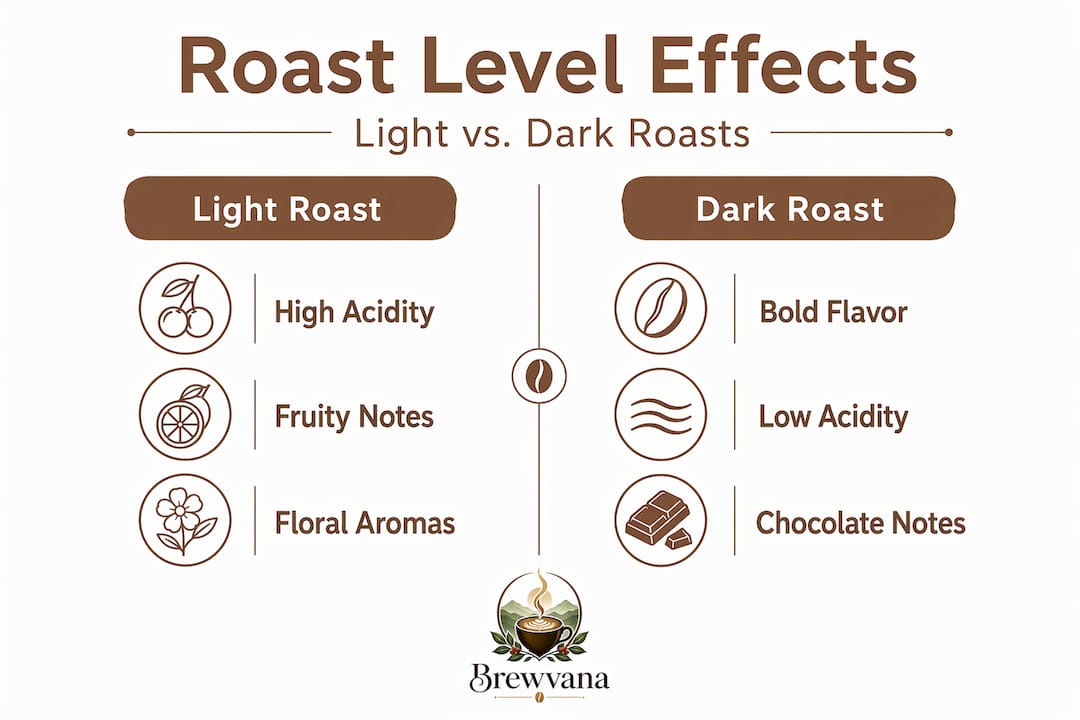
| Roast level | Acidity | Sweetness | Bitterness | Typical notes |
|---|---|---|---|---|
| Light | High | Moderate | Low | Floral, citrus, berry, tea-like |
| Medium | Balanced | High | Moderate | Caramel, stone fruit, chocolate |
| Dark | Low | Low | High | Smoke, dark chocolate, charred sugar |
Light roasts highlight acidity and preserve the origin’s floral and fruity compounds. A washed Ethiopian light roast is where you will find the clearest expression of bergamot and blueberry. A medium roast applies more heat, caramelizing sugars into toffee and softening sharp acidity into a rounder sweetness. Dark roasts push past caramelization into pyrolysis territory, burning off delicate aromatics and replacing them with roast-driven bitterness and smoke.
Roast date compounds this significantly. A freshly roasted coffee releases carbon dioxide (CO2) for the first week or two after roasting, a process called degassing. During this window, the coffee is at peak aromatic complexity. After about four weeks without proper sealing, oxidation flattens the profile noticeably. Buying coffee with a recent roast date is not a premium preference. It is the baseline for actually tasting what the roaster intended.
My perspective: what tasting notes actually taught me
I used to dismiss tasting note labels as marketing copy. “Blueberry? In coffee? Come on.” That skepticism lasted until I had a natural-process Ethiopian Yirgacheffe side by side with a washed version of the same origin. The difference was not subtle. The natural was fruit-forward, almost jammy. The washed version was bright and floral. Same country, same altitude, different processing. That moment made tasting notes make sense in a way no explanation had before.
What changed for me was understanding the chemistry. Once I knew that Ethiopian coffees carry higher concentrations of terpenes and esters linked to floral and berry perception, the notes stopped feeling like a stretch. I started tasting them not because I was told to, but because I knew what to look for. That shift from passive drinking to active tasting took about three months of intentional practice. It was not difficult. It just required paying attention.
The most surprising discovery was how much roast date matters. I had been buying the same single-origin Colombian for months and found it inconsistent. When I started checking roast dates and drinking the coffee within two weeks, it was a completely different experience. The caramel sweetness I had read about on the label was suddenly obvious. Fresh coffee simply reveals what stale coffee hides.
My recommendation: start with a high-quality single-origin coffee from a known region, taste it black, and give yourself permission to be wrong about the notes. This is a skill, not a talent.
— Kimberly
Discover tasting notes through Brewvana’s freshly roasted coffees

If you are ready to put this knowledge to work, Brewvana’s lineup is built for exactly this kind of exploration. Every coffee is roasted to order, which means you are getting peak aromatic complexity from day one. Start with the Best Sellers Sample Pack to taste six distinct profiles across multiple origins and roast levels side by side. It is the fastest way to train your palate without committing to one coffee. For a deeper dive into origin-driven flavor, Brewvana’s single-origin collection curates coffees from Ethiopia, Colombia, Peru, and beyond, each selected for expressive, traceable flavor profiles. And if you want to understand how roast level shapes what you taste before you buy, the roast level flavor guide on the Brewvana blog is the clearest breakdown you will find.
FAQ
What are coffee tasting notes?
Tasting notes are descriptors used by roasters and tasters to communicate the natural flavors present in a coffee, like “peach,” “jasmine,” or “dark chocolate.” They are not added flavors but expressions of origin, processing, and roast.
Why does coffee smell different than it tastes?
Coffee contains over 800 aroma compounds detectable by the nose, while the tongue is limited to five basic tastes. This gap between nasal and gustatory perception explains why the aroma always seems richer than the actual sip.
Why do different coffee origins taste so different?
Each origin produces distinct volatile compounds during growing and processing. Ethiopian coffees are high in terpenes that create floral and berry notes, while Brazilian coffees carry more pyrazines, producing nutty and chocolatey profiles.
Does roast level change a coffee’s tasting notes?
Yes, significantly. Light roasts preserve the origin’s natural acidity and fruitiness, while dark roasts replace those notes with roast-driven flavors like smoke and dark chocolate by burning off delicate volatile compounds.
How do I get better at identifying tasting notes?
Taste coffee without additives, focus on aroma before sipping, and use a flavor wheel to build your vocabulary. Tasting is a skill that builds through observation and repetition, not a fixed ability you either have or don’t.