

You already know that coffee tastes different depending on where it comes from or how it’s roasted. But what most home brewers don’t realize is that the processing method, meaning what happens to the coffee cherry between harvest and the roasting stage, has an enormous impact on what ends up in your cup. In fact, processing is a primary predictor of cup style, from clarity to fruit-forward sweetness, and matching a method to your taste preferences can change your daily brew more than any gear upgrade ever will. This article walks you through the key methods, what they taste like, and how to choose the right one for you.
Table of Contents
- How coffee bean processing shapes your cup
- The main coffee bean processing methods explained
- Side-by-side: Comparing processing methods
- Choosing the right processing method for your taste
- Why processing trumps many other factors for home brewers
- Explore diverse coffee flavors with Brewvana
- Frequently asked questions
Key Takeaways
| Point | Details |
|---|---|
| Processing shapes flavor | How coffee beans are processed is the main driver of cup body, sweetness, and acidity. |
| Choose by cup style | Selecting beans by processing method helps you target the coffee taste experience you truly want. |
| Each method has pros and cons | Natural, washed, honey, and wet-hulled processes offer unique flavor advantages and risks. |
| Match process to brewing | Some methods suit certain brewing techniques and preferences better than others. |
How coffee bean processing shapes your cup
Before you can pick the right beans, it helps to understand what “processing method” actually means. When a coffee cherry is harvested, it looks a lot like a small red or yellow fruit. Inside that fruit is the seed we roast and grind. Processing is everything that happens to remove the fruit from the seed and prepare it for export, and the details of that process have a direct, powerful effect on your final cup.
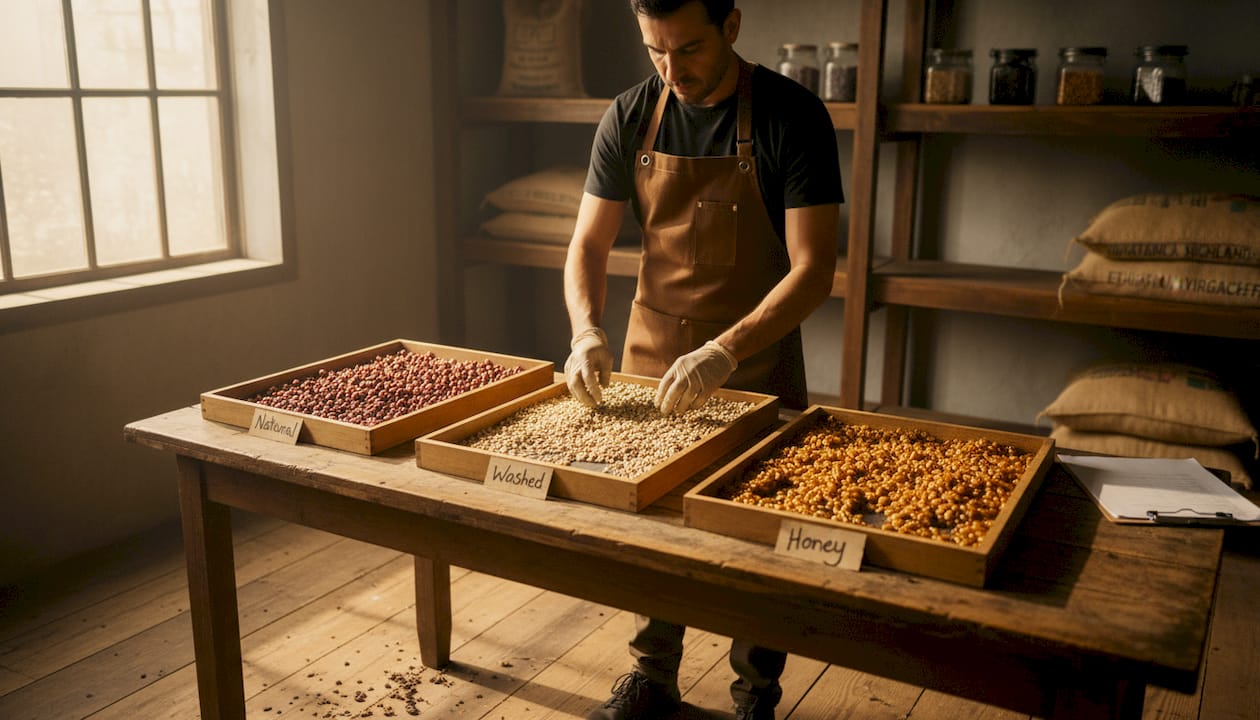
The method determines how much fruit contact the seed gets, how long it ferments, and how quickly it dries. All of those variables affect the flavor, body, acidity, and sweetness you taste in the finished brew. Think of it this way: the cherry’s fruit sugars, acids, and microbes are like a marinade. Leave the seed in that marinade longer, and those compounds sink deeper into the bean.
Key factors shaping flavor during processing include:
- Fermentation duration: Longer contact between the bean and the fruit or mucilage creates more complex, sometimes wine-like notes
- Drying conditions: Slow, shaded drying preserves certain flavors; fast drying locks in others
- Oxygen exposure: More air access during drying can amplify sweetness or introduce earthy depth
- Consistency control: Controlled environments reduce the chance of defects
As research shows, fermentation and drying conditions are central to a coffee’s sensory fingerprint and determine how risky or consistent the outcome will be. This is why two bags from the same farm in Ethiopia can taste completely different if one is washed and the other is naturally dried.
Understanding processing also helps you interpret roast behavior. A naturally processed bean tends to carry more sugars into the roaster, which can caramelize differently than a washed bean. That connection between process and roast is why coffee flavor and roast date are both worth understanding together when you select beans.
Pro Tip: When a roaster’s label says “natural” or “washed,” that’s your first and best hint about what the coffee will taste like before you even open the bag.
The main coffee bean processing methods explained
There are four primary processing methods you’ll encounter as a home brewer. Each one takes a different approach to separating the seed from the fruit, and each one produces a distinctive set of flavors.
1. Natural (dry) processing
This is the oldest method. The whole coffee cherry is dried intact, usually on raised beds or patios under the sun, for several weeks.
Process steps:
- Cherries are sorted and floated to remove defects
- Whole cherries are spread on drying beds or patios
- They dry in the sun for two to six weeks, with regular turning
- Once moisture drops to the target level, the dried fruit is stripped away by machine
As the cherry dries on the bean, fruit sugars and aromatic compounds absorb into the seed. Natural processing often increases fruit-forward character and body but raises consistency and defect risk compared to washed approaches.
Typical flavor notes: Blueberry, strawberry, tropical fruit, chocolate, wine-like depth Body: Heavy Acidity: Low to medium Common origins: Ethiopia, Brazil, Yemen
2. Washed (wet) processing
In washed processing, the fruit is stripped away almost completely before drying. This gives producers more control and typically results in cleaner, brighter cups.
Process steps:
- Cherries are depulped to remove the outer skin
- Beans are fermented in tanks to break down the remaining mucilage
- They are rinsed clean with water
- Clean, parchment-covered beans are dried on raised beds
The result is a cup where the bean’s origin characteristics, especially its terroir and acidity, come through with a lot of clarity. Washed coffees tend to taste lighter and more transparent.
Typical flavor notes: Lemon, floral, jasmine, peach, clean green tea Body: Light to medium Acidity: Bright and defined Common origins: Ethiopia (Yirgacheffe), Kenya, Guatemala, Colombia
“Washed processing gives the bean nowhere to hide. If the origin is extraordinary, that brilliance shines through. If there are flaws in the crop, those show up too.”
3. Honey processing
Honey process is a creative middle ground between natural and washed. Honey processing removes the cherry’s skin but intentionally leaves varying amounts of sticky mucilage on the bean during drying. Despite the name, there’s no actual honey involved — the term refers to the sticky texture of the mucilage.
The different “honey” levels correspond to how much mucilage is retained:
- White honey: Very little mucilage left, close to washed in cup
- Yellow honey: Light mucilage, mild sweetness bump
- Red honey: Moderate mucilage, noticeable body and sweetness
- Black honey: Maximum mucilage, often slow-dried, rich and complex
Typical flavor notes: Caramel, stone fruit, mild berry, brown sugar Body: Medium to full Acidity: Soft and rounded Common origins: Costa Rica, El Salvador, Panama
Pro Tip: If you love washed coffees but want just a little more sweetness without the wildness of a natural, start with a yellow or red honey. It’s a low-risk gateway into the honey style.
One excellent way to experience these honey and other processing styles side by side is through a Flavored Coffees Sample Pack, which puts a range of taste profiles in your hands all at once.
4. Wet-hulled (Giling Basah)
This method is closely tied to Indonesia, particularly Sumatra, Sulawesi, and Flores. It was developed specifically to manage the challenging climate conditions in those regions.
Wet-hulled coffee involves producers removing the parchment layer while the bean is still relatively wet, at around 35 to 40 percent moisture, and then re-drying the now-exposed green bean. This unusual approach, done partly to speed up drying before the next rain season, produces a very distinctive flavor profile.
Typical flavor notes: Dark chocolate, earth, cedar, tobacco, mushroom Body: Heavy and syrupy Acidity: Very low Common origins: Sumatra, Sulawesi, Flores (Indonesia)
This method is unusual and polarizing. Some coffee drinkers love the bold, savory depth it produces. Others prefer fruitier or cleaner cups. Knowing this background immediately explains why Sumatran coffees taste so radically different from an Ethiopian washed bean.
Side-by-side: Comparing processing methods
Now that you understand each method individually, here’s a direct comparison to make decisions easier at a glance.
| Processing method | Flavor character | Body | Acidity | Consistency | Common origins |
|---|---|---|---|---|---|
| Natural (dry) | Fruity, wine-like, sweet | Heavy | Low to medium | Lower, weather-dependent | Ethiopia, Brazil |
| Washed (wet) | Clean, bright, floral | Light to medium | High, defined | High | Kenya, Colombia, Guatemala |
| Honey | Caramel, stone fruit, sweet | Medium to full | Soft, rounded | Medium | Costa Rica, El Salvador |
| Wet-hulled | Earthy, chocolatey, bold | Heavy, syrupy | Very low | Medium | Sumatra, Sulawesi |
A few things stand out when you look at the table this way. Washed processing consistently produces the most predictable results for producers and buyers, which is one reason it’s so widespread at the specialty level. Natural processing is more weather and climate dependent, with higher defect risk, which is why naturally processed coffees sometimes cost more and vary more bag to bag.
For cold brew lovers specifically, naturally processed or wet-hulled beans tend to perform beautifully because the heavy body holds up well to dilution. If you enjoy a Cold Brew Coffee with bold, fruity depth, reaching for a natural Ethiopian or a Sumatran wet-hulled bean is a smart call.
What to look for by processing style:
- For bright, sparkling cups: Washed process from East Africa or Central America
- For rich, chocolatey depth: Wet-hulled Indonesian or natural Brazilian
- For sweet, smooth everyday drinking: Red or black honey from Costa Rica
- For fruit-bomb adventure: Natural Ethiopian, especially during peak crop season
Choosing the right processing method for your taste
Here’s where theory turns into practical decisions. The goal is to match processing style to what you personally enjoy drinking, and also to your preferred brewing method.
| If you like this… | Choose this process | Best brewing method |
|---|---|---|
| Clean, bright, lemon-like cups | Washed | Pour-over, AeroPress |
| Fruity, wine-forward intensity | Natural | Espresso, French press |
| Sweet, smooth, balanced | Honey (red or black) | Drip, pour-over |
| Bold, earthy, heavy body | Wet-hulled | French press, cold brew |
| Mild, approachable everyday cup | Yellow honey or light washed | Drip brewer |
A key insight worth repeating: processing is a primary predictor of cup style, and matching it to your sensory preferences can be more impactful than any tweak to your brew technique.
Pour-over brewing amplifies clarity and acidity, which is why it pairs so naturally with washed coffees. The clean flavors get to express fully without interference. Espresso, on the other hand, concentrates everything, so a natural or honey process delivers that sweetness and fruit character more intensely as a shot.
Pro Tip: If you’re not sure where to start, try a washed and a natural from the same country, like two Ethiopian coffees processed differently. The contrast will teach you more about processing in one sitting than any article can.
Why processing trumps many other factors for home brewers
Here’s an opinion that might be slightly uncomfortable but is worth saying plainly: most home brewers spend too much time worrying about origin, roast level, and equipment, and not enough time thinking about processing.
It makes sense why. Origin stories are romantic. New gear is exciting. Roast profiles are easy to see on a bag. But all of that sits on top of a foundation set by processing. A washed bean and a natural bean from the same farm in the same harvest year can taste like two entirely different coffees. No grinder upgrade will change that.
The processing method as a primary predictor framework gives you a genuinely useful shortcut. Once you know you love the fruit-forward sweetness of naturals, or the crystalline clarity of washed coffees, you can filter your buying decisions immediately. You stop buying bags at random and start building a personal flavor map.
We’ve also found that understanding processing sheds light on why the same roast level lands so differently on different beans. A medium roast on a natural Ethiopian feels lush and fruity. The same medium roast on a washed Kenyan tastes bright and tea-like. Processing set those different starting points long before the roaster got involved. Pairing that understanding with awareness of roast date vs processing impact creates a more complete picture of what drives your cup.
Start with process. Then let origin, roast, and technique follow. It’s a cleaner path to coffees you actually love.
Explore diverse coffee flavors with Brewvana
Understanding processing methods is exciting, but the real magic happens when you taste the differences yourself.

At Brewvana, we’ve curated our selection specifically to help you explore a range of processing styles without guesswork. Our coffee sample packs make it easy to taste natural, washed, and honey processed coffees side by side, so you can identify exactly what your palate responds to. For deeper exploration, our single origin options highlight the farm-level stories and processing details that make each bag unique. If convenience is part of your daily routine, our Instant Coffee brings that same premium quality to any moment. Every order is roasted or prepared fresh, and a portion of each sale supports local schools — so great coffee does a little good too.
Frequently asked questions
What is the difference between washed and natural coffee processing?
Washed processing removes the cherry skin and mucilage before drying, resulting in a clean and bright cup, while natural processing keeps the whole cherry intact to enhance body and fruitiness but with more variability in the final cup.
Does the processing method affect how I should brew my coffee?
Yes, absolutely. Processing predicts cup style so well that washed coffees tend to shine in pour-over setups, while naturally processed beans bring more fruity intensity to espresso and immersion brews like French press.
What is honey processed coffee and how does it taste?
Honey process leaves some sticky mucilage on the bean during drying, which creates a cup with more sweetness and body than washed, but without the full fruit intensity of a natural process coffee.
Is one coffee processing method healthier than another?
No evidence points to any one method being more nutritious than another. The primary differences between methods are in flavor, texture, and aroma, not in the nutritional profile of the coffee you drink.
Why do some Indonesian coffees taste so different?
Most Indonesian coffees, especially from Sumatra, use wet-hulling (Giling Basah), a unique method that produces the characteristic heavy body and very low acidity that sets these coffees apart from anything else in the world.