

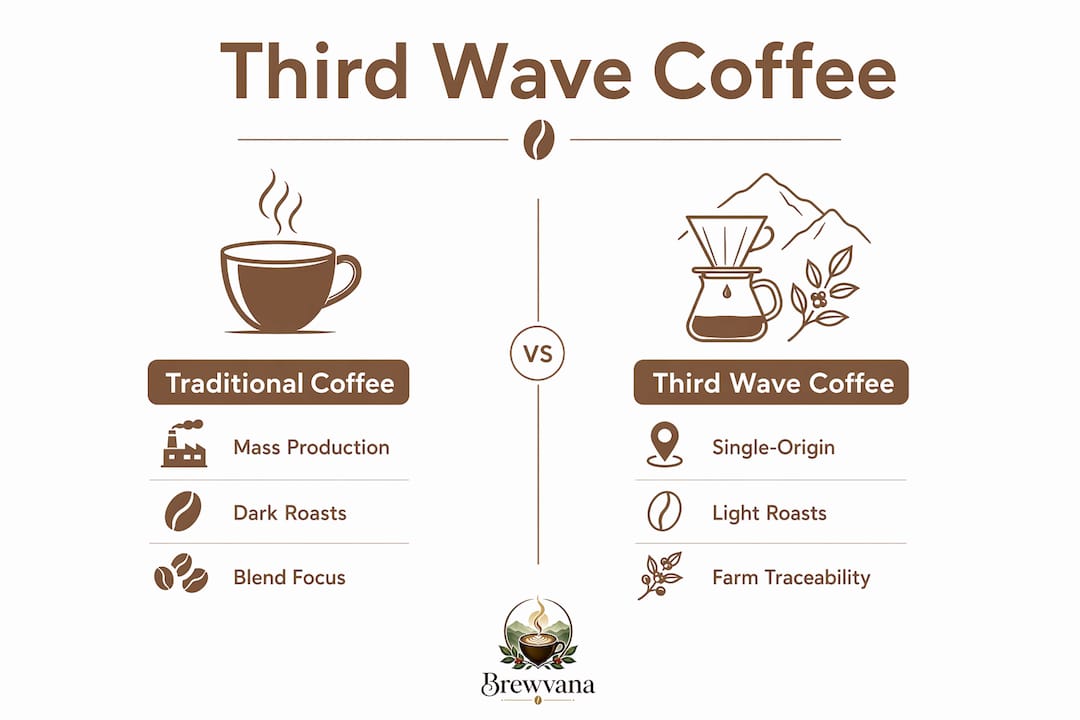
Third wave coffee is a quality-driven movement that treats coffee as an artisan craft rather than a commodity. It centers on single-origin beans, transparent sourcing, light roast profiles, and direct relationships between roasters and farmers. The term is primarily used in the United States coffee industry, and it signals something bigger than a brewing style. It’s a philosophy about how coffee should be grown, traded, roasted, and experienced.
The core markers of third wave coffee:
- Single-origin beans sourced from specific farms or regions, not blended commodity lots
- Light to medium roast profiles designed to preserve the natural flavors of each origin
- Direct trade relationships where roasters work closely with farmers over multiple seasons
- Consumer education as a central part of the coffee experience, not an afterthought
- Traceability and transparency across the entire supply chain, from farm to cup
- Scoring standards aligned with the Specialty Coffee Association’s 80-point quality threshold
Brewvana’s Kenya Single Origin Coffee and Ethiopia Natural Process Single Origin Coffee are built around exactly these principles: traceable origin, careful processing, and roasting that lets the bean speak for itself.
Table of Contents
- What is third wave coffee, and how did it develop?
- How the industry actually uses the term “third wave coffee”
- Key characteristics that define third wave coffee
- What experts say about where coffee culture is heading
- How third wave coffee changed brewing techniques and equipment
- The role of roasters and baristas in the third wave movement
- Brewvana brings third wave quality to your door
- Key Takeaways
What is third wave coffee, and how did it develop?
The story of third wave coffee only makes sense against the backdrop of what came before it.
The first wave was the 19th-century surge that made coffee a household staple across America. Think Folgers on every kitchen table, Maxwell House in every diner. Coffee was cheap, convenient, and treated as pure fuel. Quality was irrelevant.
The second wave arrived in the 1960s and accelerated through the 1980s and 1990s. It brought espresso culture, regional roasts, and the rise of coffee shop chains. Consumers started caring about the experience of drinking coffee, not just the caffeine. This era made terms like “latte” and “dark roast” part of everyday American vocabulary.
The third wave emerged as a reaction to both. The approach originated in the 1970s with small specialty roasters, but the movement took shape formally in the 1980s and gained its name in 1999. Key milestones in its development:
- 1970s: Early specialty roasters begin sourcing higher-quality green coffee and experimenting with lighter roast profiles.
- 1982: The Specialty Coffee Association of America is founded, creating a formal framework for quality standards and barista training.
- 1999: The term “third wave” is coined by Trish Rothgeb to describe the movement’s emphasis on coffee quality and artisan craft.
- Early 2000s: Direct trade relationships between U.S. roasters and origin farmers become a defining practice of the movement.
- 2002: The Cup of Excellence auction program expands, giving farmers a direct path to premium prices for exceptional lots and giving roasters access to traceable, high-scoring beans.
- Mid-2000s: Pour-over brewing, Chemex, and AeroPress gain traction in third wave cafés as manual methods that highlight origin flavor.
- 2008 onward: The Specialty Coffee Association’s barista championships grow in visibility, professionalizing the barista role and raising consumer expectations.
- 2010s: Third wave coffee goes mainstream in U.S. cities, with independent roasters opening across the country and single-origin offerings appearing on menus nationwide.
- 2020s: Conversations about equity, sustainability, and what comes after the third wave begin reshaping the industry’s self-understanding.
How the industry actually uses the term “third wave coffee”
The phrase functions more as a cultural shorthand than a strict product category. Third wave coffee is distinguished from specialty coffee in a specific way: specialty coffee refers to beans scoring 80 or more points on a 100-point scale, a measurable product standard. Third wave coffee is the broader cultural movement built around those beans, including the narrative, the transparency, and the consumer education that surrounds them. You can serve specialty coffee in a setting that has none of those values. Third wave is the whole experience.
That framing matters because it explains why the term has staying power even as critics question its usefulness. The waves model is widely acknowledged as an oversimplification, but it remains the clearest shorthand the industry has for explaining how coffee culture evolved from commodity to craft. Conversations about a “fourth wave” focused on data, fermentation science, and equity are growing, but most of the U.S. specialty coffee world still operates within the third wave framework.
Key characteristics that define third wave coffee
Third wave coffee is recognizable by a specific set of values that show up consistently across sourcing, roasting, and service.
- Transparent sourcing: Consumers know the farm, the region, and often the farmer behind their coffee.
- Direct trade: Roasters build long-term relationships with farmers, returning season after season and sometimes financing infrastructure improvements to raise harvest quality.
- Light roast preference: Roasters track temperature curves, rate of rise, and development time to preserve the delicate flavors unique to each origin rather than masking them with dark roast character.
- Origin-driven flavor: A washed Ethiopian coffee tastes nothing like a natural Brazilian. Third wave baristas are trained to explain why.
- Barista as educator: Service is part of the product. Explaining tasting notes, brewing ratios, and origin stories is standard practice.
- Ethical sourcing: Fair pay, sustainable farming practices, and long-term investment in origin communities are built into the sourcing model, not bolted on as marketing.
| Characteristic | Third Wave Approach |
|---|---|
| Bean sourcing | Single-origin, farm-traceable |
| Roast profile | Light to medium, origin-preserving |
| Trade model | Direct trade with long-term farmer relationships |
| Consumer role | Educated participant, not passive drinker |
| Quality standard | Specialty grade (80+ points, SCA scale) |
| Brewing methods | Pour-over, AeroPress, Chemex, precise espresso |
Brewvana’s Costa Rica Single Origin Coffee illustrates the sourcing side of this. It’s a traceable, single-origin bean chosen for its distinct regional character, the kind of coffee that only makes sense in a third wave context.
What experts say about where coffee culture is heading
The waves model has always had its critics, and the people who built it are among the most candid about its limits.
Rothgeb herself has said the framework was always meant to be a conversation starter, not a permanent taxonomy. The fourth wave concept points toward data-driven roasting, fermentation innovation, and a sharper focus on equity and accessibility at origin. These aren’t rejections of third wave values so much as extensions of them, pushing further on sustainability and transparency rather than abandoning them.
Pro Tip: When you see a coffee labeled with a specific farm name, processing method (washed, natural, honey), and harvest year, that’s third wave traceability in action. Those details aren’t decoration; they tell you exactly what you’re tasting and why.
The ongoing debate about wave labels reflects something healthy in the industry: a refusal to stay comfortable with its own definitions. Whether the next chapter gets called a fourth wave or something else entirely, the core values of quality, transparency, and farmer equity aren’t going anywhere.
How third wave coffee changed brewing techniques and equipment
Third wave coffee made precision brewing a mainstream expectation. Manual methods like pour-over, Chemex, AeroPress, and siphon brewing became standard in specialty cafés because they give the brewer direct control over water temperature, flow rate, and contact time. Each variable affects extraction, and third wave culture treats that control as a feature, not a burden.
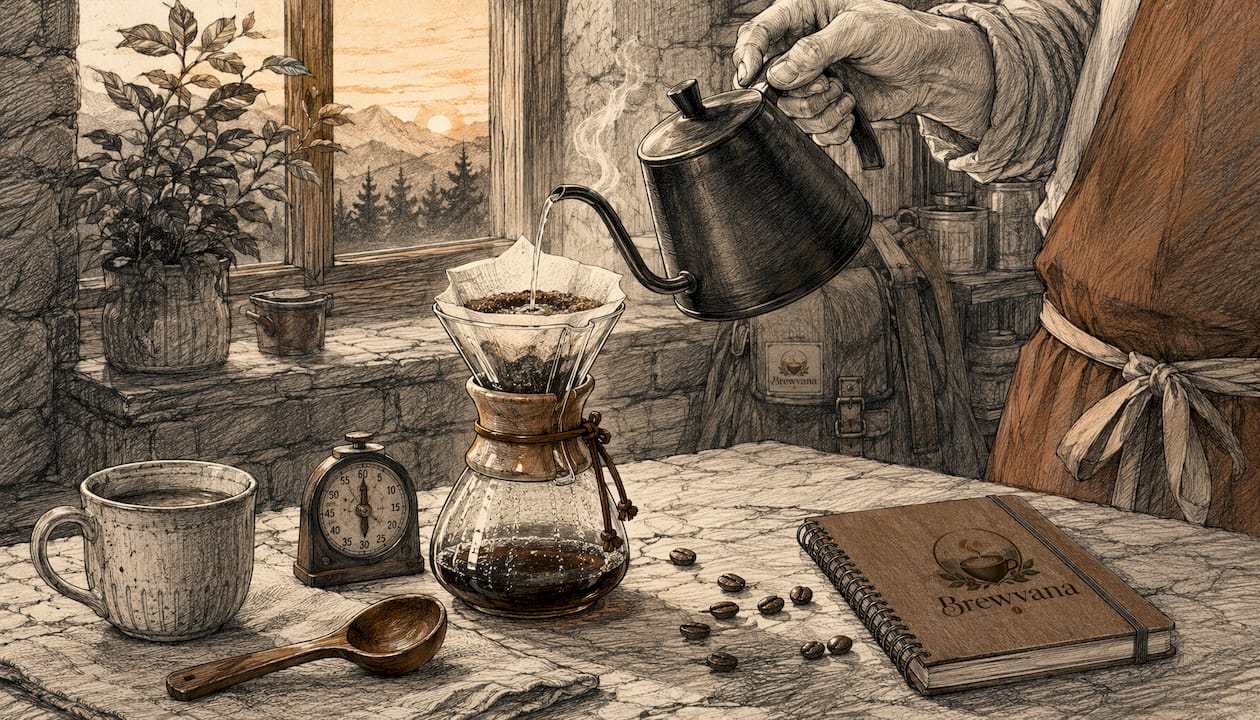
Espresso also got more precise. Pressure profiling, shot timing, and dose-to-yield ratios became standard practice in third wave cafés, a level of rigor that barely existed in second wave settings. Home brewing followed the same trajectory, with burr grinders, gooseneck kettles, and digital scales moving from professional tools to consumer products. The luxury preparation methods that once lived only in specialty cafés are now accessible to anyone willing to learn the basics.
The role of roasters and baristas in the third wave movement
Roasters and baristas aren’t just producers and servers in the third wave model. They’re the connective tissue between origin and cup. Roasters take on the responsibility of sourcing ethically, choosing ethically sourced beans with documented provenance, and then roasting with enough precision to honor the farmer’s work. That means detailed roast logs, small-batch production, and a willingness to let the bean’s natural character lead.
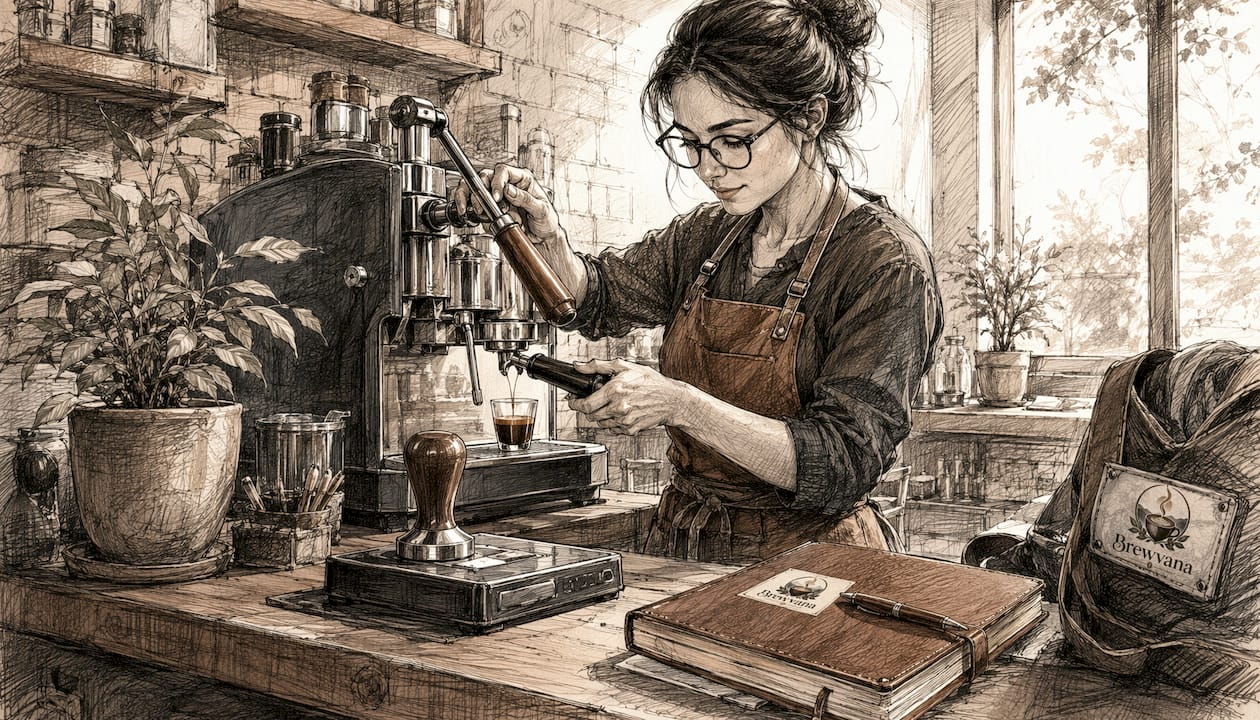
Baristas, meanwhile, became professionals in a way the first and second waves never demanded. Certifications through the Specialty Coffee Association, competition circuits like the World Barista Championship, and a culture of continuous learning reshaped what it means to work behind a bar. A third wave barista can explain the difference between a washed and natural process, dial in an espresso by taste, and guide a customer through a tasting the way a sommelier would. That expertise is part of what the customer is paying for.
Brewvana brings third wave quality to your door
Third wave coffee is built on the idea that great coffee deserves great sourcing, careful roasting, and a customer who actually knows what they’re drinking. Brewvana delivers all three without requiring a trip to a specialty café.
Every Brewvana coffee is roasted to order for maximum freshness, sourced with the traceability and quality standards the third wave movement established. The Kenya Single Origin Coffee brings the bright, complex flavors that made East African beans a third wave staple. The Ethiopia Natural Process showcases the fruit-forward character that natural processing unlocks. For those who want something with serious caffeine alongside craft-level quality, the Max Caf High-Caffeine Coffee Blend delivers. Brewvana also donates a portion of every sale to local schools, so your morning cup supports something beyond the cup itself. Browse the full collection at brewvana.us and find the coffee that fits how you drink.
Key Takeaways
Third wave coffee is a cultural movement built on transparency, direct trade, and treating coffee as an artisan product with traceable origin and measurable quality standards.
| Point | Details |
|---|---|
| Third wave definition | A cultural movement emphasizing quality, transparency, and artisan craft, not just a product category. |
| Specialty coffee distinction | Specialty coffee scores 80+ points on the SCA scale; third wave adds narrative, education, and supply chain transparency. |
| Direct trade commitment | Roasters build long-term farmer relationships, sometimes investing in farm infrastructure to improve quality over time. |
| Roasting precision | Light to medium roast profiles, tracked with temperature and rate-of-rise logs, preserve each origin’s distinct flavors. |
| Brewvana’s approach | Brewvana offers roasted-to-order single-origin and blend coffees, including Kenya, Ethiopia Natural Process, and Max Caf, built on third wave sourcing values. |