

Impact investing in the coffee industry means deploying capital with the explicit goal of generating measurable social and environmental benefits alongside a financial return. It’s not philanthropy, and it’s not conventional investing. The Global Impact Investing Network (GIIN) defines the practice around four core principles:
- Intentionality: The investor deliberately targets positive outcomes, not just profit.
- Financial return: Investments are expected to generate returns, ranging from capital preservation to market-rate gains.
- Range of asset classes: Impact capital flows through loans, equity, and blended finance structures.
- Impact measurement: Outcomes are tracked using defined metrics, not assumed.
In coffee specifically, these principles address a sector where nearly half of smallholder producers still live in poverty despite decades of sustainability certifications. Impact investing differs from traditional coffee investment by requiring proof of social or environmental change, not just a profitable harvest. Cooperatives, development finance institutions, and specialized funds like Root Capital and Oikocredit operate as key vehicles, channeling capital where conventional banks won’t go.
What drives impact investing in the coffee sector?
The core motivation is a financing gap that standard banking cannot bridge. Most smallholder coffee farmers need loans too large for microfinance institutions but too small and risky for commercial banks. Impact investors fill this gap with tailored financial products and hands-on advisory support, building the business skills cooperatives need to actually repay and grow.
Three stakeholder groups shape how this works in practice:
- Farmers and cooperatives: They receive capital, training, and market access they couldn’t otherwise reach.
- Impact funds and development finance institutions: They structure deals, absorb first-loss risk, and track outcomes.
- NGOs and technical assistance providers: They deliver agronomic training, financial literacy programs, and gender inclusion initiatives.
The environmental dimension is just as deliberate. Coffee farming contributes to deforestation and soil degradation when practiced conventionally. Impact investors specifically fund the shift toward regenerative agroforestry, water conservation, and circular nutrient management, treating environmental outcomes as a required deliverable, not a side effect.
Pro Tip: When evaluating any impact fund focused on coffee, ask for its Theory of Change document. A credible fund maps exactly how each dollar flows from investment to a specific farmer outcome, not just a general sustainability goal.
How does impact investing perform financially in coffee?
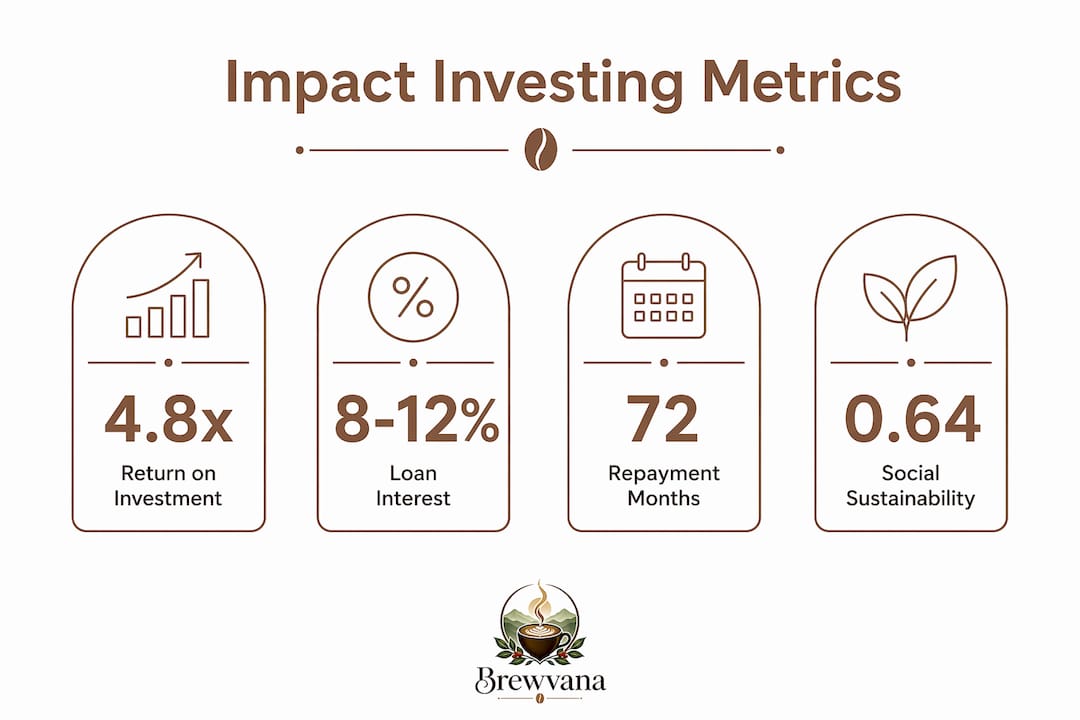
The financial case is real, though not without nuance. Impact loans to coffee SMEs typically carry interest rates of 8–12% with repayment terms up to 72 months, and they show lower default rates than comparable conventional agricultural loans. That combination makes them attractive to patient capital seeking stable, long-duration returns.
| Metric | Typical Range |
|---|---|
| Loan interest rate | 8–12% |
| Repayment term | Up to 72 months |
| Farmer income ROI (AAA Program, Kenya) | 4.8x per dollar invested |
| Cooperative wage premium (PRODECOOP, Nicaragua) | 20–30% above national average |
The Nespresso AAA Sustainable Quality Program, run with TechnoServe across Ethiopia and Kenya, generated a 4.8x return on investment in farmer income for every dollar invested, with farmers who adopted regenerative practices increasing their coffee incomes by up to 250% in Kenya. Those numbers come from third-party research by Laterite, not self-reported program data.
Adoption is growing across the sector. Institutional investors increasingly treat coffee impact funds as a diversification tool within broader agricultural or ESG portfolios, drawn by the long-duration loan structures and the growing consumer premium attached to traceable, ethically sourced coffee. The gourmet food and beverage market has made ethical sourcing a purchase driver, which translates directly into price premiums that underpin fund returns.
What are the real challenges and opportunities here?
The risk profile is the first thing any honest conversation about this space has to address.
“There’s 10 times the risk profile of a standard US venture deal without the same potential upside.” This is the structural reality of impact investing in coffee-producing regions, where political instability, climate volatility, and thin margins compound the usual agricultural risks.
That quote, cited in reporting on Nicaragua’s coffee sector, captures why blended finance models exist. By stacking concessional public capital beneath private investment, blended structures absorb first-loss risk and make deals viable that no single investor would touch alone.
Farmer-led organizations score highest on social sustainability indices, reaching 0.64 on a standardized scale compared to lower scores for private companies and middlemen. That finding points to cooperatives as the most effective vehicle for impact, but cooperatives themselves face real barriers: limited credit history, dispersed membership, and management capacity gaps that investors often lack the expertise to evaluate.
The Brand Coffee Farm in Uganda illustrates what’s possible when these barriers are addressed directly. Blended finance and youth-led training networks there support over 900 farmers, connecting them directly to export markets in Rotterdam and funding infrastructure that improved both quality control and earnings. The “train-the-trainer” model used there embeds knowledge in local communities rather than relying on periodic workshops that farmers forget between visits.
The PRODECOOP cooperative in Nicaragua shows a parallel story. With capital and education from impact investors, PRODECOOP members earn 20–30% above the national wage average, and the cooperative has expanded gender inclusion programs that give women access to credit and leadership roles. These are not soft outcomes. They reduce turnover, improve farm management quality, and lower default risk for the investors funding the loans.
How transparency and traceability make impact measurable
Transparency is what separates genuine impact investing from greenwashing. Without granular traceability, an investor cannot verify that a dollar deployed actually reached a specific farmer, changed a specific practice, or produced a specific environmental outcome.
Technologies now used across the coffee supply chain include:
- Blockchain platforms (such as Farmer Connect and IBM Food Trust) that create immutable records linking a bag of coffee to its farm of origin.
- IoT sensors that monitor soil moisture, temperature, and processing conditions in real time.
- AI-driven data analytics that identify supply chain inefficiencies and flag quality deviations before they reach the roaster.
The metrics used to evaluate social and environmental outcomes in coffee impact investments typically include: farmer net income versus a living income benchmark, gender inclusion rates within cooperatives, carbon sequestration from agroforestry adoption, water use per kilogram of processed coffee, and yield per hectare before and after training interventions. The ethically sourced coffee movement depends on exactly these metrics to give certifications real teeth.
Pro Tip: Always look for independent third-party verification of impact data. Self-reported metrics from a fund or cooperative are a starting point, not a conclusion. Firms like Laterite and specialized ESG auditors provide the external validation that makes impact claims credible to institutional investors.
Traceability also serves consumers directly. When a roaster can show you the GPS coordinates of the farm, the processing method, and the price paid to the farmer, that’s not marketing. It’s the output of a functioning impact measurement system. Community-supported agriculture models in coffee are building exactly this kind of direct producer-to-consumer accountability.
Key Takeaways
Impact investing in coffee generates measurable social and environmental outcomes alongside financial returns, with farmer-led cooperatives and blended finance structures proving the most effective delivery mechanisms.
| Point | Details |
|---|---|
| Dual-return structure | Impact investments target both financial returns and verified social or environmental outcomes, not one or the other. |
| Cooperative advantage | Farmer-led organizations score 0.64 on social sustainability indices, outperforming private companies and middlemen. |
| Loan terms | Coffee impact loans typically carry 8–12% interest rates with repayment terms up to 72 months. |
| Blended finance necessity | Risk profiles run roughly 10x higher than standard US venture deals, making public-private blended structures essential. |
| Traceability tools | Blockchain, IoT sensors, and AI analytics now link consumer purchases to verified farm-level impact data. |
Taste the difference that ethical sourcing makes
Every cup of coffee tells a story about the farm it came from. Brewvana sources with that story in mind, offering single-origin coffees from regions where responsible farming practices are part of the supply chain, not an afterthought. The Colombia single origin and Ethiopia Natural Process options reflect exactly the kind of traceable, farm-level sourcing that impact investing in coffee is designed to support. Brewvana also donates a portion of every sale to local schools, because the connection between a great cup and a better community shouldn’t stop at the farm gate.