

Coffee degassing is defined as the release of carbon dioxide (CO₂) gas from roasted coffee beans, a process that begins the moment roasting ends and directly shapes how your coffee tastes. Most coffee drinkers never think about it, yet it controls extraction quality, aroma, and the flavor balance in every cup. Understanding the coffee degassing process puts you in control of freshness in a way that no grinder upgrade or brewing gadget can replace.
What is coffee degassing and how does it work?
Coffee degassing is the release of CO₂ produced during the Maillard reaction and Strecker degradation reactions inside the bean’s cell walls. These are the same chemical reactions that create the complex flavors and aromas you associate with roasted coffee. The roasting process traps enormous amounts of CO₂ inside the bean’s microscopic cellulose structure, and once the beans cool, that gas begins migrating outward through the porous cell walls.
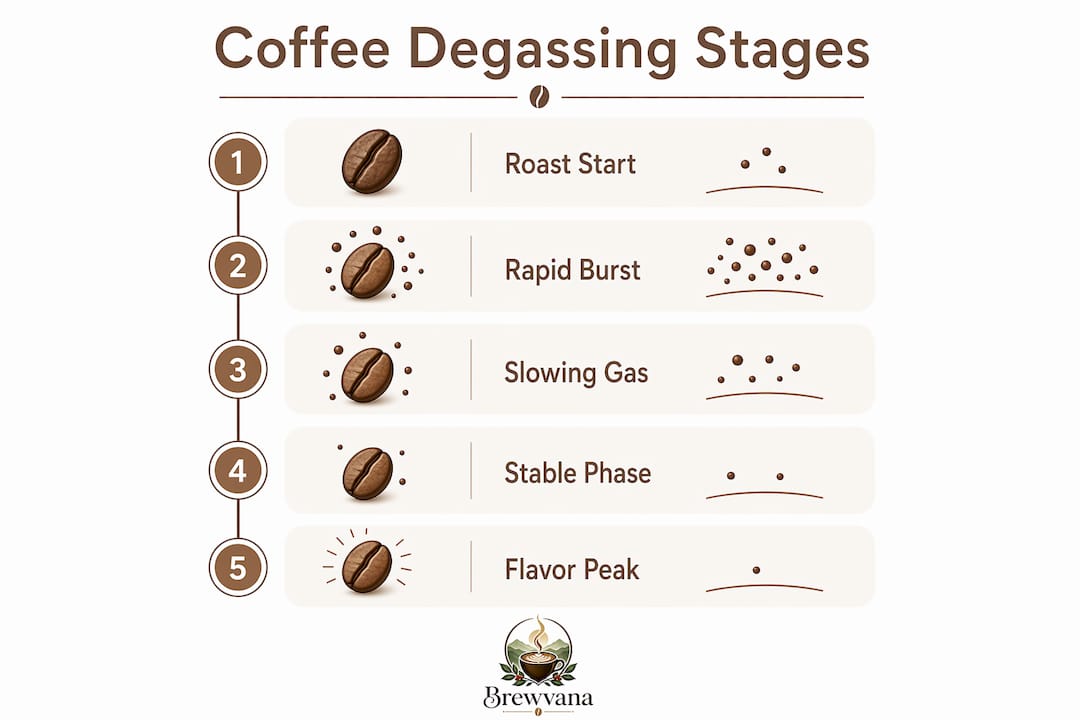
The coffee off-gassing process moves through three recognizable stages. First comes a rapid initial burst in the first 24–48 hours after roasting, when the highest concentration of gas escapes quickly. The second phase is a slower, steady release that continues over the following days and weeks. The third phase is a long-term stabilization where gas release slows to a near stop and oxidation becomes the dominant concern.
Temperature, pressure, and packaging all influence how fast gas migrates. Warmer storage accelerates degassing. Airtight bags without a release valve trap gas and can cause the bag to swell or burst. One-way degassing valves allow CO₂ to escape packaging while preventing oxygen from entering, which preserves freshness longer. That small plastic button on your coffee bag is doing critical work.
Pro Tip: If your coffee bag is noticeably puffed up, that is a sign of active degassing, not spoilage. A puffed bag means the beans are fresh and releasing gas normally.
Why does coffee degassing matter for flavor and brewing?
The importance of coffee degassing becomes obvious the first time you brew beans that are one day off the roaster. Excess CO₂ causes uneven water saturation and produces sour or metallic notes because the gas physically repels water from the coffee grounds. The result is a poorly extracted cup with a thin, sharp flavor profile that has nothing to do with bean quality.
The bloom step in pour-over and French press brewing exists specifically because of degassing. When you pour hot water over fresh grounds and let them rest for 30–45 seconds, you are allowing trapped CO₂ to escape before full extraction begins. Skip the bloom on very fresh beans and you get channeling, where water finds paths of least resistance through the grounds rather than saturating them evenly.
Crema quality in espresso is also tied directly to degassing. Fresh beans produce thick, abundant crema because CO₂ creates the foam. Beans that are too old produce thin, pale crema because most of the gas has already escaped. The sweet spot for espresso is typically 5–14 days post-roast, depending on roast level.
“The pace of gas release influences aroma volatility and coffee’s perceived freshness and flavor balance.” — Lygon Coffee
Most coffees taste best between 7 and 21 days post-roast. By day 4–7, degassing slows enough to allow normal water interaction. Brewing before that window produces over-gassed, uneven extraction. Brewing after the window, past 3–4 weeks for most roasts, risks flat, stale flavor as oxidation takes over.
The effects of degassing coffee also show up in aroma. CO₂ carries volatile aromatic compounds out of the bean as it escapes. Brew too early and those aromatics leave the bean before they reach your cup. Brew at the right time and the remaining aromatics are released directly into the brew, producing the full fragrance you expect from quality coffee.
How long does coffee take to degas?
Degassing timelines vary significantly by roast level, bean density, and storage conditions. The table below shows practical resting windows for each roast type.
| Roast level | Degassing speed | Recommended rest before brewing |
|---|---|---|
| Light roast | Slow (dense cell structure) | 7–14 days post-roast |
| Medium roast | Moderate | 5–10 days post-roast |
| Dark roast | Fast (porous cell structure) | 2–7 days post-roast |
Darker, more porous roasts degas quickly and are ready in 2–7 days. Denser light roasts degas slower and benefit from 7–14 days of rest to reduce sharp acidity. This is why a light roast Ethiopian natural and a dark roast French blend require completely different resting strategies, even if they arrived from the roaster on the same day.
Bean origin and processing method also affect gas retention. Naturally processed beans, where the fruit dries on the bean, tend to have denser cellular structures and hold CO₂ longer. Washed process beans often degas faster. Single-origin beans from high-altitude farms like those in Peru or Costa Rica tend to be denser and benefit from the longer end of the resting window.
Storage conditions matter just as much as roast level. Beans stored at room temperature in an airtight bag with a one-way valve will degas at a predictable rate. Beans stored in a warm kitchen or an open container will degas faster, which shortens the optimal brewing window. Refrigeration slows degassing but introduces moisture risk, so most coffee professionals recommend room temperature storage in a sealed, valve-equipped bag.
How can you manage degassing for a better cup?
Managing the coffee freshness and degassing relationship comes down to four practical habits.
- Check the roast date, not the “best by” date. Roast date tells you where the beans are in the degassing curve. A “best by” date tells you almost nothing useful about when to brew.
- Extend your bloom for very fresh beans. Extending bloom time to 45–60 seconds helps reduce gas-driven channeling for coffee consumed less than 5 days post-roast. Standard bloom times of 30 seconds are fine for beans in the 7–14 day window.
- Read the bloom as a freshness gauge. Violent foaming during the bloom means the beans are too fresh. A flat, barely active bloom means the beans are past peak. A steady, domed bloom that holds its shape for 20–30 seconds signals optimal degassing.
- Store beans in a sealed bag with a one-way valve. This is the single most effective storage upgrade you can make. It lets CO₂ escape without letting oxygen in, which preserves the flavor window.
Pro Tip: Write the roast date on your bag with a marker the day you open it. Tracking days post-roast takes the guesswork out of bloom time and brewing adjustments.
Brewing adjustments for very fresh beans go beyond bloom time. Higher water temperatures compensate for elevated CO₂ levels by improving extraction efficiency. A water temperature of 200–205°F works well for fresh beans where you might normally brew at 195–200°F. For roast date and flavor connections, the difference between a 3-day-old bag and a 10-day-old bag is dramatic in the cup.
Proper storage extends the usable freshness window significantly. Beans stored correctly in a valve bag at room temperature, away from light and heat, can stay at peak flavor for up to 4 weeks post-roast. After that, oxidation accelerates and the flavor flattens regardless of how well you brew. For a full breakdown of coffee bean storage methods, the difference between a good bag and a poor one is measurable in cup quality.
Key Takeaways
Coffee degassing is the CO₂ release process that controls extraction quality, aroma, and flavor balance, and managing it is the most underrated skill in home brewing.
| Point | Details |
|---|---|
| Degassing starts at roast | CO₂ releases immediately after roasting via Maillard and Strecker reactions inside bean cells. |
| Optimal brewing window | Most coffees taste best between 7 and 21 days post-roast, when gas levels allow even extraction. |
| Roast level changes timing | Dark roasts are ready in 2–7 days; light roasts need 7–14 days before brewing. |
| Bloom reveals freshness | Violent foam means too fresh; a flat bloom means past peak; a steady dome signals the sweet spot. |
| One-way valves preserve freshness | Valve-equipped bags let CO₂ escape without letting oxygen in, extending the flavor window. |
Brewvana’s take on degassing: the most ignored variable in home brewing
Most home brewers obsess over grind size, water temperature, and pour technique. Degassing gets almost no attention, and that is exactly why so many home-brewed cups fall short. The beans are doing something critical in the days after roasting, and ignoring that process means you are fighting the chemistry instead of working with it.
The mistake I see most often is brewing beans the same day they arrive. The bag smells incredible, the excitement is real, and the cup is disappointing. That disconnect is almost always degassing. The CO₂ is still escaping aggressively, the water cannot saturate the grounds evenly, and the result tastes sharp and hollow. Waiting three more days costs nothing and changes everything.
Different brew methods also respond to degassing differently. Espresso is the most sensitive because pressure amplifies the effect of CO₂. Pour-over is forgiving if you extend the bloom. French press is the most tolerant because immersion brewing compensates for uneven saturation. Knowing your brew method helps you decide how strict to be about the resting window.
The freshness curve is worth tracking personally. Brew the same beans at day 4, day 8, day 14, and day 21 post-roast and take notes. The flavor shifts are real and often dramatic. That exercise builds an intuition for degassing that no article can fully replace. Once you taste the difference, you will never ignore the roast date again.
— Brewvana
Fresh coffee, handled right: Brewvana’s single-origin collection
Brewvana roasts to order and ships with roast dates printed on every bag, so you always know exactly where your beans are in the degassing curve.

Every bag uses one-way degassing valves to let CO₂ escape without exposing beans to oxygen, which keeps the flavor window intact from roaster to your kitchen. Brewvana’s single-origin coffees include options like Costa Rica, Ethiopia Natural Process, and Peru, each sourced from high-altitude farms with dense bean structures that reward proper resting. When you know what degassing does to flavor, you want beans that are handled with that knowledge built into every step.
FAQ
What is coffee degassing in simple terms?
Coffee degassing is the process where roasted coffee beans release CO₂ gas produced during roasting. This gas escapes gradually over days and weeks after the roast date.
How long should I wait to brew after roasting?
Most coffees are best brewed between 7 and 21 days post-roast. Dark roasts are ready in as few as 2–7 days, while light roasts benefit from 7–14 days of rest.
Why does my coffee bag puff up?
A puffed coffee bag is a normal sign of active degassing. The beans are releasing CO₂ after roasting, and the gas collects inside the bag before escaping through the one-way valve.
Does degassing affect espresso differently than pour-over?
Espresso is the most sensitive brew method to degassing because pressure amplifies CO₂ effects. Pour-over is more forgiving when you extend the bloom to 45–60 seconds for very fresh beans.
Can coffee degas too much?
Yes. Once most CO₂ has escaped, oxidation accelerates and flavor goes flat. Beans stored past 3–4 weeks post-roast in poor conditions lose the aromatic compounds that make fresh coffee taste vibrant.