

Ethically sourced coffee is defined as coffee grown, harvested, and traded under conditions that respect fair economic compensation, humane working conditions, and environmental stewardship. When you choose ethically sourced coffee beans, you are directly influencing whether farmers earn a living wage, whether ecosystems stay intact, and whether rural communities can invest in schools and healthcare. The industry term for this practice is “ethical sourcing,” and it operates across three pillars: economic fairness, social responsibility, and environmental protection. Certifications like Fair Trade, Rainforest Alliance, and Organic provide structured frameworks, while direct trade relationships offer an alternative path. Understanding both gives you the tools to shop with confidence.
What certifications and labels indicate ethical coffee sourcing?
Certifications are the most visible signal of ethical sourcing, but they are not all equal. Each program sets its own standards for pricing, labor practices, and environmental requirements, and the differences matter more than most packaging suggests.
Fair Trade is the most recognized label. Fairtrade International and Fair Trade USA split in 2011, and their standards diverge in meaningful ways, though packaging rarely makes the distinction clear. Fairtrade International maintains stricter cooperative requirements, while Fair Trade USA allows individual farm certification. Both programs set a price floor of $1.80 per pound plus a $0.20 per pound community premium. That premium funds local community projects like schools and clinics, but it does not always reach individual farmers proportionally.
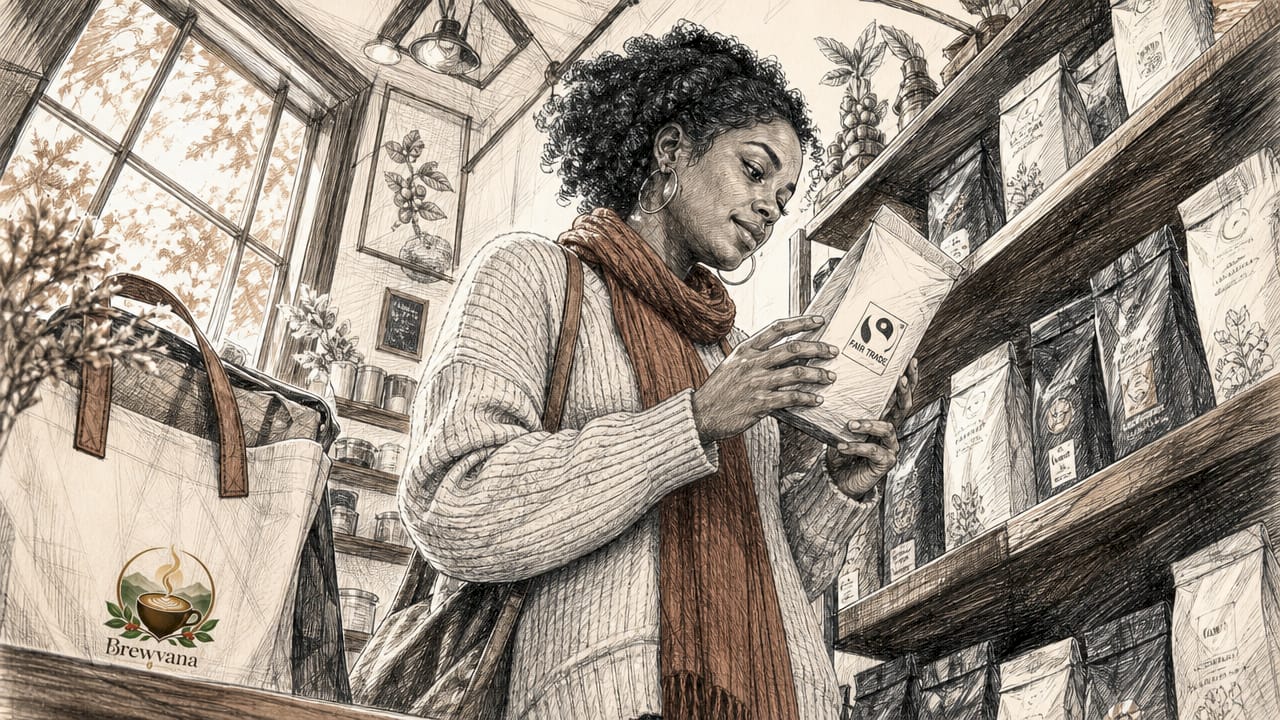
Rainforest Alliance focuses more heavily on environmental and social standards than on price guarantees. It audits farms for biodiversity protection, water management, and worker rights. Organic certification confirms no synthetic pesticides or fertilizers were used, which protects soil and ecosystem health. Many small farms actually meet organic standards in practice but cannot afford the certification process, so the absence of a label does not always mean the absence of the practice.
Here is a quick comparison of the major certifications:
| Certification | Price guarantee | Labor standards | Environmental focus | Auditing body |
|---|---|---|---|---|
| Fairtrade International | Yes ($1.80/lb floor) | Strong | Moderate | FLO-CERT |
| Fair Trade USA | Yes ($1.80/lb floor) | Moderate | Moderate | SCS Global Services |
| Rainforest Alliance | No | Strong | Strong | Rainforest Alliance |
| Organic (USDA) | No | Minimal | Strong (soil/water) | USDA-accredited certifiers |
| UTZ (merged with RA) | No | Moderate | Moderate | Rainforest Alliance |
The core limitation of all certifications is that auditing happens periodically, not continuously. A farm can pass an audit and still fall short between inspection cycles. Certifications are a strong starting point, not a guarantee. Treat them as one layer of evidence, not the whole story.
How direct trade differs from certification and why it matters
Direct trade is a sourcing model where a roaster buys coffee directly from a specific farm or cooperative, bypassing commodity brokers and certification bodies. It is relationship-based rather than rules-based, which is both its strength and its weakness.
The financial case for direct trade is compelling. Direct-trade roasters pay at least 25% above the Fair Trade minimum price to farmers, which creates real capacity for farm reinvestment and infrastructure improvements. That premium also incentivizes farmers to produce higher-quality, specialty-grade coffee, since the roaster is paying for specific flavor profiles and consistency. The traceability is tighter too. A direct-trade roaster typically knows the farm owner by name, visits regularly, and can tell you the elevation, processing method, and harvest date.
Watch for these red flags when a brand claims direct trade:
- No named farm, region, or cooperative on the packaging or website
- Price at or below commodity-grade levels for a “premium” product
- Vague language like “sourced responsibly” with no supporting detail
- No published sourcing reports or farm visit documentation
- Claims of direct trade on blends with no single-origin transparency
Pro Tip: Search the roaster’s website for a “sourcing” or “our farms” page. Legitimate direct-trade brands publish farm names, GPS coordinates, or at minimum the name of the cooperative and the country region. If that page does not exist, the claim is marketing, not sourcing.
Direct trade is not regulated, so any roaster can use the term. Your job is to verify the claim with specifics.
How to evaluate ethical sourcing beyond certifications
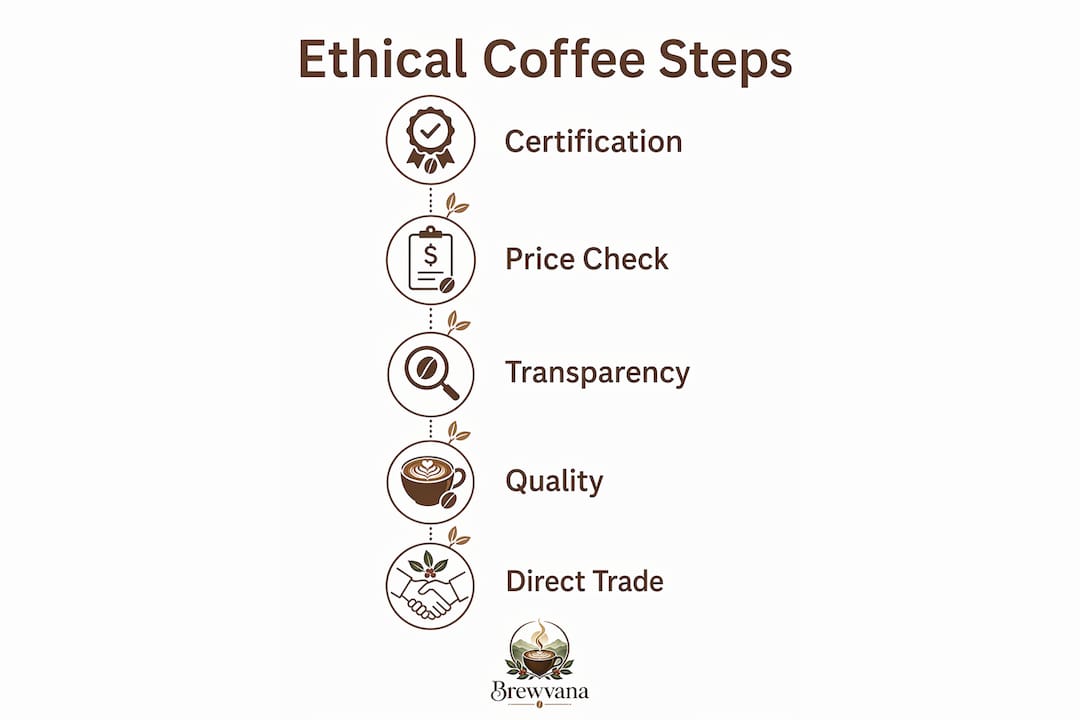
Price is the most honest signal you have. Coffee priced at commodity levels cannot support fair farmer payments, full stop. Specialty-grade ethical coffee typically retails between $16 and $22 per 12-ounce bag in 2026. If a bag claims ethical sourcing and costs $8, the math does not work. The retail price reflects the entire supply chain, and a low price almost always means someone upstream absorbed the cost.
Transparency in sourcing goes beyond a logo. Look for farm names, cooperative names, importer names, and ideally published audit reports. Some roasters now use digital lot codes that link to a sourcing page showing the farm, the harvest season, and the price paid. Blockchain technology is being piloted by several specialty importers to create tamper-proof documentation from farm to cup, making it harder to fabricate ethical claims.
Quality and ethics are closely linked. Specialty-grade coffee, scored 80 or above on the Specialty Coffee Association scale, requires careful farming, selective harvesting, and precise processing. These practices align directly with ethical labor standards, since they demand skilled workers paid fairly for their attention to detail. Learning to identify high-quality beans gives you a parallel track for assessing ethical sourcing.
Pro Tip: When you receive a bag, check for a roast date rather than a “best by” date. Roasters who print roast dates are signaling transparency and freshness standards. That same transparency mindset usually extends to their sourcing practices.
What are the environmental and social benefits of buying ethically sourced coffee?
The benefits of ethical coffee extend well beyond the cup. Ethical sourcing supports fair wages, safe working conditions, and environmental stewardship simultaneously, rather than trading one off against another. When all three pillars are active, the effects compound.
On the environmental side, farms operating under ethical standards typically avoid synthetic pesticides and practice shade-grown cultivation, which protects bird habitats and maintains soil biodiversity. Many farms meet organic-equivalent standards without formal certification because the cost of certification is prohibitive for smallholders. Shade-grown coffee also sequesters carbon and reduces erosion on steep hillsides, which is where most high-altitude specialty coffee is grown.
On the social side, the benefits are direct and measurable:
- Fair wages reduce dependence on child labor, which remains a documented problem in parts of West Africa and Southeast Asia
- Community premiums from Fair Trade certification fund school construction, clean water access, and healthcare clinics
- Premium certification programs incentivize farmers to adopt climate-resilient practices like drought-resistant varietals and water-efficient processing
- Women-led cooperatives, particularly in Ethiopia, Rwanda, and Colombia, receive targeted premiums from several specialty importers, improving gender equity in farming communities
- Stable, above-market pricing gives farmers the financial security to plan multi-year investments rather than reacting to commodity price crashes
The climate resilience angle deserves more attention than it typically gets. Coffee is one of the crops most vulnerable to rising temperatures and shifting rainfall patterns. Farmers who receive fair prices can afford to experiment with new varietals and processing methods, which is the only realistic path to long-term supply stability.
Step-by-step guide: how to choose ethically sourced coffee beans when shopping
Follow these steps every time you buy, whether online or in a specialty store:
- Check for certifications first. Look for Fairtrade International, Fair Trade USA, Rainforest Alliance, or USDA Organic seals. Note which certification body issued the seal, since standards differ.
- Research the brand’s sourcing page. Before purchasing, spend two minutes on the roaster’s website. Look for named farms, cooperatives, or importers. Brands committed to ethical sourcing publish this information because it is a selling point, not a liability.
- Evaluate the price. Specialty-grade ethical coffee costs more to produce. If the price seems too low for a claimed premium product, treat that as a red flag and investigate further.
- Look for named origins. Single-origin coffees with a named farm or cooperative are easier to verify than blends. A label reading “Colombia” is less informative than “Huila, Colombia, La Esperanza Cooperative.”
- Check for women-producer or social premium labels. Some roasters partner specifically with women-led cooperatives or fund specific community projects. These details signal deeper sourcing relationships.
- Assess freshness indicators. A roast date on the bag signals that the roaster values transparency. Ethical sourcing and quality standards tend to travel together in the specialty coffee world.
- Buy from roasters with a track record. Established specialty roasters with published sourcing reports and repeat farm relationships are lower-risk choices than brands making broad claims without documentation.
Conscious purchasing by consumers directly strengthens transparent, equitable trading relationships. Every bag you buy from a verified ethical source sends a market signal that fair practices are commercially viable.
Key takeaways
Choosing ethically sourced coffee requires verifying certifications, evaluating price relative to quality, and confirming sourcing transparency through named farms, cooperatives, and published documentation.
| Point | Details |
|---|---|
| Certifications are a starting point | Fair Trade, Rainforest Alliance, and Organic each cover different standards; use them as one layer of evidence. |
| Price signals ethics | Specialty-grade ethical coffee retails above $16 per 12-ounce bag; commodity-level pricing cannot support fair farmer pay. |
| Direct trade pays more | Direct-trade roasters pay at least 25% above Fair Trade minimums, enabling real farm investment. |
| Transparency is verifiable | Named farms, lot codes, and sourcing pages are concrete proof; vague claims without detail are marketing. |
| Buying ethical benefits ecosystems | Ethical farms protect soil, biodiversity, and water while building climate resilience for long-term supply stability. |
Brewvana’s take on the complexity of ethical coffee
Certifications are useful, but they are not the whole answer. After working closely with specialty coffee sourcing, the pattern that stands out most is the gap between what a label promises and what actually reaches the farmer. A Fair Trade seal guarantees a price floor, but it does not guarantee that the $0.20 community premium was spent on what the community actually needed. That gap is where direct trade relationships, when they are genuine, do their best work.
Price is the most honest signal in the market, and it is the one most consumers overlook. When a bag of “ethically sourced” coffee costs the same as a commodity blend, someone in the supply chain absorbed the difference. That someone is almost always the farmer. Paying more for verified ethical coffee is not a premium for your conscience. It is the actual cost of fair production.
The environmental angle also deserves more weight in purchasing decisions. Shade-grown, organic-equivalent farming is not just better for birds and soil. It produces more complex, higher-quality coffee. The farms doing the most careful environmental work are often the same ones producing the most interesting cups. Ethics and quality point in the same direction more often than the market suggests.
Supporting women-led cooperatives in Ethiopia, Rwanda, and Colombia is one of the highest-impact choices a consumer can make. These cooperatives consistently produce exceptional specialty-grade coffee and reinvest premiums directly into their communities. If a roaster lists women-producer partnerships on their sourcing page, that is a strong signal of genuine sourcing depth.
— Brewvana
Explore Brewvana’s ethically sourced coffee selection
Brewvana curates every coffee in its catalog with sourcing transparency as a non-negotiable standard. Each product listing includes origin details, processing method, and roast date, so you know exactly what you are buying and where it came from.
Browse Brewvana’s single-origin coffees to find traceable, specialty-grade beans from named farms and cooperatives across Ethiopia, Colombia, Peru, Bali, and beyond. If you want to explore multiple origins before committing, the sample pack collection lets you taste your way through ethically sourced options from different regions. Every purchase also supports Brewvana’s commitment to donating a portion of sales to local schools, so your morning cup contributes beyond the farm.
FAQ
What is ethical coffee sourcing?
Ethical coffee sourcing is the practice of buying coffee that meets fair economic, social, and environmental standards across the supply chain. It includes three core pillars: fair wages, safe working conditions, and environmental stewardship.
How do I know if a coffee brand is truly ethical?
Look for named farms or cooperatives on the packaging, published sourcing reports, and recognized certifications like Fairtrade International or Rainforest Alliance. Price is also a reliable indicator: genuine specialty-grade ethical coffee costs more to produce than commodity-grade alternatives.
Is direct trade better than Fair Trade certification?
Direct trade typically pays farmers at least 25% more than the Fair Trade minimum price and offers stronger traceability, but it is unregulated and requires verification. Fair Trade certification provides audited accountability but does not guarantee premiums reach individual farmers proportionally.
Does buying ethical coffee actually help farmers?
Yes. Conscious purchasing of certified and transparently sourced coffee enables fair wages and reinvestment in sustainable farming. Fair Trade community premiums fund schools, healthcare, and infrastructure in producing regions.
Why does ethical coffee cost more?
Ethical coffee reflects the true cost of fair production, including above-market prices paid to farmers, investment in sustainable farming practices, and certification or sourcing program fees. Coffee priced at commodity levels cannot support genuine fair-pay claims.