

Walk into any coffee shop or browse an online roaster, and you’ll find names like “blonde,” “city roast,” “Vienna,” and “French” sitting side by side with no real explanation of what they mean. Coffee roast levels explained clearly would solve a lot of confusion, because the terminology is notoriously inconsistent across the industry. Here’s what actually matters: roast level is the single biggest driver of what your cup tastes, smells, and feels like. And no, darker does not mean stronger in caffeine. This guide breaks down every major roast level, what happens to the bean during roasting, and how to choose the right roast for your brewing method and palate.
Table of Contents
- Key takeaways
- Coffee roast levels explained: the roasting process
- The main roast levels and their flavor profiles
- How roast level affects brewing
- Choosing the right roast for your taste and brewing method
- My take on roast levels after years of brewing
- Find your roast with Brewvana
- FAQ
Key takeaways
| Point | Details |
|---|---|
| Roast names are not standardized | The same roast can carry a dozen different names depending on the roaster. |
| Roast level shapes flavor completely | From bright and fruity in light roasts to smoky and bittersweet in dark roasts, roast determines taste. |
| Brewing parameters must match roast | Light roasts need hotter water and finer grinds; dark roasts extract faster and need cooler water. |
| Caffeine myth is widespread | Roast level does not significantly change caffeine content, despite what many people assume. |
| Sample packs are the smartest way to explore | Tasting multiple roast levels side by side is the fastest path to knowing your preferences. |
Coffee roast levels explained: the roasting process
Understanding what roasting actually does to a coffee bean is the foundation for everything else. Green coffee beans are dense, grassy, and completely undrinkable. Roasting transforms them through heat-driven chemical reactions that develop color, aroma, and all the flavors you associate with coffee.
The process moves through a predictable sequence of physical and chemical changes:
- Drying phase. The bean loses moisture rapidly in the first few minutes inside the drum roaster. This is purely evaporative and sets up the thermal conditions for what comes next.
- Yellowing phase. Beans turn from green to yellow as sugars begin to caramelize and the grassy smell gives way to something warmer, almost like bread.
- First crack. Around 196 to 205°C, the internal pressure from steam causes an audible cracking sound. At this point, the bean becomes porous and genuinely drinkable. Light roasts are pulled shortly after this milestone.
- Development phase. Between first and second crack, the roaster controls how much additional character develops. This is where medium and medium-dark roasts land.
- Second crack. This indicates darker territory. Cell walls begin to break down, oils migrate to the surface, and roast-derived flavors like smoke and char start to dominate.
Roasting typically lasts 8 to 15 minutes, with beans losing roughly 15% of their mass and gaining about 20% in volume. That mass loss is almost entirely water, which is why freshly roasted coffee needs a short rest before brewing.
Pro Tip: Pay attention to roast date, not just roast level. A light roast that’s three months old will taste flatter than a medium roast from two weeks ago. The roast date impact on flavor is just as significant as the roast level itself.
Modern roasters also use real-time data tools that track temperature curves and rate of rise to hit specific roast profiles with precision, which means the roast level on your bag reflects an intentional decision, not a guess.
The main roast levels and their flavor profiles
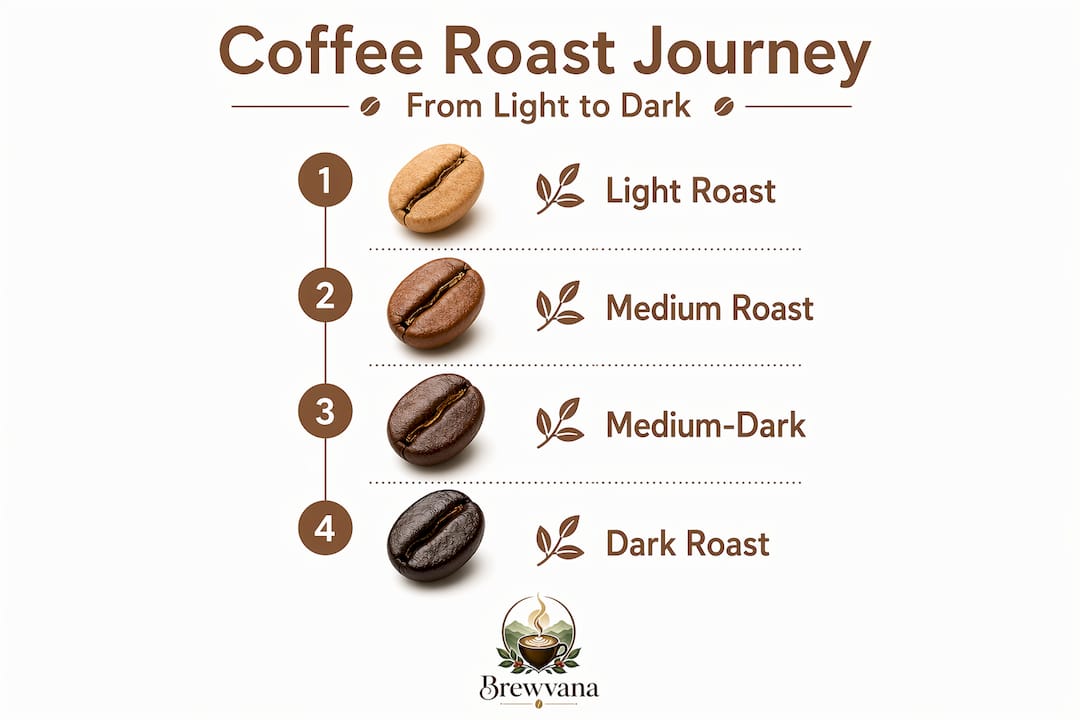
This is where coffee roast types get genuinely interesting and where most of the confusion lives. There is no universal standard for roast names, which means one roaster’s “dark roast” can be another’s “medium-dark.” What matters more than the label is the flavor description on the bag.
Here’s a breakdown of the four core categories most specialty roasters recognize:
| Roast Level | Surface | Flavor Notes | Acidity | Body |
|---|---|---|---|---|
| Light | Dry, light brown | Fruity, floral, citrus, tea-like | High | Light |
| Medium | Slightly oily, medium brown | Caramel, chocolate, balanced | Moderate | Medium |
| Medium-dark | Some oil, rich brown | Toasted nuts, dark fruit, mild bitterness | Low-moderate | Full |
| Dark | Very oily, dark brown to nearly black | Smoky, bitter, roasty, sometimes ashy | Low | Heavy |
Light roasts preserve the origin character of the bean most faithfully. Light roasts retain more fruity and floral characteristics, including bright citric notes and a tea-like delicacy you simply cannot get from a darker roast. Ethiopian single origins are a classic example: roasted light, they can taste like blueberries and jasmine. Push the same bean to dark, and that complexity disappears under smoke and bitterness.
Medium roasts hit the sweet spot for most drinkers. They balance origin and roast flavors in a way that feels approachable without being boring. You get caramel sweetness and gentle acidity without having to think too hard about what you’re tasting.
Medium-dark roasts start crossing into second crack territory. The body gets heavier, caramelized sugars become more prominent, and a subtle bitterness starts to develop. This is where roasts labeled “Full City” or “Vienna” often land.
Dark roasts are the most divisive category. Fans love the boldness; critics argue you’re mostly tasting the roast rather than the coffee. Both are correct, which is a matter of preference rather than quality.
Pro Tip: When trying a new roaster, skip straight to the flavor notes on the bag and ignore the roast label. A bag labeled “medium” with tasting notes of “dark chocolate and tobacco” is telling you more than the roast level ever could.
How roast level affects brewing
This is where understanding coffee roasting pays off in your actual cup. Roast level changes the physical structure of the bean, and that directly affects how you should grind, heat your water, and time your brew.
Light roasts are denser because less cell structure has broken down. This means:
- They resist extraction. You need a finer grind to increase surface area.
- They need hotter water, typically 94 to 96°C, to pull flavor efficiently.
- They benefit from longer brew contact, whether that’s a longer pour-over or a slower espresso pull.
- Under-extracting a light roast produces a sour, thin, underwhelming cup. It’s the most common mistake people make when brewing specialty single-origin beans.
Dark roasts are more porous and fragile. Their cell walls have partially broken down, so they extract much faster. Light roasts need hotter water while dark roasts extract best at cooler temperatures. Specifically:
- Use a coarser grind to slow extraction and avoid bitterness.
- Drop your brew water to 88 to 92°C.
- Shorten your brew time or you’ll pull harsh, bitter compounds quickly.
- Over-extracting a dark roast turns an already bold cup into something genuinely unpleasant.
Pro Tip: If your light roast tastes sour, grind finer or increase water temperature before you blame the bean. If your dark roast tastes burnt and bitter, coarsen the grind or lower the water temperature. Roast level and brewing variables work together, not independently.
The stakes with espresso are even higher. A 30-second pull is a tight window, and pulling a light roast at the same settings as a dark roast will produce radically different results. This is why many cafes use medium to medium-dark roasts as their espresso base. It gives them more forgiveness in the shot.
Choosing the right roast for your taste and brewing method
Now the practical part: which roast should you actually buy? The answer depends on three things: how you brew, what flavors you like, and what you’re using the coffee for.
Here’s a simple framework to follow:
- Pour-over and filter brewing: Go light to medium. These methods highlight delicate, nuanced flavors. A quality light roast from a single-origin Ethiopian or Kenyan bean will reward your attention with complexity that feels more like tea or fruit juice than stereotypical coffee.
- Drip machine: Medium is your safest starting point. Medium roasts are adaptable across brewing methods and tolerate the slightly imprecise water temperature of most home machines without punishing you.
- Espresso: Medium to medium-dark roasts are the industry standard for a reason. The higher body and lower acidity translate beautifully under pressure. If you add milk to your espresso drinks, medium-dark to dark roasts give you the boldness that cuts through the dairy.
- Cold brew: This is where darker roasts genuinely shine. Medium to dark roasts produce richer, smoother cold brew because the lower acidity and stronger body hold up through a 12 to 18-hour steep without becoming harsh. Light roasts can taste flat or underdeveloped in cold brew. For a deeper look at which beans work best, the cold brew bean guide on Brewvana’s site is worth a read.
- French press and stovetop brewing: Medium-dark to dark roasts pair naturally with these immersion methods. The heavier body and bold flavors are exactly what these brewing styles amplify.
One additional factor worth considering: bean processing methods also shape flavor alongside roast level. A natural-processed bean roasted light will taste very different from a washed bean at the same roast level. If you’re building genuine coffee knowledge, roast level and processing are two sides of the same coin.
My take on roast levels after years of brewing
I’ll say this plainly: roast labels have caused more confusion among coffee drinkers than almost anything else in this category. I’ve watched people avoid light roasts because they assumed dark meant stronger or better, then taste a well-sourced Ethiopian light roast and completely rethink their assumptions.
What I’ve learned from working with a lot of different coffees is that the label is almost irrelevant if you’re not also reading the flavor notes. A roaster who writes “bright lemon acidity, floral finish, stone fruit sweetness” on a bag is telling you everything you need to know, regardless of whether they call it light or medium. Trust that information over the category name.
The caffeine myth is worth addressing directly. Roast level barely changes caffeine content. By weight, the difference is negligible. By volume, a lighter roast might actually have a tiny bit more caffeine because the beans are denser and you fit more into a scoop. But for practical purposes, this should not factor into your roast selection at all.
My actual advice: buy a sample pack with at least three different roast levels and brew them the same way back to back. You’ll learn more about your preferences in one weekend than you will reading any guide, including this one.
— Kimberly
Find your roast with Brewvana
Knowing the difference between roast levels is genuinely useful. Putting that knowledge into practice is even better, and that starts with having quality beans across the spectrum to compare.
Brewvana’s full coffee collection covers everything from delicate light roasts to bold, oily dark roasts, all roasted to order so freshness is never a variable you have to worry about. If you’re not sure where your palate lands, the sample packs are the smartest way to explore. They’re designed exactly for this: tasting multiple roast levels side by side without committing to a full bag of each. For cold brew fans specifically, Brewvana’s cold brew coffee is already dialed in for that smooth, rich extraction that medium and dark roasts deliver best. And if you want something genuinely unexpected, the mushroom dark roast is worth trying for a full-bodied cup with an earthy, smooth character unlike anything in a standard lineup.
FAQ
What are the main coffee roast levels?
The four main roast levels are light, medium, medium-dark, and dark. Each produces a distinct flavor profile, from bright and fruity in light roasts to smoky and bold in dark roasts.
Does dark roast have more caffeine than light roast?
No. Roast level barely affects caffeine. By weight, the difference between light and dark roast caffeine content is negligible, making this one of the most persistent myths in coffee.
What roast is best for espresso?
Medium to medium-dark roasts are the standard for espresso because they produce the body, sweetness, and lower acidity that hold up well under pressure, especially in milk-based drinks.
What roast should I use for cold brew?
Medium to dark roasts work best for cold brew, producing a richer, smoother flavor during the long steeping process. Light roasts often taste flat or underdeveloped in cold brew.
Why do roast names vary so much between brands?
There is no industry-wide standard for roast names, so terms like “city roast,” “French,” or “blonde” mean different things to different roasters. Reading the tasting notes on the bag is a more reliable guide than the roast category name.