

Ethiopia produces 4% of the world’s coffee, every pound of it Arabica, and no other origin comes close to matching its genetic range. The best Ethiopian coffee beans are not a single variety or region. They are a spectrum. Yirgacheffe delivers the most recognizable profile: jasmine, bergamot, and a tea-like clarity that washed processing makes almost luminous. Harrar goes the opposite direction, wild and fruit-forward, with a blueberry intensity that natural drying amplifies into something almost jammy. Sidama (formerly Sidamo) sits between them, balanced and full-bodied. Guji has emerged as a powerhouse for stone fruit and floral complexity. Limu offers a quieter, spiced sweetness that rewards slower sipping. And for buyers who want consistency backed by agricultural science, JARC varieties 74110 and 74158 deliver high cup quality with the disease resistance that keeps yields reliable.
There is no single “best” Ethiopian coffee. The right choice depends on whether you want the clean brightness of a washed Yirgacheffe or the full-bodied fruit punch of a natural Harrar. What follows is a region-by-region breakdown, a processing guide, and the practical buying advice you need to find the right bag.
- Top regions: Yirgacheffe, Sidama, Harrar, Guji, Limu
- Best for floral/citrus: Yirgacheffe (washed)
- Best for fruit intensity: Harrar (natural)
- Best for stone fruit complexity: Guji (natural or washed)
- Best for balance: Sidama (washed)
- Expert-developed varieties: JARC 74110 and 74158
What makes each Ethiopian coffee region distinct?
Ethiopia’s coffee map is not uniform. Elevation, rainfall, soil type, and processing tradition vary so dramatically from east to west that a Harrar and a Yirgacheffe can taste like they come from different planets. Understanding the regions is the fastest way to stop buying coffee you do not love.
Yirgacheffe
Yirgacheffe started as a woreda (district) within the Sidama zone and earned its own appellation because its flavor profile was simply too distinct to lump in with the rest. Grown between 1,900 and 2,200 meters, it gets ample rainfall and a mild climate that slows cherry maturation and concentrates sugars. The result is bright acidity, pronounced floral notes, and a crisp, tea-like finish that no other region reliably produces. Most Yirgacheffe is washed, which strips the fruit pulp before drying and keeps the cup clean and transparent.
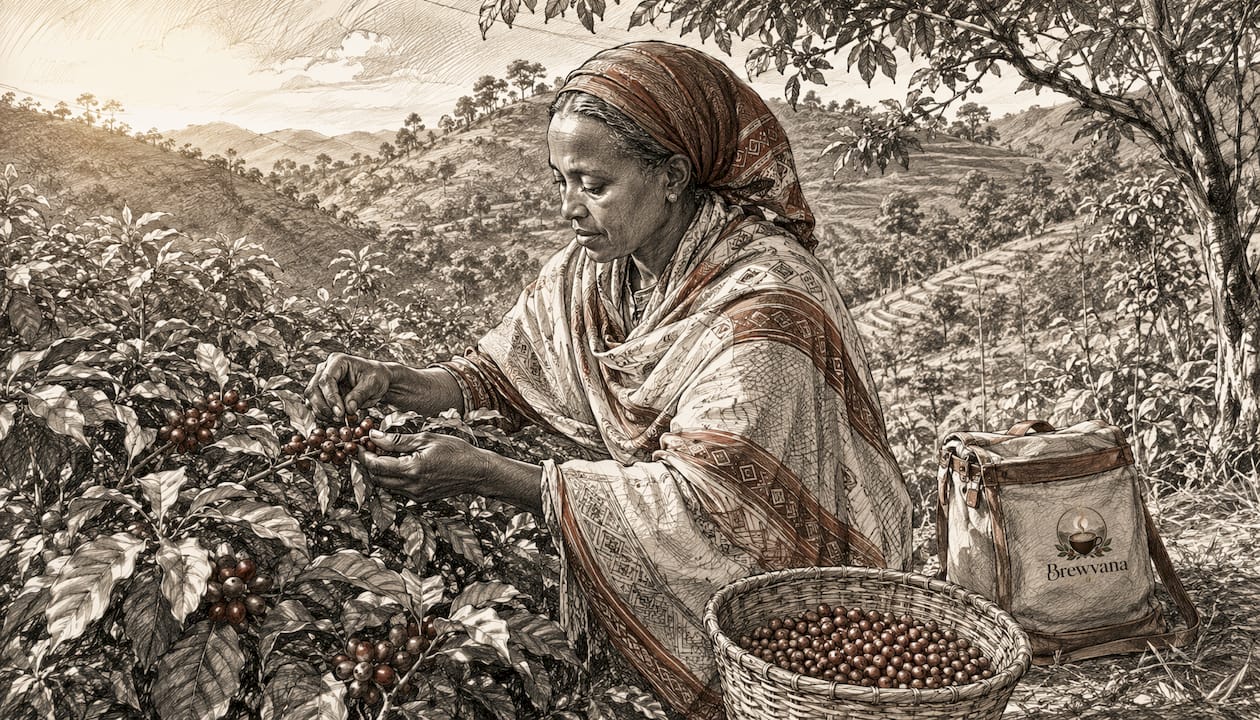
Pro Tip: If you are new to Ethiopian coffee, start with a washed Yirgacheffe. The clarity of the cup makes individual tasting notes far easier to identify than in a natural-processed coffee.
Sidama
Sidama’s high elevation (1,550 to 2,200 meters) and consistent rainfall create ideal Arabica conditions. A large proportion of Sidama coffee is washed, producing a crisp acidity and full body that many roasters describe as the most approachable of Ethiopia’s major regions. The name itself carries a correction worth knowing: “Sidamo” was a colonial-era misspelling dating to the 1880s. The region’s official name is Sidama, reflecting the identity of the people who grow the coffee.
Harrar
Harrar sits in eastern Ethiopia, far from the lush southern highlands, and it operates by different rules. Coffee here comes from wild native trees, dry processed on raised beds under the sun. That natural method lets the fruit sugars ferment into the bean, producing what specialty buyers call the “Blueberry Bomb” character: winey, heavy-bodied, with notes of blueberry, blackberry jam, and dark chocolate. Harrar was the gold standard for Ethiopian export quality in the 19th century, and its intensity still makes it a favorite addition to espresso blends.
Guji
Guji was once folded into the Sidama classification, but its volcanic soils and high diurnal temperature range produce a profile distinct enough to earn its own recognition. At 1,400 to 2,100 meters, Guji coffees show bright citrus and berry acidity alongside stone fruit sweetness, with peach and melon notes appearing frequently in both washed and natural lots. Specialty buyers have taken notice: Guji now regularly appears in high-scoring competition lots.
Limu
Limu grows in the western highlands at 1,200 to 1,900 meters and is almost exclusively wet processed. The cup is gentler than Yirgacheffe or Harrar, with floral and spicy undertones, mild citrus, and a smooth, rounded sweetness. Limu and Sidama share enough flavor overlap that roasters sometimes use them interchangeably in blends, though Limu tends to carry a slightly more pronounced spice note.
How processing shapes the Ethiopian coffee flavor profile
Processing is the single biggest lever a producer pulls after harvest, and in Ethiopia it separates two entirely different drinking experiences. Understanding washed versus natural processing is not optional knowledge for anyone serious about buying Ethiopian coffee.
Washed (wet) process:
- Fruit pulp is removed via water and fermentation tanks before drying
- Flavor: clean, high acidity, floral, tea-like, light to medium body
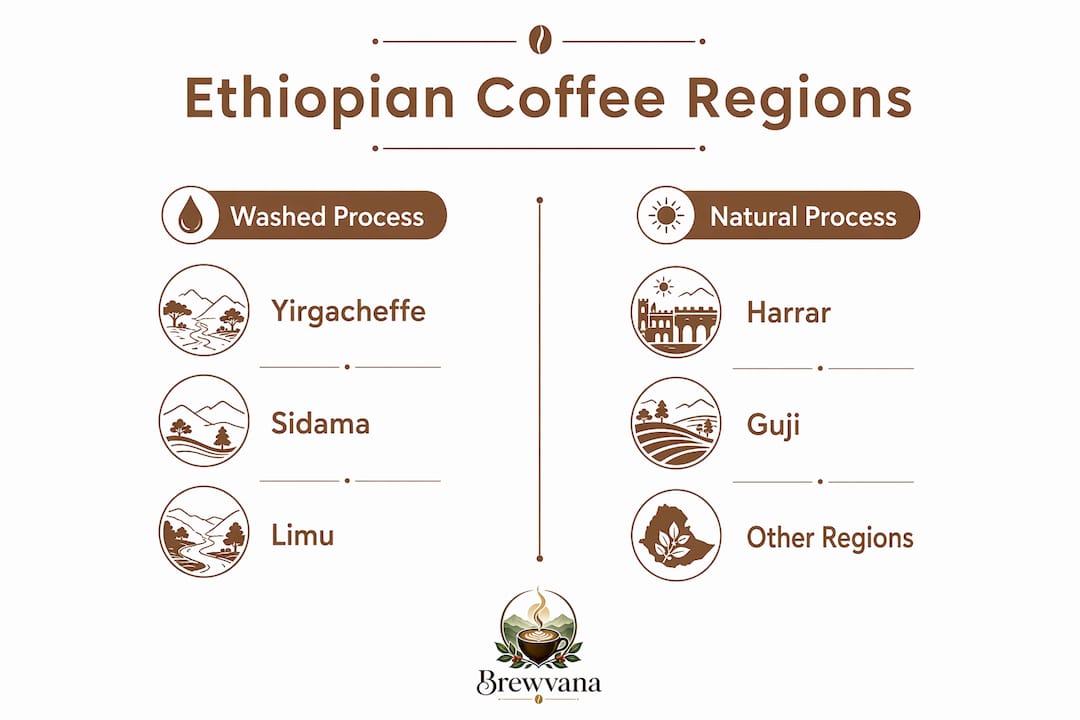
- Dominant regions: Yirgacheffe, Sidama, Limu
- Tasting notes: jasmine, bergamot, lemon, chamomile, peach
Natural (dry) process:
- Whole cherry dries on raised beds in the sun, fruit intact
- Flavor: sweet, fruit-forward, winey, heavy body
- Dominant regions: Harrar, Guji (often), Jimma
- Tasting notes: blueberry, blackberry jam, dark chocolate, stone fruit, melon
The washed process produces clean, high-acidity cups with floral notes, while natural processing yields sweeter, fruit-forward coffees with a heavier body. That contrast is not subtle. A washed Yirgacheffe and a natural Harrar are as different as white wine and port.
| Aspect | Washed process | Natural process |
|---|---|---|
| Flavor | Clean, floral, bright acidity, tea-like | Sweet, fruity, winey, heavy body |
| Body | Light to medium | Full, syrupy |
| Common regions | Yirgacheffe, Sidama, Limu | Harrar, Guji |
| Key tasting notes | Jasmine, bergamot, citrus, chamomile | Blueberry, blackberry, dark chocolate, peach |
| Processing risk | High water usage | Mold risk if not turned regularly |
| Price impact | Grade 1 commands premium for sorting labor | Natural Grade 1 also premium; less water cost |
Grading matters here too. Grade 1 allows for almost zero primary defects and commands a significantly higher price than Grade 3, particularly for washed Yirgacheffe where the sorting labor is intensive. When you see “Grade 1” on a bag, it is a real quality signal, not marketing language.
Notable Ethiopian coffee varieties: heirlooms, Gesha, and JARC selections
Ethiopia’s genetic depth is unlike any other coffee origin. The Ethiopian Heirloom classification covers thousands of genetically diverse landraces adapted to specific microclimates, most of them never formally cataloged. When a bag says “Ethiopian Heirloom,” it is not a single variety. It is a shorthand for a vast, largely unclassified genetic pool that produces terroir-specific flavors no other country can replicate. Estimates put the number of distinct varieties growing wild in the Ethiopian highlands somewhere between 6,000 and 10,000.
Within that pool, a few named varieties stand out:
- Kurume: Common in Sidama and Yirgacheffe, known for jasmine and bergamot aromas, bright acidity, and a clean finish.
- Welicho: Found in Sidama, fuller-bodied than Kurume, with red berry and stone fruit notes and good disease resilience.
- Dega: Thrives at high altitudes in Yirgacheffe and Sidama, producing apricot, peach, and melon notes with a tea-like body.
Then there is the Gesha question. Gesha (spelled with an “a”) is a native Ethiopian variety from the Gori Gesha forest in the Bench Sheko zone. Geisha (spelled with an “i”) refers to the same genetic material after it traveled to Panama and was cultivated into the auction-record-setting variety the specialty world obsesses over. Distinguishing Gesha from Geisha by spelling and origin is not pedantry. It traces provenance, which directly affects both flavor expectations and market value. An Ethiopian Gesha and a Panamanian Geisha are related but not identical in cup character.
JARC varieties 74110 and 74158
The Jimma Agricultural Research Center (JARC) developed selections from local landraces specifically matched to Ethiopia’s agro-forestry zones. These are not hybrids. They are carefully chosen plants from existing genetic material, selected for yield, disease resistance, and cup quality. JARC varieties 74110 and 74158 offer consistent, high-quality profiles that balance all three. Among the JARC selections, 74110 and 74158 are the most recognized, noted for floral clarity, fruit-forward sweetness, and natural balance that has earned them high scores in international competitions. Specialty buyers increasingly seek them out precisely because the consistency they deliver is rare in a country where most coffee grows from unclassified heirloom stock.
Why Ethiopia’s coffee history still shapes what’s in your cup
Ethiopia is the birthplace of Coffea arabica. That is not a marketing claim. Ethiopia and the Boma Plateau of Sudan are the origin of Coffea Arabica, the species that accounts for the vast majority of the world’s specialty coffee. Every Arabica bean grown in Colombia, Guatemala, or Indonesia traces its genetic ancestry back to Ethiopian forests.
The traditional Ethiopian coffee ceremony is not a tourist attraction. It is a daily social ritual in which green beans are roasted over charcoal, ground by hand, and brewed in a clay pot called a jebena, then served in three rounds. Each round has a name: Abol, Tona, and Baraka. The ceremony can take an hour or more and functions as a community gathering. That relationship between coffee and social life has shaped how Ethiopian farmers approach the crop for centuries.
Harrar’s historical significance runs deep. It was the premier Ethiopian export coffee in the 19th century, traded through the port of Djibouti and prized by European buyers for its intensity. The renaming of Sidamo to Sidama reflects something more recent: a formal recognition of the Sidama people’s ethnic identity and the region’s updated geopolitical boundaries, formalized when Sidama became Ethiopia’s tenth regional state in 2020. For informed coffee buyers, using the correct name is a small act of respect for the people who grow the coffee.
Farming practices in Ethiopia remain largely traditional. Most coffee grows under shade trees in garden or forest systems, which supports biodiversity and often meets organic standards without formal certification. That farming context connects directly to the flavor complexity that makes Ethiopian coffee so sought after globally.
How to find and buy the best coffee beans from Ethiopia in the U.S.
Buying Ethiopian coffee in the U.S. market is easier than it was a decade ago, but the quality gap between a well-sourced bag and a generic supermarket offering is enormous. A few specific criteria separate the good from the great.
Start with region and processing. Know what you want before you buy. Washed Yirgacheffe for floral brightness, natural Harrar for fruit intensity, Guji for stone fruit complexity. Vague “Ethiopian blend” labels with no regional specificity are a red flag.
Check the grade. Grade 1 or Grade 2 beans are the standard for specialty coffee. Grade 1 allows for almost zero primary defects. If a bag does not list a grade, the seller likely does not know or does not want you to know.
Verify the roast date. Freshness is not optional. Ethiopian coffees, especially washed lots, lose their floral and citrus notes quickly after roasting. Look for a roast date on the bag, not just a “best by” date. Aim to brew within four to six weeks of roast.
Understand roast level’s impact. Light and medium roasts preserve the origin character that makes Ethiopian coffee worth buying. A dark roast will push those jasmine and bergamot notes into the background and replace them with roast-driven bitterness. For ethically sourced single-origin Ethiopian coffees, a light or medium roast is almost always the better choice.
Storage matters more than most buyers realize. Keep beans in an airtight container away from light, heat, and moisture. Do not refrigerate whole beans. The freezer works for long-term storage only if the bag is completely sealed and you are not opening it repeatedly.
Brewing methods that highlight Ethiopian flavors:
- Pour-over (V60, Chemex): The best format for washed Yirgacheffe and Sidama. The slow, controlled extraction keeps the cup clean and lets floral notes shine.
- AeroPress: Works well for Guji and Sidama, producing a concentrated cup with good body.
- French press: Suits natural Harrar well. The full immersion and metal filter let the heavy body and fruit notes come through without over-filtering.
- Espresso: Harrar is a classic espresso blend addition for its deep fruit notes. Washed Yirgacheffe as espresso is more unusual but produces a bright, complex shot.
Pro Tip: For washed Ethiopian coffees, use water around 200°F (just off boil) and a medium-fine grind. Cooler water and a coarser grind tend to mute the floral notes that make these beans worth buying.
When sourcing online, look for roasters who list the specific woreda or washing station alongside the region. “Yirgacheffe” alone is broad. “Yirgacheffe, Gedeb woreda, Halo Bariti washing station” tells you the producer knows the supply chain. For organic whole bean options, roasted organic whole beans from verified sources are worth comparing against single-origin specialty lots for value and freshness. The Arabica varietal flavor guide at Brewvana is also a useful reference for understanding how Ethiopian varieties compare to other Arabica origins before you commit to a bag.
Brewvana’s Ethiopian coffee selection is worth your attention

If you have read this far, you already know more about Ethiopian coffee than most buyers. The next step is finding a roaster who matches that knowledge with sourcing discipline. Brewvana roasts to order, which means the bag you receive was not sitting in a warehouse for three months before it reached your door. For Ethiopian coffees specifically, that freshness gap is the difference between a cup that tastes like jasmine and one that tastes like cardboard.
Brewvana’s light roast collection is where washed Yirgacheffe and Sidama shine, preserving the floral and citrus notes that make these origins worth the price. For natural-processed lots with more body, the medium roast options hit the right balance between origin character and roast development. And if you want to explore Ethiopian beans alongside other single-origin coffees, the full coffee collection gives you a range to work through at your own pace. Every purchase also supports local schools through Brewvana’s community giving program. Browse the current selection and order a freshly roasted bag this week.
Key Takeaways
Ethiopia’s best coffee beans are defined by region and processing method, with Yirgacheffe’s washed floral brightness and Harrar’s natural fruit intensity representing the two poles of what this origin can deliver.
| Point | Details |
|---|---|
| Region determines flavor | Yirgacheffe is floral and citrus-forward; Harrar is winey and fruit-heavy; Guji offers stone fruit complexity; Sidama delivers balance. |
| Processing is the biggest variable | Washed coffees are clean and bright; natural-processed coffees are sweet, full-bodied, and fruit-forward. |
| Grade signals quality | Grade 1 allows for almost zero primary defects and is the standard for specialty Ethiopian coffee worth buying. |
| JARC varieties add consistency | JARC selections 74110 and 74158 combine disease resistance with high cup quality, making them reliable picks for specialty buyers. |
| Brewvana roasts to order | Freshly roasted Ethiopian beans from Brewvana preserve the floral and citrus notes that make this origin exceptional. |