

Bean density is defined as the weight of green coffee relative to its volume, and it directly controls how heat moves through the bean during roasting. Specialty coffee beans range from 300 to 700 g/L, a span wide enough to demand fundamentally different roasting approaches. The role of bean density in roasting is not a secondary concern. It governs heat transfer speed, first crack timing, and the final flavor clarity in your cup. Roasters who treat density as a fixed quality label rather than a thermophysical variable consistently produce uneven results, regardless of how good their equipment is.
How does bean density affect heat transfer and roasting profiles?
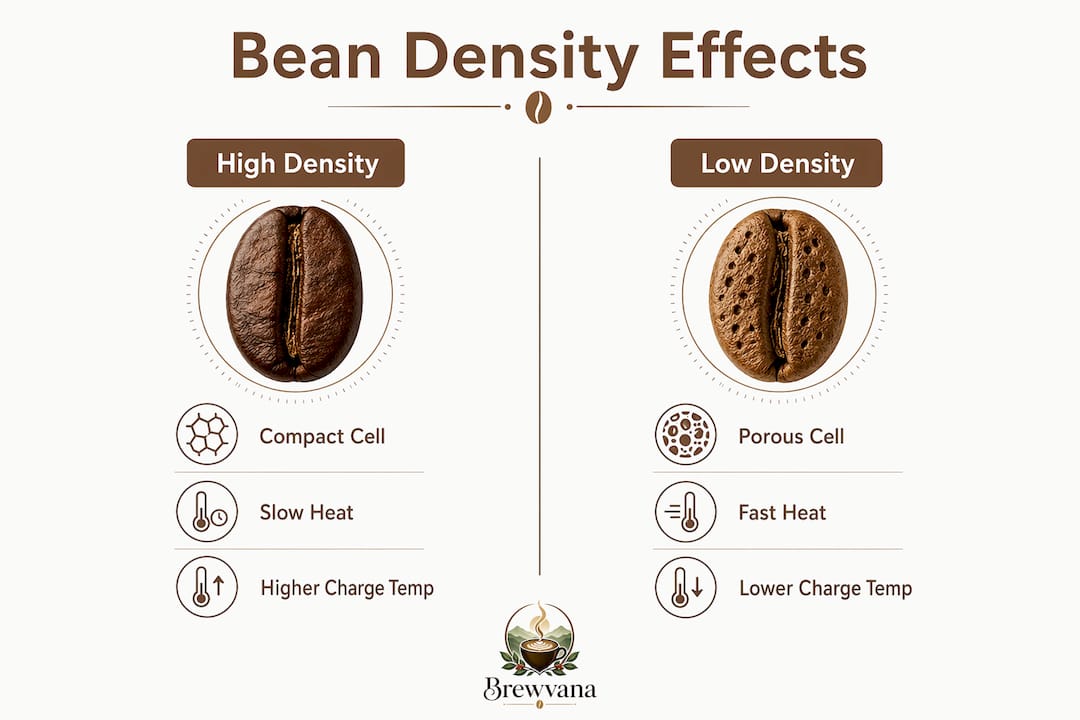
Dense beans have compact cellular structures that slow heat penetration from the drum surface to the bean’s core. This means the outer layer absorbs energy faster than the interior can respond. The result is a lag between surface temperature and core temperature that roasters must account for from the moment the beans hit the drum.
Low-density beans, by contrast, are more porous. Heat moves through them quickly, which sounds like an advantage until you realize that speed creates its own problem. Without careful management, the surface scorches before the interior has time to develop. Low-density beans need gentler, more controlled heat to avoid this outcome.
The concept of energy momentum matters here. Momentum in a roast is not just about how much heat you apply. It is about how the bean stores and releases that energy across roast stages. Dense beans affect energy storage and release, shifting first crack timing and the rate at which the roast accelerates. A roaster who ignores this will see stalling or runaway development and wrongly blame the machine.
| Trait | High-density beans | Low-density beans |
|---|---|---|
| Cellular structure | Compact, slow heat penetration | Porous, fast heat penetration |
| Initial heat need | Higher charge temperature | Lower, gentler heat input |
| First crack timing | Later, more gradual | Earlier, faster |
| Scorching risk | Lower at surface | Higher without careful control |
| Flavor potential | High clarity and complexity | Muted if undermanaged |
Pro Tip: Watch your drum temperature in the first 90 seconds after charge. A flat or sluggish temperature curve on a high-density lot means your charge temperature is too low. Correct it on the next batch, not mid-roast.
What adjustments should roasters make based on bean density?
Charge temperature is the first variable to adjust. A 40–50 g/L difference in density calls for a 10–15°F shift in charge temperature to keep development consistent. That is not a trivial change. For a roaster moving from a soft Central American bean at 620 g/L to an Ethiopian natural at 680 g/L, the charge temperature needs to go up, and the early roast energy must be sustained longer.
Beyond charge temperature, roasters should adjust these parameters when density changes:
- Airflow: High-density beans benefit from slightly reduced airflow in the early phase to retain heat around the bean surface. Open airflow too early and you pull heat away before the core has absorbed enough energy.
- Drum speed: Faster drum rotation increases convective heat transfer. For dense beans, a moderate increase in drum speed during the drying phase helps distribute heat more evenly.
- Development time ratio: Dense beans need a longer development window after first crack to allow the core to finish. Cutting development short produces underdeveloped interiors even when the surface color looks correct.
- Batch sorting: Sorting green coffee by screen size and density prevents mixed batches from producing uneven results. Dense beans in the same batch as soft beans will be underdeveloped while the soft beans overdevelop.
The impact of bean density also shows up in how you read roast color. A dense bean at the same surface color as a soft bean is almost always less developed at its core. Color alone is not a reliable endpoint for high-density lots.
Pro Tip: Avoid overcorrecting by raising charge temperature too aggressively for dense beans. A 5°F increment between batches is safer than a 20°F jump. Overcorrection causes scorching on the outer layers before the core catches up.
How does bean density influence flavor profiles and coffee quality?
High-density beans tolerate sustained Maillard development, which is the browning reaction responsible for sweetness and complexity. When roast energy is managed properly, these beans produce cups with clear acidity, layered sweetness, and structural complexity. That is why high-altitude single-origin coffees from Ethiopia or Colombia consistently score well in specialty cupping.
Bean density correlates with altitude and varietal. High-altitude beans above 680 g/L tend to deliver more balanced acidity and flavor clarity. Lower-altitude beans below 640 g/L are softer, roast faster, and require a different energy strategy to avoid flat or muddy cups. Understanding how altitude shapes flavor gives roasters a useful framework for predicting density before they even measure it.
Low-density beans are not inferior by nature. They can produce excellent cups when roasted with appropriate care. The problem arises when roasters apply a high-density profile to a soft bean. The result is a scorched exterior, an underdeveloped core, and a cup that tastes simultaneously bitter and flat.
Key flavor outcomes tied to density management:
- Clarity: High-density beans roasted with proper development produce cleaner, more defined flavor notes.
- Sweetness: Sustained Maillard development in dense beans builds caramelization without tipping into bitterness.
- Acidity: Dense beans from high altitudes retain bright, structured acidity when not over-roasted.
- Complexity: The compact cellular structure of dense beans holds more soluble compounds, which extract as layered flavor in the cup.
Density is not a quality guarantee on its own. Roasters use density for lot evaluation and roast control, not as a direct predictor of cup score. A dense bean from poor processing will still taste poor.
What are common challenges and mistakes roasters face with bean density?
The most common mistake is treating density as a static quality label. Roasters see a high-density reading and assume the bean will behave predictably. Two beans with identical density readings can behave differently due to moisture content, water activity, and storage conditions. A bean stored in a humid warehouse for six months will not roast the same as a freshly milled bean at the same density.
Ignoring density leads roasters to blame equipment for stalling or scorching that is actually caused by misaligned energy input. A roast that stalls at 300°F is not a drum problem. It is a charge temperature problem caused by underestimating the bean’s resistance to heat penetration.
Mixed-density batches are another consistent source of failure. When a batch contains beans across a wide density range, the soft beans overdevelop while the dense beans stay underdeveloped. The cup tastes uneven because it is uneven. Sorting by density before roasting is not optional for quality-focused operations.
Additional challenges roasters face:
- Moisture variability: Green coffee moisture content affects how beans respond to heat, independent of density. Beans at 12% moisture behave differently from beans at 10% moisture even at the same g/L reading.
- Storage degradation: Long storage reduces water activity and changes how beans absorb energy. A density reading taken at origin may not reflect the bean’s behavior six months later.
- Seasonal variation: Beans from the same farm and varietal can vary in density between harvests due to rainfall, soil conditions, and processing differences.
The fix for all of these challenges is consistent measurement combined with sensory feedback. Density data without roast logging and cupping notes is incomplete information.
How can roasters measure and integrate bean density into their workflow?
Measuring bean density is straightforward. The most practical method for small to mid-scale roasters is the weight-to-volume ratio: fill a known-volume container with green coffee, weigh it, and divide weight by volume. This gives you g/L. Displacement methods using water are more accurate but less practical in a production environment.
Once you have a density reading, integrate it into your workflow with these steps:
- Record density at intake. Log the g/L reading for every green coffee lot when it arrives. This becomes the baseline for charge temperature decisions.
- Sort by density and screen size. Sorting by both screen size and density before roasting prevents uneven heat absorption across a batch.
- Set charge temperature by density tier. Group your lots into density tiers (for example, below 640 g/L, 640–680 g/L, above 680 g/L) and assign a starting charge temperature range to each tier.
- Monitor Rate of Rise in the first 120 seconds. RoR in the first 2 minutes after drop tells you whether your charge temperature matches the bean’s density. A slow RoR on a dense bean means you need more initial heat.
- Log and cup every batch. Connect density data to sensory outcomes over time. Patterns will emerge that let you refine profiles for each origin and lot.
Pro Tip: Use your first-minute RoR as a live density check on every roast. If the RoR for a new lot does not match your expected curve for that density tier, adjust charge temperature on the next batch before committing to a full production run.
Key Takeaways
Bean density is a thermophysical constraint that governs heat transfer, roast timing, and flavor development, and roasters who measure and apply it consistently produce better cups.
| Point | Details |
|---|---|
| Density range matters | Specialty beans span 300–700 g/L, requiring distinct charge temperatures and energy strategies. |
| Adjust charge temperature | A 40–50 g/L density difference calls for a 10–15°F charge temperature shift to maintain development. |
| Sort before roasting | Mixing densities in one batch causes simultaneous underdevelopment and overdevelopment. |
| Monitor RoR early | Rate of Rise in the first 2 minutes confirms whether charge temperature matches bean density. |
| Density is not quality alone | Moisture, water activity, and storage all affect roasting behavior independent of density readings. |
Density is a tool, not a shortcut
Brewvana has spent years sourcing beans from high-altitude origins across Colombia, Ethiopia, and Peru. The consistent lesson is that density data is only as useful as the roaster’s willingness to act on it. A g/L number sitting in a spreadsheet does nothing. The same number paired with a charge temperature adjustment, a sorted batch, and a post-roast cupping note is a genuine process improvement.
The roasters who get the most out of high-density beans are not the ones who simply crank up the charge temperature. They are the ones who watch the drum, track the RoR, and cup every batch with the density reading in front of them. Density is a thermophysical constraint that governs energy, airflow, and time. Treat it as a dynamic variable, not a fixed label.
The uncomfortable truth is that most roast failures attributed to equipment or green coffee quality are actually density management failures. The bean told you what it needed. The charge temperature, airflow, and development time did not listen. Fixing that gap does not require new equipment. It requires better observation and a willingness to adjust based on what the data and the cup are telling you together.
— Brewvana
Brewvana beans built for density-aware roasting
Brewvana sources single-origin coffees with consistent density profiles, so roasters and enthusiasts get predictable behavior from batch to batch. Every lot is roasted to order, which means you receive beans at peak freshness rather than beans that have been sitting in a warehouse losing water activity.

The Colombia single-origin is a strong starting point for roasters working with high-density profiles. Grown at altitude, it delivers the compact cellular structure that rewards careful Maillard development with bright acidity and layered sweetness. For roasters who want to compare density effects across origins, the single-origin sample pack includes multiple lots with distinct density characteristics. Each one gives you a direct, side-by-side look at how density shapes the cup.
FAQ
What is bean density in coffee roasting?
Bean density is the weight of green coffee per unit of volume, measured in grams per liter (g/L). It determines how quickly heat penetrates the bean and directly influences charge temperature, roast timing, and flavor development.
Why do high-density beans need more heat?
High-density beans have compact cellular structures that slow heat penetration to the core. Roasters must apply higher initial heat and sustain energy longer to achieve even development throughout the bean.
How does density affect cup flavor?
High-density beans roasted with proper energy management produce cups with clear acidity, structured sweetness, and complexity. Low-density beans roasted with the same profile risk scorching and flat flavor.
Can two beans with the same density roast differently?
Yes. Moisture content, water activity, and storage conditions all affect roasting behavior independent of density. Two beans at the same g/L reading can behave differently if their moisture levels or storage histories differ.
How do roasters measure bean density practically?
The most common method is the weight-to-volume ratio: fill a container of known volume with green coffee, weigh it, and divide weight by volume to get g/L. This reading then guides charge temperature and batch sorting decisions.