

Coffee cupping is the standardized sensory evaluation method professionals use to assess a coffee’s intrinsic quality, origin characteristics, and consistency by tasting it without filters or brewing pressure. The process strips away the variables of your usual brewing setup so you can taste the coffee itself, not the method. Here is what a cupping session involves:
- Grinding coffee to a medium-coarse consistency and measuring a precise coffee-to-water ratio
- Pouring hot water directly over the grounds in small cups, letting a crust of grounds form on top
- Smelling the dry grounds (fragrance) and then the wet coffee after pouring (aroma)
- Breaking the crust, skimming off the grounds, and tasting by slurping from a spoon
- Scoring attributes like acidity, body, sweetness, flavor, and aftertaste using a standardized sheet
The Specialty Coffee Association (SCA) publishes the protocols most professionals follow, making cupping a shared language across the global coffee industry. Whether you are a roaster dialing in a new origin or a curious enthusiast building your palate, the process is the same.
Who cups coffee and why it matters
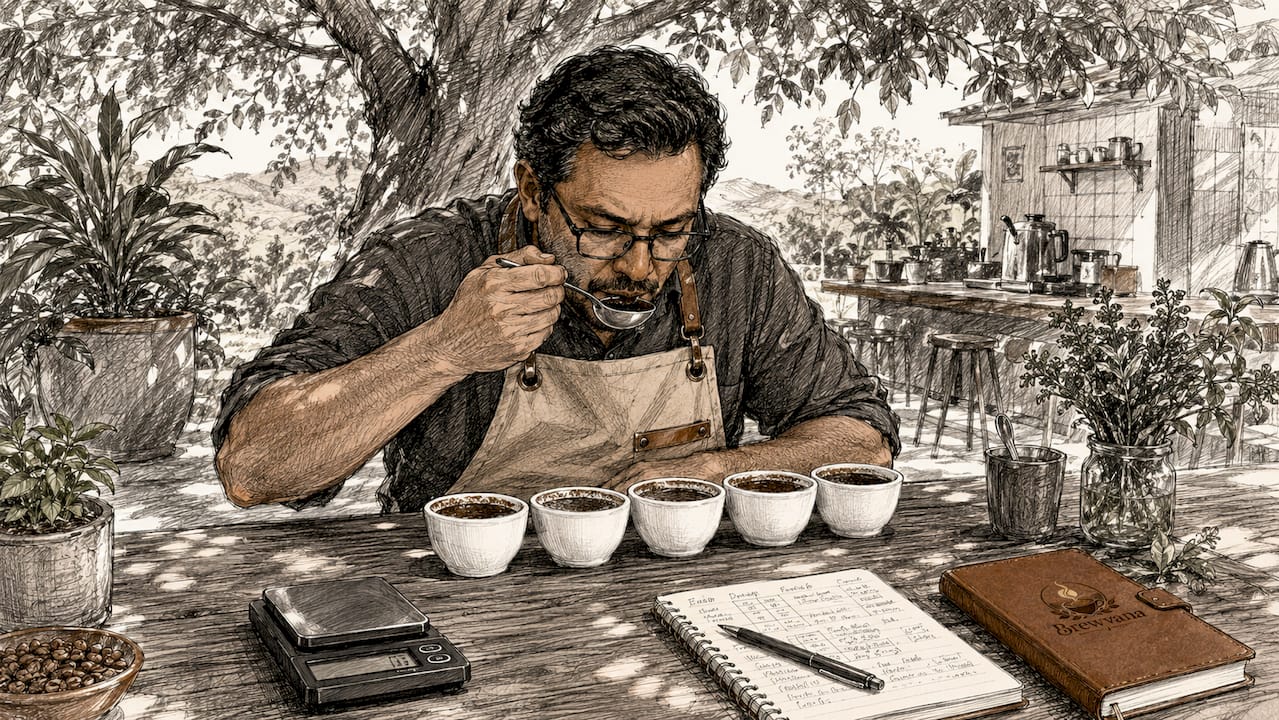
Cupping sits at the center of nearly every professional coffee decision. Roasters cup to check consistency between batches and to develop roast profiles. Green coffee buyers cup dozens of samples before committing to a purchase. Quality control managers cup to catch defects before a lot ships. Traders and importers use it to verify that what arrives matches what was promised at origin.
Farmers cup their own harvests to understand how processing choices affect flavor. Baristas cup to connect what they taste in the cup with what they dial in on the espresso machine. The goals differ, but the method stays consistent.
- Roasters cup to verify batch consistency and refine roast development
- Buyers and traders cup to make purchasing decisions based on flavor and quality
- Quality controllers cup to detect defects, off-notes, or storage damage before a lot moves
- Baristas cup to sharpen their palate and understand how origin flavors translate to espresso or filter
- Enthusiasts cup to train their senses and learn to distinguish origins, processing methods, and roast levels
Cupping also catches problems that would otherwise slip through. A lot stored improperly can develop musty or fermented notes detectable only through careful tasting. Catching that at the cupping table saves money and protects a roaster’s reputation.
How to conduct a coffee cupping session
The SCA cupping standard specifies a medium-coarse grind, a precise coffee-to-water ratio, and water poured at approximately 93°C ± 3°C (roughly 200°F). Follow these steps to run a session correctly.
- Grind fresh. Use a medium-coarse grind, similar to coarse sea salt. Grind each sample immediately before the session to preserve volatile aromatics.
- Measure your ratio. The SCA protocol calls for a specific coffee-to-water ratio. Weigh both your coffee and water rather than estimating by volume.
- Smell the dry grounds. Before adding water, bury your nose in each cup and inhale. This is the fragrance stage, and it captures aromatic compounds that disappear once water hits the grounds.
- Pour the water. Pour hot water (around 93°C) directly over the grounds in a slow, even pour. Start a timer.
- Evaluate the aroma. As the crust forms, lean in and smell each cup. The fragrance and aroma stages are distinct: dry grounds smell different from wet coffee, and both tell you something about the coffee’s character.
- Break the crust. At around four minutes, use a spoon to push through the crust on each cup with three gentle strokes. Lean in and smell as you break it. The crust releases a concentrated burst of aroma.
- Skim the grounds. Use two spoons to remove the floating grounds and foam from each cup. This keeps the tasting surface clean.
- Wait before tasting. Let the cups cool before you start sipping. High temperatures numb your taste buds and mask subtle notes. Waiting until the coffee feels comfortably warm rather than hot gives you a much clearer picture.
- Slurp from a spoon. Fill a cupping spoon and slurp forcefully. Slurping atomizes the coffee, spraying it across the entire palate and engaging more taste receptors than a normal sip would.
- Spit, don’t swallow. Use a spittoon. Cupping sessions often involve multiple samples, and swallowing every sip leads to over-caffeination and a dulled palate fast.
- Score each attribute. Work through fragrance, aroma, flavor, aftertaste, acidity, body, balance, sweetness, uniformity, and clean cup. The SCA scoring sheet gives each attribute a numerical value, and scores above 80 points qualify a coffee as specialty grade.
- Clean your spoon between samples. Rinse in water between each cup to avoid carrying flavors from one sample into the next.
- Taste again as it cools. Flavors shift as coffee cools. A coffee that tasted flat at high temperature may reveal bright fruit or floral notes once it drops further.
Pro Tip: Start your tasting passes at the warmest comfortable temperature and return to each cup two or three times as it cools. Some of the most interesting flavor notes, particularly delicate florals and stone fruit, only become clear once the coffee drops well below serving temperature.
How cupping differs from regular coffee tasting
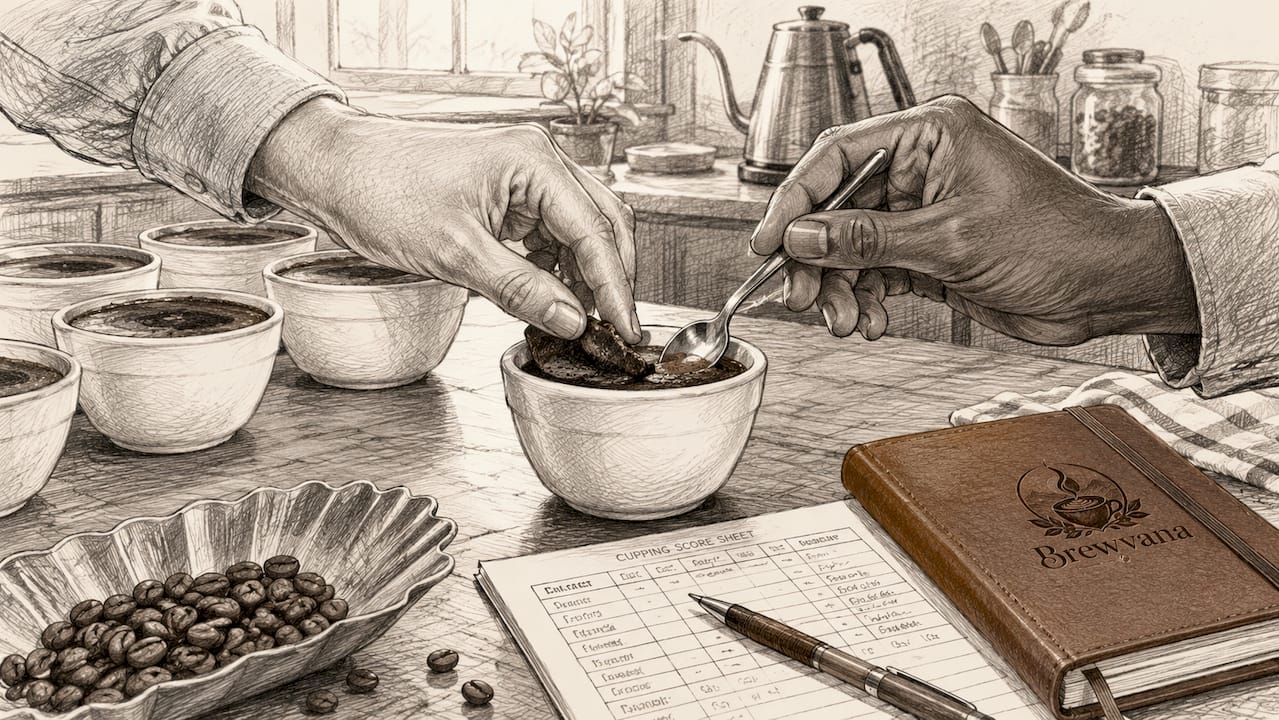
Cupping is not just a fancy version of drinking coffee and noticing what you taste. The method is deliberately stripped down to remove the influence of brewing equipment, extraction variables, and serving style.
| Factor | Coffee cupping | General coffee tasting |
|---|---|---|
| Brewing method | No filter, no pressure, direct immersion | Espresso, pour-over, French press, etc. |
| Purpose | Isolate intrinsic coffee attributes | Evaluate a finished beverage |
| Technique | Slurping from a spoon, spitting | Normal drinking |
| Scoring | Standardized SCA sheet | Informal or none |
| What it reveals | Coffee’s potential and raw character | How a specific brew method performs |
Wine tasting offers the closest parallel. Both use slurping, spitting, and structured scoring sheets. Both try to identify origin characteristics and evaluate quality objectively. The difference is that cupping reveals potential rather than a finished product. A coffee that scores brilliantly on the cupping table might taste very different as an espresso or a cold brew, because those methods introduce their own variables. Cupping tells you what the coffee is capable of, not what it will taste like in your mug.
Cupping also splits into two distinct modes. Affective assessments focus on quality and purchasing decisions: is this lot worth buying at this price? Descriptive assessments focus on flavor profiling: what specific notes does this coffee carry, and how should it be roasted or brewed to highlight them? Both use the same table and the same spoons, but the questions being answered are different.
Common mistakes that skew your cupping results
Even experienced tasters make errors that compromise their results. Most of them come down to rushing or skipping steps that feel minor but actually matter.
- Wrong grind size. Too fine and you over-extract, producing bitterness that masks origin character. Too coarse and you under-extract, leaving the cup thin and flat.
- Tasting too hot. Heat suppresses your ability to detect subtle flavors. Tasting before the coffee cools enough means you are evaluating a numbed version of the cup.
- Sloppy crust breaking. If you do not break the crust consistently across all cups, some samples steep longer than others, creating uneven extraction and unreliable comparisons.
- Cross-contamination. Not rinsing your spoon between cups carries flavor compounds from one sample into the next. Over several cups, this compounds into a distorted picture of each coffee.
- Distracting environment. Strong perfumes, kitchen smells, or background noise genuinely impair sensory focus. A clean, quiet setting is not a luxury; it is a condition for accurate results.
- Skipping replicates. Tasting only one cup per sample means a single defective bean or an uneven pour can mislead your entire assessment. Cupping in duplicates or triplicates catches that variability.
- Swallowing instead of spitting. Once caffeine overload sets in, your palate loses sensitivity. Spitting keeps you sharp through the whole session.
How often cupping sessions happen and where they take place
Frequency depends entirely on role. A roaster doing quality control cups every day, sometimes multiple times a day when dialing in a new origin or checking production batches. A green buyer might cup dozens of samples in a single sitting during harvest season, then less frequently the rest of the year. Home enthusiasts often start with weekly sessions and adjust from there.
The SCA standard recommends limiting sessions to around six coffees to maintain palate accuracy and avoid fatigue. Beyond that, your ability to distinguish subtle differences drops off.
- Roastery quality control labs are the most common professional setting, with controlled lighting, neutral surfaces, and dedicated cupping tables
- Coffee auctions and trade events use cupping to evaluate and price lots, sometimes with dozens of buyers tasting simultaneously
- Origin farms and processing stations cup their own harvests to assess quality before export
- Coffee houses and specialty cafes increasingly host public cupping events, opening the practice to enthusiasts who want to develop their palate outside a professional context
A standard session with multiple samples takes roughly 45 minutes from grinding to final scoring pass. Running samples in parallel rather than sequentially is the whole point: side-by-side comparison reveals differences that would be invisible if you tasted each coffee alone on a different day.
How Brewvana’s curated coffees support better cupping
Starting with well-sourced, freshly roasted coffee makes a real difference in what you get out of a cupping session. Stale or poorly sourced beans flatten the flavor range you are trying to evaluate, which defeats the purpose of the exercise.
Brewvana’s focus on fresh, traceable single-origin coffees gives you a reliable starting point. When you know a coffee’s origin, processing method, and roast date, you have context for what you are tasting. That context is what turns a cupping session from a guessing game into genuine palate training.
- Single-origin selections like Brewvana’s Ethiopia Natural and Costa Rica offer distinct regional profiles, making them ideal for learning to identify origin-driven flavor differences
- Fresh roasting preserves the volatile aromatics that make fragrance and aroma evaluation meaningful; stale coffee collapses this range
- Traceability gives you the origin story to match against what you taste, reinforcing the connection between growing conditions and cup character
- Sample packs let you cup multiple origins side by side, which is exactly how professionals build comparative tasting skills
Pro Tip: Brewvana’s single-origin sample pack is built for this kind of side-by-side exploration. Cup two or three origins from the same pack in a single session and you will notice differences in acidity, body, and sweetness that are hard to detect when tasting coffees weeks apart.
The language of cupping: flavor notes and key terms
Cupping has its own vocabulary, and knowing it helps you record what you taste and communicate it to others. The SCA scoring sheet organizes evaluation around ten attributes, each with a specific meaning.
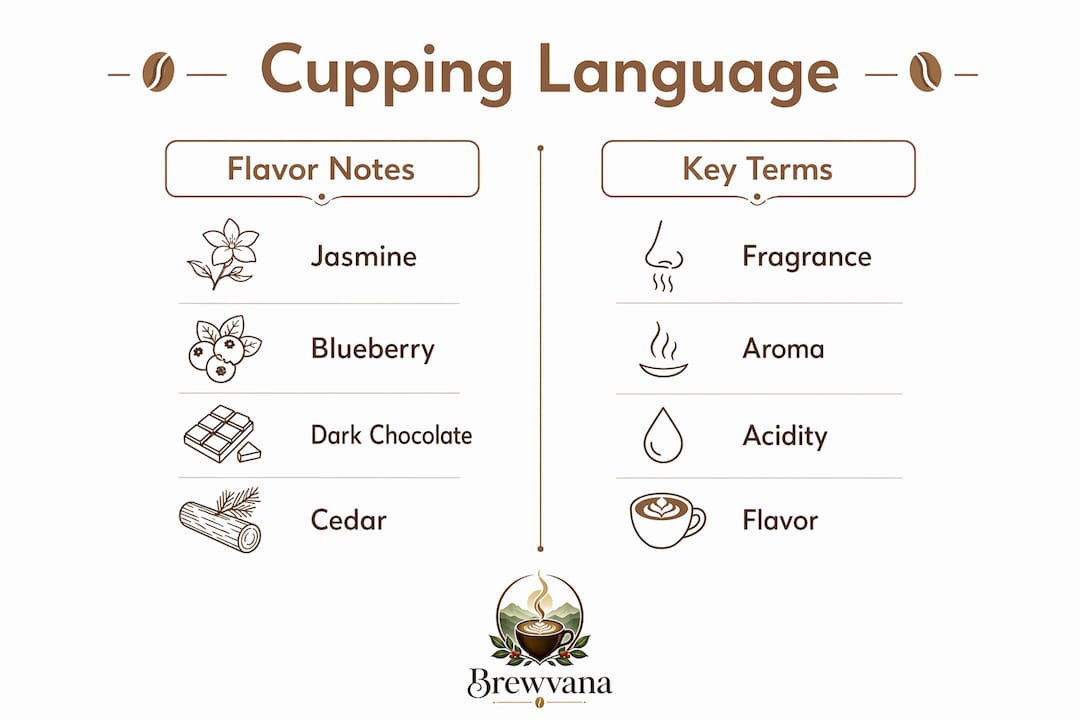
Fragrance refers to the smell of dry grounds before water is added. Aroma is the smell of the wet coffee after pouring. These two are evaluated separately because they capture different aromatic compounds. A coffee might have a rich, chocolatey fragrance that shifts to bright citrus once water hits it.
Acidity in cupping does not mean sour or unpleasant. It describes a lively, bright quality, the kind of sharpness you get from biting into a fresh apple or a ripe orange. High-grown coffees from Ethiopia or Kenya tend to carry pronounced acidity. Body describes the weight and texture of the coffee in your mouth, from thin and tea-like to heavy and syrupy. Sweetness refers to a natural, clean sweetness free of off-flavors, often described as caramel, fruit, or brown sugar. Balance captures how well all the attributes work together without one dominating.
Flavor notes like “jasmine,” “blueberry,” “dark chocolate,” or “cedar” come from the SCA Coffee Taster’s Flavor Wheel, a reference tool that maps hundreds of descriptors from broad categories down to specific notes. You are not imagining blueberry in an Ethiopian natural process coffee. Those flavor compounds are genuinely present, produced by the coffee’s genetics, growing altitude, and processing method.
How cupping shapes buying and roasting decisions
Cupping is not an academic exercise. The results drive real decisions with real financial consequences.
A green buyer evaluating a new lot from a farm in Colombia will cup it against known reference coffees to judge whether the quality justifies the asking price. If the cup shows a defect, like a fermented note or a flat, papery aftertaste, the buyer either rejects the lot or negotiates a lower price. If it scores above 85 on the SCA scale, it commands a specialty premium.
Roasters use cupping to develop and lock in roast profiles. A light roast on an Ethiopian natural might highlight the berry and floral notes that make the coffee distinctive. A medium roast on the same beans might push those notes into the background and bring forward chocolate and nuts. Cupping both roast levels side by side tells the roaster which direction serves the coffee best, and that decision shapes every bag that goes out the door.
Cupping also catches problems before they reach customers. A batch that developed unevenly in the drum will show inconsistent flavor across the replicate cups. A lot that was stored too long before roasting will taste flat or woody. These are the kinds of issues that a quick taste from the brewer would miss but that a structured cupping session catches reliably. For a roaster, that early detection is the difference between a quality product and a customer complaint.
Key Takeaways
Coffee cupping is the standardized, filter-free tasting method that reveals a coffee’s true character, guiding every professional decision from green buying to roast development.
| Point | Details |
|---|---|
| Core definition | Cupping evaluates coffee without filters or pressure to isolate its intrinsic flavor attributes. |
| SCA protocol | The Specialty Coffee Association standard governs grind size, water temperature, timing, and scoring. |
| Session size limit | Sessions cap at around six coffees to prevent palate fatigue and maintain accuracy. |
| Slurping purpose | Slurping atomizes coffee across the palate, engaging more taste receptors than a normal sip. |
| Real-world impact | Cupping scores directly influence purchasing prices, roast profiles, and quality control decisions. |