

The roast date coffee freshness window is the specific period after roasting when coffee delivers its best flavor, aroma, and body before oxidation begins to flatten the cup. Most specialty roasters, including Merit Coffee and Day9 Coffee, agree that peak flavor lands between days 4 and 14 after roasting. Understanding this window is the single most useful thing you can do to improve your home brewing. Buy coffee at the right time, store it correctly, and brew it within the window. Everything else is secondary.
What is the roast date coffee freshness window?
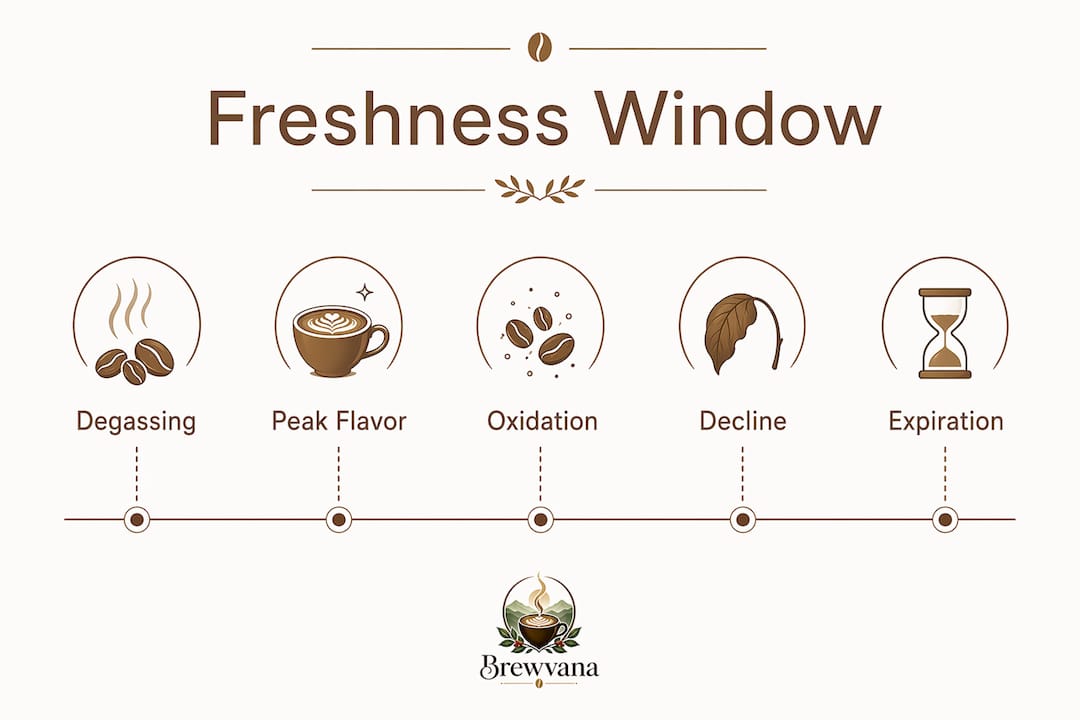
The roast date freshness window describes the arc of flavor development and decline that begins the moment coffee leaves the roaster. Industry professionals call this the “rest and peak” cycle. It has three distinct phases, and knowing each one changes how you shop, store, and brew.
Phase 1: Degassing (days 1–3). Freshly roasted beans release large amounts of CO2 immediately after roasting. This is called degassing. Brewing during this phase produces a muted, gassy cup because CO2 interferes with water extraction. Roasters typically hold coffee 3–5 days before shipping for exactly this reason.
Phase 2: Peak flavor (days 4–14). Once CO2 stabilizes, the full flavor profile opens up. Sweetness, acidity, and aroma are at their highest. This is the window you want to brew in. Day9 Coffee notes that peak flavor typically lands around days 7–11, depending on the processing method.
Phase 3: Oxidation and decline (days 15 and beyond). Oxygen attacks the aromatic compounds in the bean. Flavor becomes flat, bitterness increases, and the complexity you paid for disappears. After 30 days, the degradation is noticeable in almost every cup.
How processing method shifts the window
Not all beans follow the same timeline. Washed coffees peak earlier, around day 7, because their clean processing produces faster, more uniform degassing. Natural and honey process coffees carry more residual sugars and fruit compounds, which slow degassing and push the peak to days 9–11. If you are brewing a Brewvana Ethiopia Natural, give it a few extra days of rest compared to a washed Costa Rica.
Espresso vs. filter brew timing
Espresso is the most CO2-sensitive brewing method. Brewing espresso under 7 days post-roast causes channeling, unstable crema, and uneven extraction. Most experienced home baristas wait 10–21 days after roast for espresso. Filter brew methods like pour-over and French press are more forgiving and perform well from days 4–14.
| Days post-roast | Flavor stage | Best for |
|---|---|---|
| 1–3 | Degassing, muted | Avoid brewing |
| 4–7 | Opening up, bright | Filter brew (washed coffees) |
| 7–11 | Peak complexity | Filter brew (natural/honey) |
| 10–21 | Settled, balanced | Espresso |
| 21–30 | Fading, still usable | Any method, lower expectations |
| 30+ | Flat, stale | Not recommended |
Pro Tip: Write the roast date on a small piece of tape and stick it to your bag the day it arrives. You will never have to guess where you are in the window again.
How to read roast dates and understand coffee expiration
The roast date is the date the coffee was roasted. The best-by or expiration date is a separate label that tells you when the roaster expects flavor to decline below acceptable levels. These two dates are not the same thing, and confusing them costs you quality.
Roast date is more reliable than best-by date for judging freshness. A best-by date set 12 months out tells you nothing about when the coffee was roasted or how long it sat in a warehouse. Specialty roasters print the roast date because it gives you the actual starting point of the freshness window. Supermarket brands often omit it entirely, which is a red flag.
The specialty coffee standard for peak freshness is roughly 2–4 weeks after roasting for whole beans. Whole bean coffee peak flavor lasts about 3–4 weeks after roast. Once you open the bag, oxidation accelerates and that window narrows to about 2 weeks regardless of the original roast date.
What to check before you buy
- Roast date printed on the bag. If it is missing, move on.
- One-way valve on the packaging. This valve lets CO2 escape without letting oxygen in, which preserves freshness during shipping and storage.
- Roast date within the last 2 weeks. Anything older than 3 weeks is already past its prime window.
- Whole beans, not pre-ground. Ground coffee loses freshness within days of grinding. Whole beans give you control over when you grind.
- Single-origin or specialty label. These roasters are more likely to prioritize freshness transparency.
Without a roast date, you have no reliable way to judge where the coffee sits in its freshness arc. Buying blind is the fastest way to end up with a stale bag.
How to maximize freshness from roast date to cup
Good storage is the difference between a coffee that tastes great on day 20 and one that tastes flat on day 10. The goal is to slow oxidation and protect the aromatic compounds that make specialty coffee worth buying.
Storage rules that actually work
Airtight containers and cool, dry storage are the two most effective tools for extending freshness within the roast date window. Keep beans away from heat, light, and moisture. A ceramic or stainless steel canister with an airtight lid works well. Avoid clear glass containers on a sunny counter. The refrigerator introduces moisture and absorbs odors, so skip it for everyday storage.
Freezing is the exception. If you buy in bulk or receive a large bag, portion beans into airtight freezer bags and freeze what you will not use within 2 weeks. Thaw only what you need and never refreeze. This technique preserves freshness well beyond the standard window without significant flavor loss.
Grinding and brewing timing
- Grind only what you need immediately before brewing. Ground coffee loses its peak freshness within days. A burr grinder like the Baratza Encore or Fellow Ode gives you consistent grind size and preserves flavor far better than blade grinders.
- Track your roast date in a simple log. Note the roast date, the coffee name, and the day you opened the bag. This takes 30 seconds and removes all guesswork.
- Adjust grind size as beans age. Older beans are denser and less porous. You may need to grind slightly finer as the bag gets older to maintain extraction quality.
- Prioritize fresher bags first. If you have multiple bags open, brew the oldest one first. Rotate your stock the same way a good kitchen rotates produce.
- Wait the right amount of time before brewing. For filter brew, wait at least 4 days post-roast. For espresso, wait at least 10 days, and up to 21 days for best results.
Pro Tip: Order smaller quantities more frequently rather than one large bag every few months. A 250g bag consumed in 2 weeks stays in the freshness window the entire time. A 1kg bag consumed over 2 months does not.
What to do when coffee is past its freshness window
Coffee does not spoil the way milk or meat does. Coffee past its best-by date is safe to drink but delivers noticeably less flavor, aroma, and complexity. The question is never about safety. It is always about quality.
Stale coffee tastes flat, papery, or faintly bitter without any of the brightness or sweetness you expect from a fresh bag. The aroma is the first thing to go. If your coffee smells like cardboard or nothing at all when you open the bag, the freshness window has closed.
Signs your coffee is stale
- No aroma when you open the bag or grind the beans
- Flat, one-dimensional flavor with no brightness or sweetness
- Excessive bitterness without any fruity or chocolatey notes
- Beans look dull or dusty rather than slightly oily
- No bloom when you pour hot water over grounds during pour-over
Handling coffee with no roast date
Many supermarket coffees omit roast dates, making it impossible to know where you are in the freshness arc. If you cannot find a roast date, use the best-by date as a rough guide and subtract 9–12 months to estimate when it was roasted. That math usually reveals the coffee is already stale. The better solution is to buy from roasters who print roast dates clearly, which is standard practice among specialty brands.
If you are stuck with older coffee, brew it as a cold brew concentrate. Cold brew is more forgiving of stale beans because the long, cold extraction pulls sweetness and body without amplifying the bitterness that comes with oxidized beans. It will not taste like a fresh pour-over, but it will be far more enjoyable than a hot brew from the same stale bag.
Key takeaways
The roast date freshness window runs from roughly day 4 to day 14 post-roast, with espresso requiring up to 21 days and natural process coffees peaking slightly later than washed coffees.
| Point | Details |
|---|---|
| Peak flavor window | Coffee tastes best between days 4 and 14 after roasting, peaking around days 7–11. |
| Espresso needs more rest | Wait 10–21 days post-roast for espresso to avoid gassy, uneven extraction. |
| Roast date beats best-by date | Always use the roast date to judge freshness. Best-by dates can be misleading. |
| Storage slows decline | Airtight containers in a cool, dry place extend freshness within the window. |
| Grind fresh, grind last | Grinding immediately before brewing preserves flavor that pre-ground coffee loses within days. |
Brewvana’s take on chasing the freshness window
Tracking roast dates changed how I think about coffee at home. Before I started paying attention, I was brewing beans that were 6 weeks old and wondering why my pour-over tasted flat. The coffee was not bad. It was just past its moment.
The thing most articles do not say clearly enough is that the freshness window is not a strict rule. It is a range, and your palate is the final judge. I have had washed Ethiopian coffees that tasted brilliant at day 5 and others that needed until day 10 to fully open up. The window gives you a framework. Tasting gives you the answer.
What I have found works best at home is ordering in smaller quantities, every 2 weeks or so, from roasters who print the roast date clearly. Brewvana does this on every bag, which removes the guesswork entirely. I also keep a simple note on my phone with the roast date and the day I opened each bag. It sounds obsessive, but it takes 10 seconds and it means I am always brewing in the right part of the window.
The other lesson I learned the hard way: do not freeze and thaw repeatedly. Freeze once, in small portions, and thaw only what you need. That single habit extended the life of my bulk orders without any flavor loss.
Freshness is not about being precious with your coffee. It is about getting the most out of what you already paid for. The signs of fresh roasted beans are easy to spot once you know what to look for, and the difference in the cup is immediate.
— Brewvana
Fresh coffee, delivered at the right moment
Brewvana roasts to order, which means every bag ships within the optimal window rather than sitting in a warehouse for weeks. Each bag displays the roast date clearly, so you know exactly where you are in the freshness arc the moment it arrives. The Costa Rica Single Origin is a clean, washed coffee that hits peak flavor fast, ideal for filter brew drinkers who want to brew within the first week. For espresso lovers, the Max Caf High-Caffeine Blend is built for a longer rest and delivers a full, balanced shot at the 14-day mark. Brewvana’s freshness and storage guides give you everything you need to keep your beans at their best from delivery to the last cup.
FAQ
What is the best roast date for coffee?
Coffee tastes best when brewed between 4 and 14 days after the roast date. Filter brew performs well from days 4–14, while espresso benefits from waiting 10–21 days.
How long is coffee fresh after roasting?
Whole bean coffee stays at peak freshness for about 3–4 weeks after roasting. Once opened, the window narrows to roughly 2 weeks due to accelerated oxidation.
Is coffee with no roast date safe to buy?
It is safe to drink but risky to buy for quality. Without a roast date, you cannot judge where the coffee sits in its freshness window, and supermarket bags without dates are often already stale.
Does coffee expire or just lose flavor?
Coffee does not spoil in the traditional sense. Old coffee is safe to drink but loses its aroma, sweetness, and complexity well before any expiration date printed on the bag.
Can you freeze coffee to extend the freshness window?
Yes, freezing works if done correctly. Portion beans into airtight bags, freeze once, and thaw only what you need. Never refreeze thawed coffee, as repeated temperature changes accelerate flavor loss.