

Specialty coffee costs more because every step from farm to cup is held to a higher standard than commodity coffee. In 2026, the average retail price sits at $32.75 per pound, compared to roughly $2.69 for green commodity beans. That gap is not a markup. It reflects real labor, real risk, and real choices made at every stage of production. Understanding why specialty coffee costs more helps you spend smarter and appreciate what you are actually buying.
Why specialty coffee costs more: farming comes first
Specialty coffee is defined by the Specialty Coffee Association as scoring 80 or above on a 100-point quality scale. Reaching that score starts at the farm, and the farming methods that produce exceptional flavor are expensive by design.
High-altitude cultivation above 1,200 meters slows bean development. Slower development builds denser, more complex sugars inside the cherry. The tradeoff is lower yield per acre compared to flat, full-sun commodity farms.
Here is what drives up farm-level costs on a specialty operation:
- Hand-picking only ripe cherries. Workers pass through the same trees multiple times per season, selecting only cherries at peak ripeness. Commodity farms use mechanical strip-picking, harvesting everything at once regardless of ripeness.
- Shade-grown and regenerative practices. Shade trees require pruning, management, and years of investment before they protect the coffee beneath them.
- Smaller farm scale. Most specialty producers are smallholders, often farming fewer than 5 acres. They cannot spread fixed costs across the volume that large commodity estates can.
- Skilled labor. Selective picking requires trained workers who can identify ripeness by color and texture. That skill commands higher wages.
Pro Tip: When you see a bag labeled “hand-picked” or “single-estate,” those words signal the labor-intensive farming model that raises the cost of high-quality coffee before a single bean is processed.
The contrast with commodity coffee is stark. Brazilian commodity farms use mechanical harvesters that strip entire branches in seconds. Specialty farms in Ethiopia, Colombia, and Costa Rica rely on human hands. That labor difference alone accounts for a significant portion of the specialty coffee pricing gap.
How processing and roasting add to the price
Once the cherry leaves the farm, the cost of specialty coffee keeps climbing. Processing is where flavor profiles are shaped, and the methods used in specialty coffee are far more labor-intensive than commodity wet-milling.
The three main specialty processing methods each carry distinct cost structures:
- Natural (dry) processing. Whole cherries dry on raised beds for 3–6 weeks. Workers turn them by hand multiple times daily to prevent mold. The process requires constant monitoring and large drying areas.
- Honey processing. Some fruit mucilage is left on the bean during drying. The ratio of mucilage left determines the flavor intensity, and managing that ratio requires skilled judgment.
- Anaerobic fermentation. Cherries ferment in sealed tanks under controlled conditions. Equipment, temperature monitoring, and expertise all add cost.
Processing complexity like natural and anaerobic fermentations requires expert oversight and small-batch handling that commodity operations simply do not use. You can read more about how these methods shape flavor in Brewvana’s guide to coffee bean processing methods.
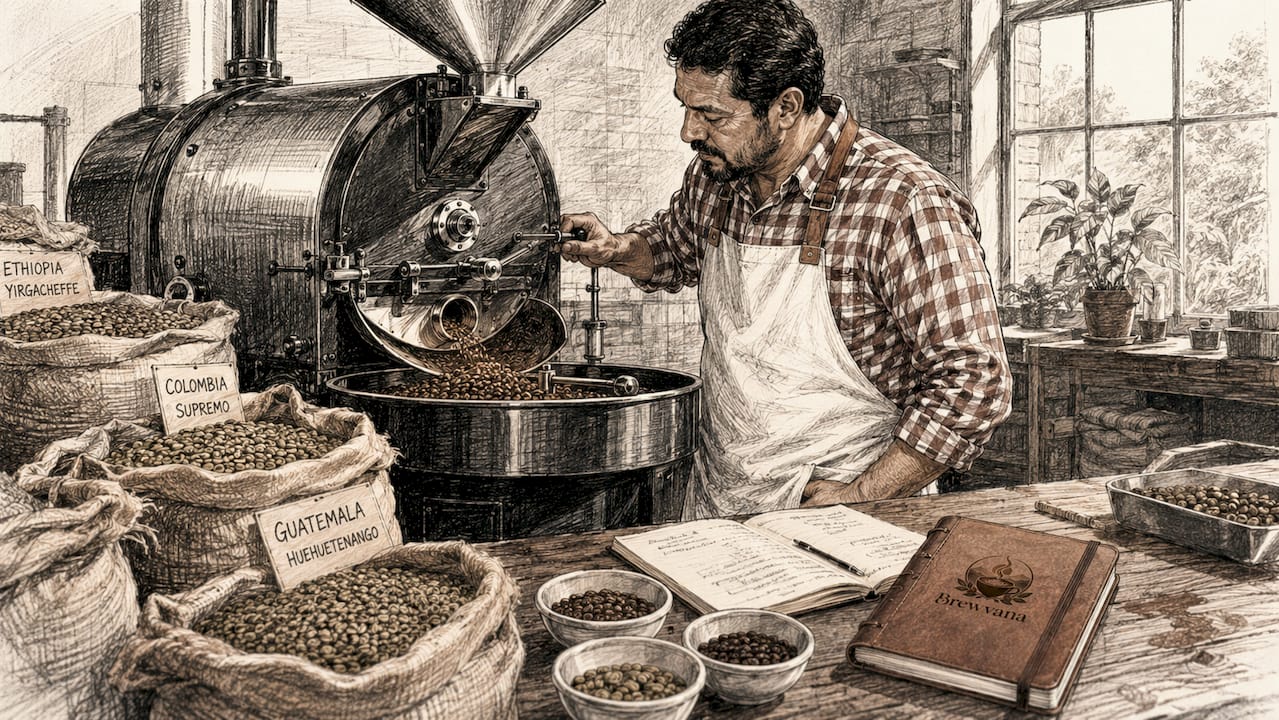
Roasting adds another layer of cost. Specialty roasters work in small batches, often 20–60 pounds at a time, tailoring temperature curves to each specific lot. Industrial commodity roasters run continuous drums processing thousands of pounds per hour. The per-pound energy and labor cost for small-batch roasting is substantially higher. Specialty coffee also loses quality rapidly after roasting, which means roasters invest in premium one-way valve bags, resealable packaging, and fast turnover logistics to protect freshness. That packaging investment is real and it shows up in the price you pay.
What market forces are pushing prices higher in 2026
Even if farming and processing costs stayed flat, market forces in 2026 are pushing specialty coffee pricing upward. The reasons for coffee cost increases this year go beyond what happens on the farm.
Vietnam’s coffee production dropped 20% during 2023/2024 due to climate disruption. Vietnam is the world’s second-largest coffee producer, and that supply shock rippled through global markets. US tariffs of up to 50% on Brazilian coffee imports caused US roasted coffee prices to surge 17% through march 2026. That is a direct cost passed to consumers.
| Market Factor | Impact on Specialty Coffee Pricing |
|---|---|
| Climate disruption (Vietnam, Brazil) | Reduced global supply, higher green bean competition |
| US tariffs on Brazilian imports | Up to 50% added import cost, 17% retail price surge |
| Freight and supply chain costs | Higher logistics expenses per shipment |
| Commodity price drop of 7.2% | Did not reduce specialty retail prices, which rose 3.9% |
The disconnect in that last row matters. Commodity green bean prices fell 7.2% in Q1 2026, yet specialty retail prices rose 3.9%. That tells you specialty coffee pricing is driven by its own cost structure, not by commodity market swings. Roasters who source ethically and pay fair prices to farmers cannot simply drop prices when commodity futures fall.
“The specialty coffee supply chain is built on relationships and quality commitments, not spot market prices. When input costs rise, there is no commodity buffer to absorb the shock.” — Specialty Coffee Transaction Guide, 2026
How overhead and retail margins shape the final price
By the time specialty coffee reaches your door or your local café, domestic operating costs have added another layer to the price. This is the part of specialty coffee pricing that most consumers underestimate.
Rent, skilled labor, energy, and specialized equipment all inflate retail prices beyond the raw cost of the beans. Specialty roasters typically operate on net margins of 10–20%. That is thin. A $2 rise per pound in green bean costs can threaten a small roaster’s viability when margins are that tight.
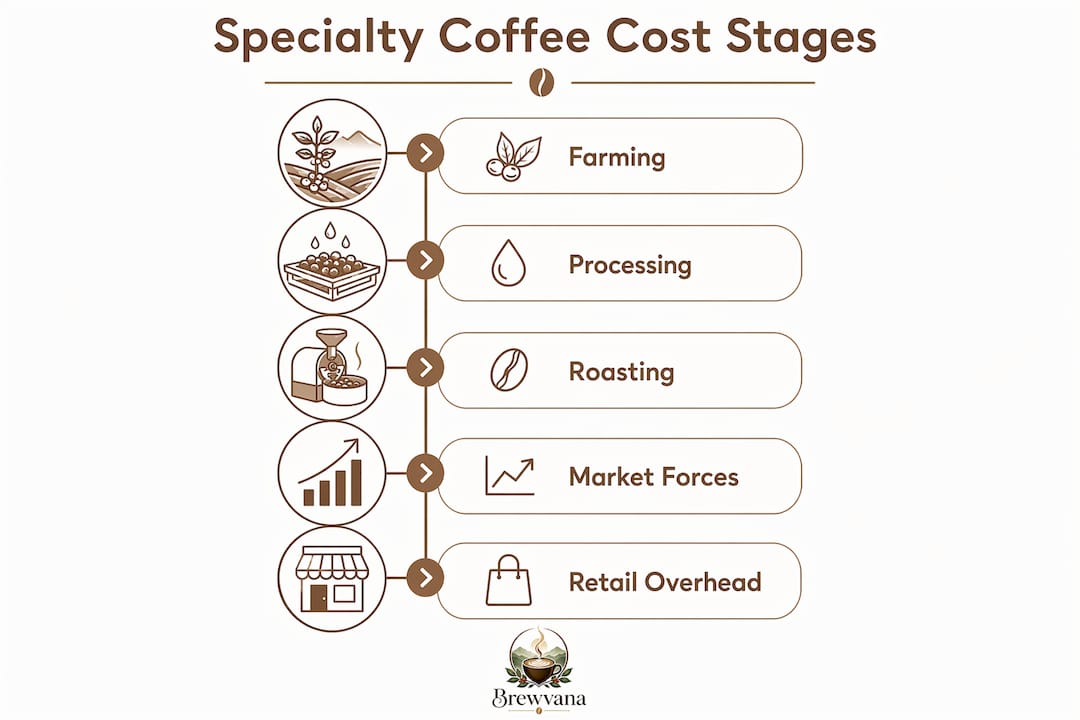
Here is how the cost of high-quality coffee breaks down from farm to retail:
| Stage | Cost Driver | Approximate Share of Retail Price |
|---|---|---|
| Farm gate | Labor, altitude farming, selective picking | 20–30% |
| Processing | Drying, fermentation, milling | 10–15% |
| Export and freight | Logistics, tariffs, identity preservation | 10–20% |
| Roasting and packaging | Small-batch roasting, premium bags | 15–20% |
| Retail overhead | Rent, staff, equipment, marketing | 20–30% |
Commodity coffee escapes most of these costs through scale. A large commercial roaster buying millions of pounds per year negotiates lower freight rates, runs continuous roasting drums, and sells through mass retail channels with thin per-unit margins offset by enormous volume. Specialty roasters cannot compete on volume. They compete on quality, and quality costs money at every row in that table.
Pro Tip: If you want to understand what makes specialty coffee pricey at your local café, ask where the beans come from and how they were processed. Roasters who can answer that question in detail are the ones paying for traceability, and that transparency is part of what you are buying.
What you actually get when you pay more
The higher price of specialty coffee is not just a cost. It is a value exchange. Analysis of 63,000 specialty coffees shows that the $25–40 price tier earns the highest customer ratings, between 4.19 and 4.46 out of 5. Consumers in that range are getting measurably better coffee by their own assessment.
Here is what the premium delivers:
- Flavor complexity. High-altitude, hand-picked, carefully processed beans produce flavor profiles that commodity coffee cannot replicate. Fruity, floral, and nuanced notes come from the same conditions that raise costs.
- Freshness. Specialty roasters roast to order or in small batches with fast turnover. You are not buying beans that sat in a warehouse for 18 months.
- Ethical sourcing. Specialty pricing supports fair payment to farmers. Commodity pricing often does not. When you pay more, more of that money reaches the people who grew your coffee.
- Traceability. Single-origin coffees command a $3.67 premium over blends because of the supply chain complexity required to preserve their identity from farm to bag. You know exactly where your coffee came from.
- Rarity. Some micro-lot coffees are produced in quantities of a few hundred pounds per year. Scarcity is a legitimate cost driver, and it is part of what makes specialty coffee pricey at the top end.
Consumers paying above $40 per bag are often paying for brand exclusivity and rarity rather than a proportionally better cup. The quality ceiling tends to plateau below $40. That is useful information when you are deciding how much to spend.
Key takeaways
Specialty coffee costs more because quality-driven farming, labor-intensive processing, and thin retail margins all stack on top of each other with no commodity shortcut available.
| Point | Details |
|---|---|
| Farming drives base costs | Hand-picking and high-altitude cultivation lower yields and raise labor expenses significantly. |
| Processing adds skilled labor costs | Natural, honey, and anaerobic methods require expert oversight that commodity wet-milling skips. |
| Market forces compound the price | Tariffs, climate disruption, and freight costs pushed US specialty prices up 17% through early 2026. |
| Retail margins are thin | Specialty roasters operate on 10–20% net margins, leaving little room to absorb cost increases. |
| The $25–40 tier offers best value | Customer ratings peak in this range, making it the sweet spot for quality without paying for pure rarity. |
Brewvana’s take on specialty coffee pricing
The $15–25 range is where most consumers find the best balance between quality and everyday value. Bags in this tier typically come from farms using selective harvesting and honest processing without the luxury markup that kicks in above $40.
Here is the part most coffee marketing skips: coffees priced above $40 often score no higher in blind tastings than well-sourced coffees at $28. The extra cost buys a story, a limited lot number, and a brand. That is not a criticism. Rarity and exclusivity are real things people value. But if your goal is the best cup per dollar, you do not need to spend at the top of the market.
What I find genuinely worth paying for is traceability. Knowing that a coffee came from a specific farm in Colombia’s Huila region, processed using the honey method, tells you something real about what is in the bag. That information costs money to preserve through the supply chain, and it is money well spent. Learning to read a coffee label the way you read a wine label changes how you shop. Origin, processing method, and roast date are the three numbers that matter most.
The labor and environmental choices behind specialty coffee pricing are not abstract. They represent real people picking cherries by hand at elevation, real farmers managing shade trees, and real roasters dialing in small batches. When you understand that chain, the price stops feeling arbitrary and starts feeling honest.
— Brewvana
Explore brewvana’s single-origin coffees
Brewvana sources specialty coffees with full traceability from Colombia, Costa Rica, Ethiopia, and Peru, each roasted to order for maximum freshness.
If you want to experience what the $25–40 quality tier actually tastes like, Brewvana’s Colombia single-origin and Ethiopia natural process are strong starting points. Both reflect the farming and processing standards this article describes. Not sure where to begin? The Single Origin Favorites Sample Pack lets you compare origins side by side before committing to a full bag. Brewvana also donates a portion of every sale to local schools, so your coffee purchase carries a bit further than the cup.
FAQ
Why is specialty coffee so much more expensive than grocery store coffee?
Specialty coffee uses hand-picked, high-altitude beans processed with labor-intensive methods and roasted in small batches. Grocery store coffee relies on mechanically harvested, commodity-grade beans processed and roasted at industrial scale, which dramatically lowers per-unit cost.
What is the average price of specialty coffee in 2026?
The average retail price of specialty coffee is $32.75 per pound in Q1 2026, with the most popular tier priced between $15 and $25 per bag. The premium $25–40 tier earns the highest customer satisfaction ratings.
Does paying more for coffee actually mean better quality?
Yes, up to about $40 per bag. Customer ratings peak in the $25–40 range, and quality improvements above $40 are minimal. Coffees priced above that threshold typically reflect rarity and branding rather than a better cup.
What does “single-origin” mean and why does it cost more?
Single-origin coffee comes from one specific farm or region, and preserving that identity through the supply chain adds logistical cost. Single-origin coffees command roughly a $3.67 premium over blends due to this traceability requirement.
How do tariffs affect specialty coffee prices in the US?
US tariffs of up to 50% on Brazilian coffee imports contributed to a 17% surge in US roasted coffee prices through march 2026. Those import costs are passed directly to roasters and ultimately to consumers.