

Every coffee lover who reaches for their single-serve machine in the morning eventually faces the same moment of hesitation: that spent pod sitting on the counter, materials unknown, destination unclear. Convenient brewing has a cost, and millions of pods end up in landfills every year because most people simply don’t know what to do with them. This guide cuts through the greenwashing and gives you the real tools, practical steps, and honest trade-offs you need to brew great coffee while genuinely reducing your environmental footprint.
Table of Contents
- Understanding coffee pod waste: What makes it a challenge?
- What you need to reduce waste: Tools, pods, and preparation
- Mastering the brew: How reusable pods and refill options change taste
- Disposal and recovery: Getting your sustainable pods where they need to go
- The uncomfortable truth about coffee pod sustainability
- Explore sustainable pod options and premium coffee
- Frequently asked questions
Key Takeaways
| Point | Details |
|---|---|
| Material isn’t enough | Actual waste reduction comes from combining pod material with the right disposal and recovery steps. |
| Reusable pods require skill | Switching to reusable capsules changes the flavor and needs careful setup for consistent results. |
| Check local infrastructure | Compostable or recyclable pods only help if your local system properly handles them. |
| Start with sustainable products | Choosing degradable or refillable pods from responsible brands is an actionable first step. |
Understanding coffee pod waste: What makes it a challenge?
Coffee pod waste is not a simple problem, and that’s exactly why so many well-meaning coffee drinkers still end up with a drawer full of guilt and a recycling bin full of questions. The challenge starts with the pod itself.
There are three main pod material categories you’ll encounter:
- Plastic pods: The most common format. Usually made of polypropylene or similar polymers. Not typically accepted by curbside recycling because they’re small and contaminated with coffee grounds.
- Aluminum pods: Widely recyclable in theory, but the coffee grounds inside and the attached foil lid complicate the process. Most curbside programs reject them as-is.
- Compostable and degradable pods: A growing category made from plant-based materials or bioplastics. These sound like the obvious answer, but they come with their own set of conditions.
| Pod type | Material | Typical recyclability | Compostable? |
|---|---|---|---|
| Plastic capsule | Polypropylene | Rarely curbside accepted | No |
| Aluminum capsule | Aluminum + foil | Specialty programs only | No |
| Compostable capsule | Plant-based film | No | Industrial composting only |
| Degradable capsule | Bioplastic blend | No | Conditions vary |
Degradable pod systems are gaining traction, but degradable pods are niche and tied to specific brewer ecosystems, so you can’t always just swap materials without changing your machine.
“The biggest misconception is that choosing a pod with ‘eco’ on the label is enough. What happens to that pod after your cup is brewed matters just as much as what it’s made of.”
Consumer confusion is real. When you’re staring at a shelf of pod options at the grocery store, the language is inconsistent. “Biodegradable,” “degradable,” “compostable,” and “plant-based” are used interchangeably by brands, but they mean very different things in terms of disposal. And that confusion leads to wishcycling, which means tossing something into recycling or compost in hope rather than knowledge, which can contaminate entire batches of legitimate recyclables.
If you’re interested in single-origin pods that pair quality sourcing with mindful packaging, options like Mexico coffee pods, Peru coffee pods, and Bali coffee pods are worth exploring as part of a more intentional pod routine.
What you need to reduce waste: Tools, pods, and preparation
Reducing pod waste isn’t about giving up convenience. It’s about upgrading your setup so that convenience and sustainability aren’t mutually exclusive. Here’s what you actually need:
Essential checklist for a lower-waste pod setup:
- A brewer that accepts reusable pods (many popular single-serve machines do)
- A reusable pod or refillable capsule compatible with your machine
- A quality grinder if you plan to grind your own coffee
- Access to local composting or a pod take-back recycling program
- Clear understanding of your municipality’s composting and recycling rules
The comparison between pod formats matters a lot here. Not all “sustainable” options perform equally, and the right choice depends on your local infrastructure as much as your preferences.
| Feature | Disposable plastic | Aluminum | Compostable | Reusable pod |
|---|---|---|---|---|
| Upfront cost | Low | Low | Medium | Higher |
| Per-use cost | Higher (ongoing) | Higher | Medium | Lowest |
| Recyclability | Poor | Specialty only | Industrial compost only | No waste |
| Flavor consistency | High | High | Medium | Variable |
| Environmental benefit | Low | Medium | Medium to high | Highest |
One of the most important things to understand is that compostable doesn’t mean home-compostable. If your area lacks industrial composting facilities, a “compostable” capsule may sit in a landfill for years, defeating the entire purpose. Before making the switch, contact your local waste management provider and ask specifically whether they accept food-grade compostable packaging.
Pro Tip: Call your municipality before buying a box of compostable pods. Ask two questions: “Do you accept industrially compostable packaging?” and “Do you accept pods with coffee grounds still inside?” The answers will tell you whether the switch is worth it for your specific location.
For those ready to stock up on capsules with thoughtful sourcing, both 12 pack capsules and the more economical 60 pack capsules offer ways to build a sustainable coffee habit at scale.
Mastering the brew: How reusable pods and refill options change taste
Here’s something most sustainability guides skip over entirely: switching to reusable pods changes how your coffee tastes, and not always in the way you’d expect. Understanding this upfront saves you weeks of frustrating mornings.

When you brew with a factory-sealed pod, the grind size, coffee volume, and packing density are all precisely calibrated for that machine. Swap in a reusable pod filled with your own coffee, and you’re now responsible for all three variables. Taste and extraction depend heavily on grind size and fill behavior, so the switch isn’t just a container change, it’s a full recalibration of your brew.
Here’s a step-by-step process for dialing in a reusable pod:
- Start with grind size. Most reusable pods work best with a medium grind, similar to what you’d use for drip coffee. If your brew tastes weak or runs through too fast, go slightly finer. If it tastes bitter or barely drips, go coarser.
- Measure your fill. Start with the manufacturer’s recommended fill amount, usually around 9 to 12 grams for a standard pod. Underfilling leads to watery coffee; overfilling can block water flow entirely.
- Pack with light pressure. Unlike espresso, you don’t want a firm tamp. Press the grounds gently to level them without compressing. This allows water to flow through at the right rate.
- Adjust your brewer settings. Some single-serve machines have a “strong” or “bold” setting that slows the brew cycle and increases extraction. Use it when brewing with a reusable pod for a more balanced cup.
- Test and iterate. Pull two or three shots with the same coffee at different grind sizes, document which tastes best, then stick with that combination.
Pro Tip: If your reusable pod coffee consistently tastes flat or dull, the issue is almost always stale coffee. The roast date matters enormously with reusable pods because you’re responsible for freshness now. Learn more about why roast date affects flavor and you’ll immediately understand why buying fresh-roasted beans or capsules makes such a difference.
It’s also worth noting that reusable pods often produce a slightly different cup character than sealed pods, sometimes brighter, sometimes more nuanced. Once you’ve dialed in your grind and fill, many coffee drinkers find they actually prefer the result.
Disposal and recovery: Getting your sustainable pods where they need to go
Brewing well is only half the equation. What happens after you lift out that spent pod determines whether your effort actually benefits the planet. This is where most sustainability conversations go quiet, and where the real impact is either won or lost.
Action steps for each pod type:
- Plastic pods: Check brand-specific take-back programs. Some manufacturers offer prepaid mail-back envelopes or in-store collection points. Empty the grounds into your compost or trash, rinse lightly, and send the pod back.
- Aluminum pods: Peel back the foil lid, empty the grounds (great for garden compost), and check whether your curbside program accepts small aluminum pieces. If not, use a brand take-back service.
- Compostable pods: Verify your local industrial composting access first. If confirmed, toss the whole pod, grounds and all, into your green bin. If no industrial composting is available, treat them as general waste for now.
- Reusable pods: Empty grounds into compost, rinse, dry, and reuse. The only waste is the spent coffee, which is genuinely compostable in most home systems.
| Capsule format | End-of-life pathway | Notes |
|---|---|---|
| Plastic | Take-back program or brand mail-back | Cannot go in curbside recycling |
| Aluminum | Brand take-back or specialty aluminum recycling | Must be emptied first |
| Compostable | Industrial compost (verify locally) | Not suitable for home compost in most cases |
| Reusable pod | Grounds to home compost, pod is reused | Best overall end-of-life scenario |
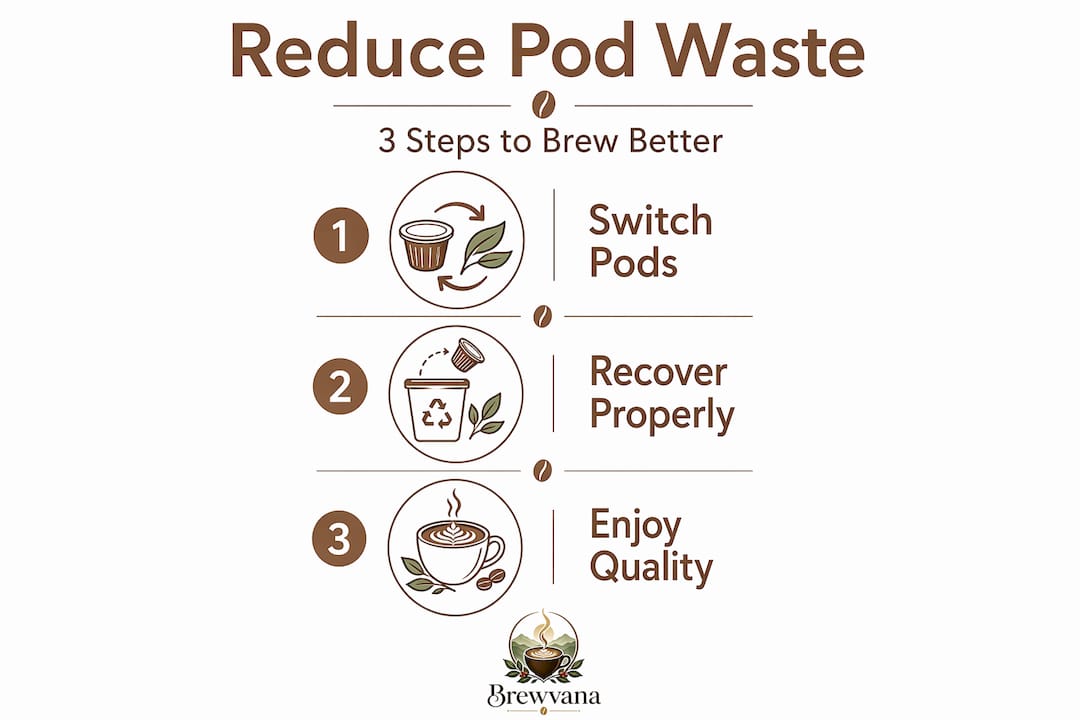
The highest-impact actions are clear: reduce disposables by switching to reusable pods, and maximize correct recovery by using the right take-back or recycling route. Material choice alone means nothing if the pod ends up in the wrong bin.
If you’re also exploring lower-packaging alternatives for travel or office use, instant coffee can serve as a genuinely minimal-waste option when pods aren’t practical.
The uncomfortable truth about coffee pod sustainability
After years of watching the sustainable coffee conversation evolve, one thing stands out clearly: most of the messaging is built around materials and almost none of it addresses what actually happens after the brew.
Brands invest heavily in redesigning their pod casings. They switch to plant-based films, print certification logos on packaging, and market themselves as the responsible choice. But if you buy a box of “certified compostable” pods and your city has no industrial composting program, you’ve spent more money for the same environmental outcome. The pod goes to landfill. The certification becomes decoration.
This is not an argument against sustainable materials. They genuinely matter when paired with the right end-of-life infrastructure. But the honest truth is that a reusable pod filled with freshly ground Mexico coffee that you empty into your home compost bin every morning is more impactful than a month’s supply of certified compostable pods that end up in the trash.
The other thing that rarely gets said: taste and sustainability are not in conflict. The assumption that “eco” means compromise is exactly wrong. When you use a reusable pod, you control the coffee. You can choose single-origin beans roasted days ago instead of months ago. You can adjust your grind. You can dial in your extraction. The result is often a better cup than you were getting from sealed pods, and zero pod waste to boot.
The same applies to instant coffee done right. The category has changed dramatically, and premium instant options now deliver real complexity without any pod waste at all. It’s not for every occasion, but it’s a legitimate option that the sustainability conversation often ignores.
Real change in your coffee routine comes from two decisions: reduce the number of disposable pods you use, and make sure the ones you do use end up in the right place. Everything else is secondary.
Explore sustainable pod options and premium coffee
Ready to put this guide into practice? Whether you’re starting with a reusable pod setup or looking for freshly sourced capsules that match your values, Brewvana has options to move your coffee routine in the right direction.
Browse sustainable sample packs to explore different origins and roast profiles before committing to a full order. If you’re ready to stock your pod stash with carefully sourced coffee, single serve capsules offer premium freshness in a convenient format. And for single-origin fans who want traceability in every cup, Mexico coffee pods are a great starting point for a more intentional brew ritual. Every purchase also supports community initiatives through Brewvana’s school donation program, so your morning cup does double duty.
Frequently asked questions
Are compostable coffee pods really better for the environment?
They can be, but only when your local waste system accepts them for industrial composting. Compostable pods behave like waste in landfills just like conventional pods do if the right infrastructure isn’t available.
What is the most effective way to reduce coffee pod waste at home?
The two highest-impact levers are switching to a reusable pod to eliminate disposables and ensuring any capsules you do use are recovered through the correct take-back or recycling route in your area.
Does switching to reusable pods affect coffee taste?
Yes, and often in a positive direction once you dial things in. Taste and extraction depend on grind size and how you fill and pack the pod, so expect a short learning curve before you find your ideal setup.
Are degradable pods available for most single-serve coffee makers?
Not widely. Degradable pods are niche and typically limited to specific brands and brewer ecosystems, so you may need to change your machine to access them.